

all in on memecoins // prediction markets // ex Bet365
Joined September 2008
- Tweets252K
- Following366
- Followers49.6K
- Likes4.6K


“ this guy is a certified freak “
he built a mission control center for seven AI agents in his bedroom and runs the entire fleet from a Discord server he never leaves
the setup, entirely custom built:
Cortex → the command bot. posts revenue updates, agent status, deployment alerts. one channel, one dashboard, zero switching between tabs
the agents → JARVIS, NOVA, CASS, FORGE, VANGUARD, TITAN, BEACON. each one has its own role, its own scope, its own channel. they report in like a crew
the workflow is one man running a fleet. type a command, FORGE ships the build. flag an error, CASS triages it. check the numbers, Cortex pulls the revenue summary. all inside Discord, all by text
drones on the wall. blue LEDs across the ceiling. ultrawide filling his entire field of view. this is not a developer’s desk anymore. it’s an operations room that happens to be in a bedroom
he controls the entire machine from a single chat window. while most people are still copy-pasting prompts into ChatGPT one at a time
save this before building a fleet of AI agents from a Discord server stops looking unhinged and starts looking normal


a woman from China made $12,000 standing in front of a wall of 200 phones broadcasting all at once.
her first year, she tried to make one channel go viral. perfect lighting, perfect pitch, ignored four nights out of five. one channel is a coin flip, and she kept landing on the wrong side.
so she stopped betting on one and built a machine.
> 200 cheap phones racked on a wall, each on its own account
> the same live sale pushed to every screen at once
> each phone wired to its own store or affiliate code
> a floor manager swapping out any stream that died
> the algorithm left to pick the winners by itself
the edge was never talent. it was volume.
> 200 channels live, only a tenth of them have to catch
> the ones that catch put the pitch in front of millions
> one broadcast selling across 200 storefronts at once
> the big rooms up the street: 100,000 orders a night, caps by the millions
> hers smaller, but it never once went dark
She continues to improve her streams every day and look for new approaches to earn even more.
Bookmark this.


Memori hits 87% on LoCoMo at 721 tokens per query, 2.8% of full context, per README
Graphiti v0.31.1 tagged Oct 15. Temporal fact graphs with validity windows.
9 open-source GitHub repos for agent memory that survives sessions and keeps the prompt short:
212,966 stars. Pushed within 31 days. 6 Apache-2.0, 3 MIT. Oct 18.
EXTRACT WHAT MATTERS
01. mem0 ★67,374: github.com/mem0ai/mem0 -> extracts facts, recalls per user
02. langmem ★1,708: github.com/langchain-ai/lang… -> agent learns from past chats
03. MemMachine ★3,073: github.com/MemMachine/MemMac… -> one store, any agent
04. memU ★14,554: github.com/NevaMind-AI/memU -> shared memory across agents
05. Memori ★17,151: github.com/MemoriLabs/Memori -> chats into structured state
LINK IT IN A GRAPH
06. graphiti ★31,950: github.com/getzep/graphiti -> facts with validity windows
07. agent-memory ★585: github.com/neo4j-labs/agent-… -> memory graph on Neo4j
RETRIEVE A SLICE
08. LightRAG ★40,200: github.com/HKUDS/LightRAG -> graph retrieval, no heavy index
09. graphrag ★36,371: github.com/microsoft/graphra… -> graph summaries for retrieval
turn → facts → graph → slice → call
pip install mem0ai
not more tokens. better recall ↓
coding agents collide and the wrong patch lands
Harbor v0.24.0, Oct 5: new sandbox providers, RewardKit judge
10 open-source GitHub repos that turn one coding agent into a scored fleet:
397,691 stars combined, 9 of 10 Apache-2.0 or MIT, checked Oct 18 2026
RUN THE CODING LOOP
01. codex ★129,704
▸ github.com/openai/codex
→ local terminal agent loop
02. cline ★70,494
▸ github.com/cline/cline
→ approval-gated agent, multi-agent SDK
03. crush ★28,687
▸ github.com/charmbracelet/cru…
→ swap models mid-session, keep context
04. kilocode ★27,648
▸ github.com/Kilo-Org/kilocode
→ 500+ models at provider rate (README)
FAN OUT A FLEET
05. orca ★95,942
▸ github.com/stablyai/orca
→ one prompt, five parallel worktrees
06. agent-orchestrator ★13,314
▸ github.com/OrchestratorInc/a…
→ per-agent worktree, live task board
CLOSE THE TICKET
07. open-swe ★11,033
▸ github.com/langchain-ai/open…
→ issue in, sandbox-validated PR out
08. mini-swe-agent ★8,615
▸ github.com/SWE-agent/mini-sw…
→ 100-line agent, >74% SWE-bench (README)
SCORE AND RETRY
09. harbor ★6,209
▸ github.com/harbor-framework/…
→ parallel sandboxes, score every run
10. SWE-bench ★6,045
▸ github.com/SWE-bench/SWE-ben…
→ real GitHub issues as the exam
the harness:
ticket → worktree → loop → test → compare → score → retry
harbor run --dataset [email protected] \
--agent claude-code \
--model anthropic/claude-opus-5-5 \
--n-concurrent 4
open-swe needs Deep Agents private beta to deploy as is
Without the score loop, broken runs hide. Tickets in, fleet out, best PR merged, weak runs retried
Not the model. The fleet around it
Fleet below ⭣
Memori hits 87% on LoCoMo at 721 tokens per query, 2.8% of full context, per README
Graphiti v0.31.1 tagged Oct 15. Temporal fact graphs with validity windows.
9 open-source GitHub repos for agent memory that survives sessions and keeps the prompt short:
212,966 stars. Pushed within 31 days. 6 Apache-2.0, 3 MIT. Oct 18.
EXTRACT WHAT MATTERS
01. mem0 ★67,374: github.com/mem0ai/mem0 -> extracts facts, recalls per user
02. langmem ★1,708: github.com/langchain-ai/lang… -> agent learns from past chats
03. MemMachine ★3,073: github.com/MemMachine/MemMac… -> one store, any agent
04. memU ★14,554: github.com/NevaMind-AI/memU -> shared memory across agents
05. Memori ★17,151: github.com/MemoriLabs/Memori -> chats into structured state
LINK IT IN A GRAPH
06. graphiti ★31,950: github.com/getzep/graphiti -> facts with validity windows
07. agent-memory ★585: github.com/neo4j-labs/agent-… -> memory graph on Neo4j
RETRIEVE A SLICE
08. LightRAG ★40,200: github.com/HKUDS/LightRAG -> graph retrieval, no heavy index
09. graphrag ★36,371: github.com/microsoft/graphra… -> graph summaries for retrieval
turn → facts → graph → slice → call
pip install mem0ai
not more tokens. better recall ↓
OpenAI assembled about 10,000 agents into a parallel colony that exchanged 2.7 million messages and produced a Navier-Stokes proof in 88 hours
A ~100-agent Euler run over ~50 hours came first. Then ~10,000 agents went live as a parallel research lab.
> WORKERS ~10,000 agents at peak on an unreleased internal model, each sandboxed with code execution and cached internet access
> MESSAGES 2.7 million exchanged between groups, about 130 billion output tokens across the full search (OpenAI figures)
> COMPETITION agent groups took on different problem versions and pursued competing outcomes
> CONSOLIDATION Codex merged useful ideas across groups and recycled them back into the search
> LEAN GATE GPT-6 Astra spent 17 more hours converting the result into Lean 4 and verifying it against Mathlib
> OPEN SOURCE Lean certificate on GitHub (openai/NavierStokesAndEuler), Apache-2.0, anyone can run the check
88 hours later: a 166-page Navier-Stokes paper, a 57-page Euler paper, and a Lean repo (OpenAI).
The proof is for the forced equation (Clay C/D), not the unforced prize problem, preprint, no prize.
Put the Lean gate last in the pipeline. The terminal below maps the colony's full 88-hour run ↓
This setup now reads memecoins, keeps one coin from 88, and runs $100 to $23,879 across five nights -- the builder's tally
Crawler reads, Jev judges, Grok bots trade. Each night the chain gets a new move.
Night 3. The crawler scans 88 fresh coins off a memecoin launchpad. Jev kills 87. For the survivor the crawler reads 1,204 posts and walks 6,389 holders. The survivor goes from $46K to $2.05M in one hour. Bots catch the $670K dip, ride it to $2.81M, take +$4,710. Buy again at $1.97M, out at $3.54M, +$1,610. One bad push at 4:50am costs $285. Holding from 11pm: +29%. Bots: +145% (builder's log). Morning balance: $12,161.
Night 4. New move -- a kill list that stomps rug pulls before they reach Jev. 81 coins in, one survives. The survivor: a nine-hour-old coin at $2.23M. Bots eat a -$106 fake bounce, catch the $708K bottom, ride the second bottom at $716K all the way to $1.69M for +$4,404. Holding from 10pm: -24%. Bots: +44.8% (same log). Balance: $17,608.
Night 5. Radar -- circles top wallets, pings big sellers before they dump. Tonight's coin: three hours old, $460K. First entry too early, -$271. Crash to $150K, buyers come back, Jev flags buy at $366K. Sold at $718K, +$2,008. Night's bottom $279K, bots ride to $558K, +$2,188. Two smaller wins, +$1,910. Holding: -40%. Bots: +35.6% -- same damn coin, same log.
$100 → $2,197 → $4,962 → $12,161 → $17,608 → $23,879.
The guide routes every trade through a referral link -- each fill pays its author.
Run the chain on paper before feeding it exchange keys.
The terminal below walks all three nights from scan to judge to fill ↓
ASTRA 6 CAUGHT A CEO'S FACE GOING FLAT FOR 3 SECONDS, A 76,460-VIEW POST CLAIMS
The headline credits OpenAI. The body describes the author's own run.
I took the setup apart. It claims to catch a number management doesn't believe, using only the webcast any retail seat gets.
→ FEEDS: raw video, clean audio and running transcript of one call, uncut and unlabeled.
→ INTAKE: pulls in all three feeds and locks them to one clock.
→ LENS: runs a separate Astra 6 pass that reads each feed on its own.
→ RIFT: marks every second where those three passes disagree.
→ ANCHOR: pins each marked second to the exact number being spoken.
What survives a check
> claimed: 3 marked seconds inside one forward-guidance sentence, per the author; every other number held.
> claimed: OpenAI let Astra 6 watch, per the headline. No OpenAI post or news backs it.
> checked: GPT-6 Astra is real, released 2026-09-04 with a 1.1M-token context.
> checked: its model listing shows text, image and PDF input only. No video or audio, contrary to the post.
> checked: published research is about voice. Tone on 1,647 calls from 691 firms tracked later returns (Journal of Finance, 2011).
> checked: no study I found ties facial cues on calls to anything, and most calls are audio-only.
> not public: the company, ticker, call date and clip, none named in the post.
Per the listing, video and sound need a step before Astra the post skips.
With no clip, the 3 seconds can't be replayed or tested.
Before you build one, read the model's input list and demand the clip.
Terminal below: transcript, audio and the claimed 3 seconds on one timeline, beside Astra's listed inputs ↓
Stanford just retired hand-built search scaffolding with Opus 5.5 plus GPT-6.1 Sol, says a 270,088-view post. The paper it matches, from Texas A&M, runs a single agent.
A second post, 231,015 views, pulls the same move on a real arXiv ID.
I read both posts and both papers. The first sells a code-search loop with no human-designed scaffolding.
> DIRECTOR plans each round from the idea graph; the post seats Opus 5.5 here.
> PROPOSER writes code variations in sandboxes; the post hands this seat to GPT-6.1 Sol.
> IDEA GRAPH stores lineage in Neo4j, so MAP-Elites and MCTS become single Cypher queries.
> EVALUATOR never mounts in the agent's container and scores a copy offline.
> META-AGENT reads transcripts between search blocks and writes skill files for later branches.
In the second post, GPT-6 Astra explores math at T=0.8 while Opus 5.5 audits steps at T=0.0.
Where it breaks
> claimed: 3.2x lower spend, 0% reward hacks, first in 7 AtCoder contests, says the first post
> claimed: MATH500 29.6% to 58.0% with Opus 5.5 auditing Astra, says the second
> checked: AgentDiscover runs Opus 5, GPT-6 Sol, Opus 4.6 or Haiku 4.5, one model per run
> checked: 7 AtCoder firsts are hypothetical placings vs past results; 153.9x kernel speedup over naive
> checked: authors found and fixed reward hacks in inherited evaluators; no 0% claim
> checked: 2608.05643 tests Qwen, Ministral and LLaMA; 58.0% is Qwen2.5-1.5B vs a 29.6% reward-model best-of-8 baseline
> not public: 3.2x and 91.2%, absent from the paper text I read; no GPT-6.1 Sol release page
Both methods run on one model; only the posts split vendors.
The graph and the walled-off evaluator are the parts with evidence.
Before paying for two frontier APIs, check the paper's authors and model table.
My terminal below plays the post's orchestration log next to a what-the-paper-says column ↓
Picture a flock of 300 starlings on a radar, every bird an AI agent, and 290 of them with nothing to do.
We animated Kimi's Agent Swarm as that murmuration.
What the swarm can do and where it stops, on one screen.
300 sub-agents. 4,000+ tool calls per task. 4.5x faster, says the vendor.
• Seats
> up to 300 sub-agents in parallel - checked on the official page
> in one guide's example, research is on batch 9 while data opens batch 1
• Steps
> over 4,000 tool calls inside one task without dropping the goal - same page
> 4.5x against a single agent working in sequence - vendor claim
• Live data
> research agents read current figures from 5 named feeds
> IMF, World Bank, Binance, Yahoo Finance, live stock feeds
• Output
> the build desk writes scoring logic, pipelines and dashboards
> 4 formats from one run - report, spreadsheet, dashboard, slide deck
• The lead
> wired to all 300, it burns its context on 300 status updates
> with department roll-ups it reads 5 summaries - 60x less reading
The guide's 5 desks, split by role:
1. research
2. data
3. engineering
4. QA
5. editor
Split by item and you get 300 copies of one generalist.
Its sizing advice:
New to swarms → most of the time saved comes from leaving a lone agent for any real team. Later seats add less.
Already running one → size the biggest desk to the count of independent items, then pace the rest to it.
On a premium-priced model a full-team run is a quarterly luxury.
The pitch here is daily, about 90x more runs a year.
The guide gives no prices, timings or results.
The 290 starlings with nothing to do are all 300 seats on a 10-item job.
97 of every 100 sit idle.
On our radar the flock hits that ring and breaks into static ↓
HAND 300 AI AGENTS A SINGLE SENTENCE: MAP THE MARKET FOR 150 AI CODING ASSISTANTS.
1 sentence → 4 deliverables across 150 tools. Two agents per tool. And the desk that finishes first loses 30 seats.
This is a scenario from a how-to guide, with no runtime, no cost and no finished ranking attached.
During the run the lead agent reads only a standup. Five lines every 200 steps, one decision back.
The rules:
- all 150 tools start in one shared queue
- a desk pulls the next tool the moment it has spare capacity
- stages overlap, so cleaning begins on the first profiles while research is still running
- a desk never passes on the same type of file it received
- a rejected claim goes back to whoever made it, with the proof
Let the build desk patch a bad price quietly and the table stops agreeing with the dashboard. So the claim goes back.
What the scenario says comes out:
1. A ranked report. All 150 tools graded on cost, feature set and traction. That is 450 scores, more than the 300 agents producing them.
2. An interactive dashboard you can filter by price tier and feature.
3. A 24-slide deck, about six tools per slide.
4. A master spreadsheet. 150 rows, and QA has checked the source link in every cell.
The guide argues a lone agent, holding every job in one memory, would reach the slides dragging roughly 100,000 tokens of scraped pricing pages. That figure is its claim.
So is the comparison to about a week of work from a small research firm.
Now the 30 seats.
QA is the slowest desk in the scenario. Research wraps early, so in one standup the lead moves 30 research seats over to QA. No human step.
That is a tenth of the whole team. On the guide's template split, QA goes from 50 seats to 80, up 60%.
We drew the scenario as one board. Goal on top, counter running to 150, cards crossing desks, 30 seat chips sliding into QA, four files stacking at the bottom. Stamped across it: scenario, nothing measured ↓
We drew a new AI bot as a paper fox kit with 7 days to leave the den. On day 1 it may touch 0 accounts.
7 days. 3 skills. 4 rules. 1 sending job. The slow part is the design.
> READ - day 2: one source, look only, its digest checked against yours
> SCHEDULE - day 3: a report-only routine, test run first
> GATE - day 4: four Never List lines become auto-review rules
> SEND - day 6: one outgoing job, every approval card opened
Under the fox is a first-week plan for a Grok bot, one checkable step a day.
Day 1 is a Never List, one bot, no access, a prompt on every command.
Day 5 it only drafts. You press send and count every rewrite, with the reason.
Three skills: how an update looks, how to escalate, what proof each claim carries.
One surprise adds two days on the same step. 7 days become 9, a 29% slip.
The plan claims week one is the only free look at everything the bot reaches for. Each approval card is one line of that inventory.
Run records cap at the 20 most recent per routine. A daily routine fills 7 in week one, 35% of the window. Day 7 is for reading them.
By that logic, switching the prompts off to save time throws the inventory away.
The plan comes with no measured results from anyone running it.
The fox's week is in the clip ↓
picture 300 termites with job titles and one boss who only ever hears from 5
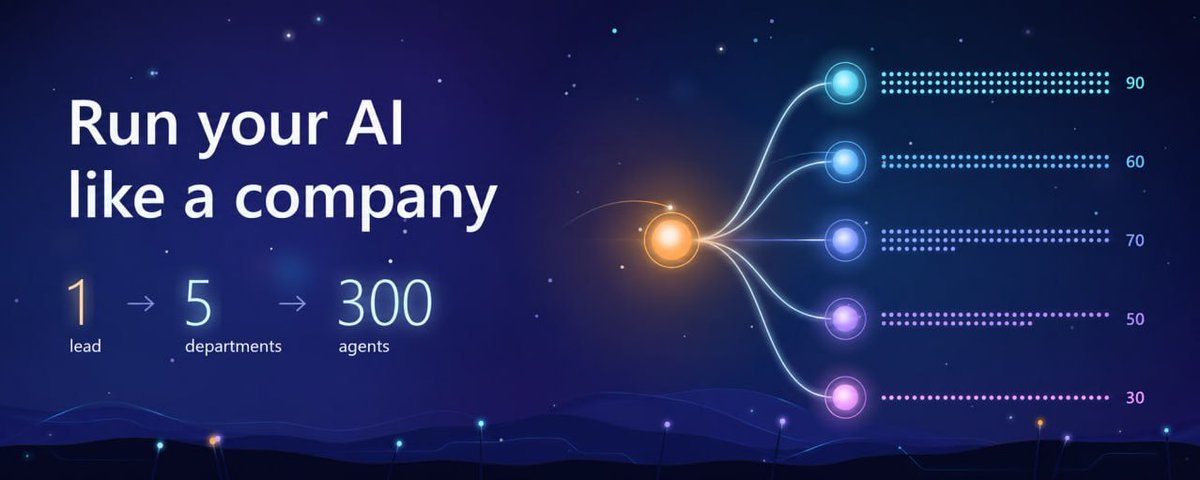
1 lead. 5 departments. 300 seats. 3 rules. one file
our clip draws an ai swarm as a voxel termite colony filling an org chart seat by seat
50 of those termites decide whether anything ships
two models: one plays team lead and draws the chart -> the other staffs every seat
three moves: each department owns one thing, hands it to a named neighbour, never checks its own work
• who sits where (sample split)
> research · 90 - owns profiles, hands them raw to data
> data · 60 - owns the master table, feeds build and qa
> build · 70 - owns scoring and visuals, sends dashboard and deck to qa
> qa · 50 - owns truth, passes a claim or bounces it
> editorial · 30 - owns the story, hands the report to the lead
1:300
one lead over the whole colony, 5 direct reports
qa sits apart by design
stated reason: an agent marking its own work tends to wave it through, a checker shown only statement and evidence stays neutral
↳ research alone is almost a third of the colony, qa + editorial only a quarter
• what the file holds
> goal - score 150 ai coding assistants for a 20-person company
> done - report + dashboard + deck, every statement sourced
> standup - one line from each department, every 200 steps
> rejects - return to the department that made them
> release - only on a green qa light
a reading-heavy job (due diligence on 100 companies) -> research 140, build shrinks. code-heavy flips it
in the clip some termites change department and the counters follow
90/60/70/50/30 is a sample split from a guide, not a measured run: no runtime, no bill, no results
the cap is checked: kimi agent swarm coordinates up to 300 sub-agents in parallel
whoever can write that one file runs 300 seats and reads 5 lines per standup ↓
OpenAI's dot can reach 4,000+ apps. While you sleep, it's reportedly allowed to act in none of them.
A seven-row side-by-side published this week describes Grok Bot as the opposite deal, a crew of bots whose loop keeps running overnight. I know which one I'd leave on tonight, and it isn't the one that does more.
The receipts from that table.
Dot: 1 agent for now, more promised. 4,000+ apps. From $100 a month.
Grok Bot, as the table tells it: several named bots on day one. $60 to $300 a month. The top bundle costs 5 times the bottom.
I haven't run either one overnight. I ran the arithmetic: Business Premium has a 2-seat minimum at $100 a seat, billed annually. That's $200 a month, a third less than the $300 bundle.
So it's one worker on a short leash against a crew on a long one. Five rows show where the leash comes from:
• Model. GPT-6 Astra for the dot. Grok and nothing else for the crew.
• Machine. The dot has its own cloud computer and browser. Each Grok bot is said to get a cloud computer on top of one shared machine.
• Reach. Integrations plus Slack, Teams and Codex for the dot. Grok Bot is said to use your real logins, a connector where one exists and browser clicks where none does.
• Overnight. The dot researches, then queues every action for your review. On Grok Bot you decide where approval sits.
• Oversight. One activity view with every step, against a separate thread per bot.
Turns out money barely separates them. $100 sits inside Grok Bot's range, $40 above the bottom and $200 under the top. Call the crew 4 bots, purely as an example, and the dot is 25% of the headcount for about the same entry money.
Where I land, and plenty of people will argue with it: I'd start on the short leash. A worker that only reads at night can waste a night. A crew that acts at night has already acted by the time I wake up, and even that table rates the long leash as equal parts power and hazard. The table's own rule works for me: crew when the work has several roles, single worker when one job has to come out right with nobody watching.
The dot's price and app count check out against outside sources. The Grok Bot column I couldn't verify, and neither side has benchmark, speed or quality numbers.
All seven rows, side by side ↓


Picture a neon inchworm measuring a bar 435,606 views tall, one loop at a time, and the bar turns out to be a multiplayer Doom lobby built as a Claude Code mod. We animated six bars like that, one for each mod in a roundup of the week's best. A worm loops up, the count locks at the top, and one worm is done after 3.5% of the Doom climb. Here's the board.
three tiers, one screen:
• the game - first place, 435,606 views
> a multiplayer Doom lobby, alone worth about 94% of the other five put together
> the roundup that listed it treats it as entertainment, nothing to copy
• the meters - second and third
> usage pills above the prompt: 176,461
> a live progress bar for plans: 149,695
• the quiet tools - fourth to sixth
> screenshot preview over the input box: 72,103
> session status board with a timer per task: 49,109
> finished-render bar with an Open video button: 15,406. That's the 3.5% worm, and first place drew 28.3x its views
six bars, 898,380 views, and the top two hold more than two thirds of them. Runtimewire dates the launch of mods to October 1, so all of that piled up in days.
-> the roundup itself sits at 35,300 views as of October 6. The Doom lobby out-drew the post that listed it 12.3x
counts are as quoted in that roundup on October 4, we did not audit them ↓


imagine a seahorse rendering itself from one prompt
8 open-source GitHub projects for turning one prompt into a finished video
01 MoneyPrinterTurbo
▸ github.com/harry0703/MoneyPr…
→ topic → script + footage + music → video
02 VoiceStudio
▸ github.com/debpalash/VoiceSt…
→ local voice cloning + dubbing + transcription
GENERATE THE FOOTAGE
03 Wan2.2
▸ github.com/Wan-Video/Wan2.2
→ open text-to-video + image-to-video models
04 ComfyUI
▸ github.com/Comfy-Org/ComfyUI
→ node graph for image + video + audio
CODE THE FRAMES
05 HyperFrames
▸ github.com/heygen-com/hyperf…
→ HTML → headless Chrome → MP4
06 Manim
▸ github.com/ManimCommunity/ma…
→ Python code → explainer animations
CUT AND CAPTION
07 OpenCut
▸ github.com/OpenCut-app/OpenC…
→ free timeline editor, web + desktop
08 Faster Whisper
▸ github.com/SYSTRAN/faster-wh…
→ speech → timed text for subtitles
the timeline:
prompt → script → voice → footage → frames → cut → captions → check
553,454 stars combined, checked Oct 6
all eight pushed in the 15 days before
Wan2.2's README: 24GB VRAM minimum for the 5B model
the prompt is one line
the studio is eight repos
we animated that seahorse from glitch to clean frame ⭣
GitHub lets your trading bot go broke on paper
10 open-source GitHub projects for turning a trading idea into a paper-tested bot
GET THE DATA
01 yfinance
▸ github.com/ranaroussi/yfinan…
→ Yahoo Finance data → Python
02 CCXT
▸ github.com/ccxt/ccxt
→ one API, 100+ crypto exchanges
TEST THE IDEA
03 backtesting.py
▸ github.com/kernc/backtesting…
→ backtest in a few lines
04 Qlib
▸ github.com/microsoft/qlib
→ ML quant research platform
05 QuantStats
▸ github.com/ranaroussi/quants…
→ risk + return report
PAPER-RUN THE BOT
06 Freqtrade
▸ github.com/freqtrade/freqtra…
→ crypto bot + dry-run + backtests
07 Hummingbot
▸ github.com/hummingbot/hummin…
→ market-making bots + paper-trading script
08 OctoBot
▸ github.com/Drakkar-Software/…
→ grid + DCA + paper trading
HARDEN THE ENGINE
09 NautilusTrader
▸ github.com/nautechsystems/na…
→ same strategy code, backtest + live
10 LEAN
▸ github.com/QuantConnect/Lean
→ event-driven engine + Python or C#
the route:
data → rules → research → score → dry-run → live engine → review
269k stars combined, as of Oct 6
live mode trades real money and needs exchange API keys
paper shows where an idea breaks, not whether it pays ⭣
Picture four office mice writing your Friday report for $100 a month, after everyone has gone home.
We drew that scene for our video.
The routine under it comes from a guide posted October 1 (82,893 views by the next day). By its account, an always-on agent runs on its own cloud computer and browser, so the owner's laptop can stay off.
When it finishes, the human gets exactly one message.
The $100 is the guide's number, the entry Pro tier's monthly price. Set it next to US median pay for an administrative assistant: $48,310 a year (BLS, May 2025), about 40x the plan's $1,200.
None of this replaces a person. The guide only claims one weekly summary task and calls its own example numbers estimates.
Friday, 16:00. The laptop is shut.
In our video the lights go down, the chair is empty, and four mice come out from under the skirting board.
> LOOKOUT - carries in five crumbs, never more
> MAKER - lays them out in three columns, SHIPPED / MOVED / WAITING
> SKEPTIC - checks every crumb for a thread, drags the bare ones to WAITING, then jumps on the PASS stamp
> RUNNER - pushes the sheet into a folder named for the week
5 bullets. 3 sections. 360 words at most. About a minute and a half of reading.
Swap crumbs for bullets and threads for links, and you get the five moves the guide describes:
1. The clock starts it, Friday at 16:00. A typed command works too.
2. The lookout checks calendar, email and the repo for what a Monday newcomer would need, and tags each bullet as needing a decision or not.
3. The maker writes from those bullets only, 120 words a section, every shipped line with a link.
4. The skeptic runs the checkpoint. A shipped line with no link gets demoted to waiting.
5. After PASS, the runner saves the page under that week's date and adds one line to the index.
It sends the digest to no one.
$100 is about half a workday of that median pay, and it covers the month.
That one message answers a single checkpoint question: what breaks if this is approved and it's wrong?