

Content Creator & Researcher | Ex Google Dm open ✉️
Ai
Joined December 2021
- Tweets10.7K
- Following832
- Followers15.2K
- Likes50.9K


TypeSafe built Jev to return probabilities, not prose. A typed model that scores a full passage pool in one request and fires two binary gates on the spot.
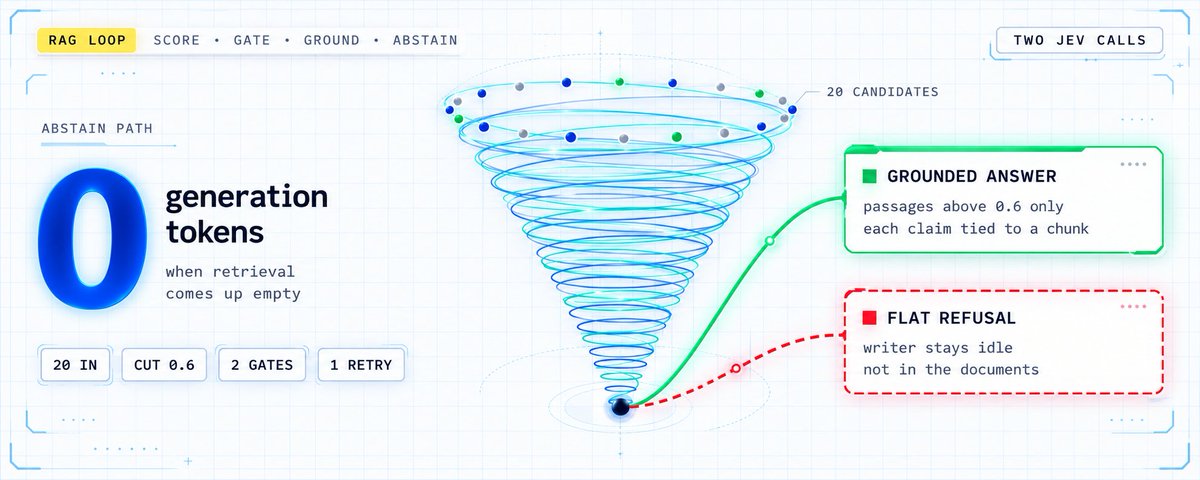
Hindsight swapped their MiniLM reranker for it: 0.027 s vs 0.12 s per query at 30 candidates, recall@1 0.950 vs 0.800 (Hindsight benchmark, LoCoMo). Two Jev calls score and verify the whole loop:
1. HYBRID SEARCH: dense vectors + keyword match surface the top 20 candidates (design value, per the post)
2. JEV #1: one request scores all 20 passages and fires two gates: answerable? injection?
3. THRESHOLD: 0.6 drops everything below it. The writer agent never sees low-confidence material (design value, per the post)
4. WRITER: drafts the answer from the passages that survived
5. JEV #2: walks every claim in the draft back to its source passage
6. GATE FAIL: answerable returns no, writer never fires. A researcher reshapes the query for one retry. Second miss kills the loop: "not in the docs"
the injection flag is a retrieval filter, not a security perimeter.
remove the answerable gate and every unanswerable query becomes a paid hallucination. two scoring calls, two gates, one hard no.
The full loop runs in the terminal below ↓

Ridark retweeted
MY FIRST HOUR WITH THE NEW GROK BOT WENT ON TAKING PERMISSIONS AWAY, NOT ADDING THEM.
The release shipped Coinbase, Robinhood and eToro connectors, access to your X Chat, email aliases, and a public trigger: anyone can tag @bot under your post and start a task.
That is not a faster chatbot. That is a funded account with a front door.
So before I gave it a single job:
→ Execution runs in its own sub-account with a hard cap. The main balance stays disconnected.
→ Nothing sends on its own. DM and email drafts wait for me.
→ One connector per agent. Only the Head of Desk sees all of them.
→ Every routine gets its own email alias, so launches and invoices never share a queue.
A boring hour. It is the reason the rest runs while I am not there.
Then the part nobody is posting.
Everyone aimed the new connectors at the market on day one. The most expensive thing an agent like this finds is almost never a trade. SpaceXSI pointed theirs at their own vendor contracts and unused seats. Over $100k in the first week, and that template is public.
The fastest alpha in this release is not a token. It is a subscription you forgot to cancel.
Decide what your bot cannot do while it is still boring. After it is connected, that conversation gets expensive.
Ridark retweeted

si queréis aprender sobre IA solo os diré que sigáis a esta cuenta, no diré nada mas.

Ingeniero de Anthropic:
"99% de las personas usan Claude Code como Google, y solo el 1% están ejecutando enjambres de agentes Claude de autoaprendizaje.
Yo estoy ejecutando más de 100 agentes en un bucle. Tengo un agente Jefe, agentes PM - ellos gestionan todo el equipo.
en un taller de 30 minutos, un ingeniero de Anthropic reveló cómo obtener el máximo valor de Claude Code con el mínimo costo.
esto vale más que otro curso de $500
guárdalo y sígueme para más → @robiartec
MY FIRST HOUR WITH THE NEW GROK BOT WENT ON TAKING PERMISSIONS AWAY, NOT ADDING THEM.
The release shipped Coinbase, Robinhood and eToro connectors, access to your X Chat, email aliases, and a public trigger: anyone can tag @bot under your post and start a task.
That is not a faster chatbot. That is a funded account with a front door.
So before I gave it a single job:
→ Execution runs in its own sub-account with a hard cap. The main balance stays disconnected.
→ Nothing sends on its own. DM and email drafts wait for me.
→ One connector per agent. Only the Head of Desk sees all of them.
→ Every routine gets its own email alias, so launches and invoices never share a queue.
A boring hour. It is the reason the rest runs while I am not there.
Then the part nobody is posting.
Everyone aimed the new connectors at the market on day one. The most expensive thing an agent like this finds is almost never a trade. SpaceXSI pointed theirs at their own vendor contracts and unused seats. Over $100k in the first week, and that template is public.
The fastest alpha in this release is not a token. It is a subscription you forgot to cancel.
Decide what your bot cannot do while it is still boring. After it is connected, that conversation gets expensive.
8 Grok bots fight over one wallet and every morning the loser is deleted while the winner clones itself
A head-of-desk Grok agent ranks the whole thing. 8 pods, 8 trading strategies, one shared capital pool, scored once a day.
→ LAUNCH: eight pods go live, each strategy different, all drawing from one pool
→ RANK: head-of-desk Grok scores every pod at the day's close
→ DELETE: bottom pod wiped on the spot, no appeal
→ CLONE: top pod copies itself into the empty seat, arena stays at 8
→ GATE: anything large routed to the owner for sign-off before it fires
→ RE-RANK: next morning the whole arena is re-scored and the cycle eats the next weakest
One swap per day, eight seats. Run that for eight rounds and every original can be gone. The whole arena descended from a single line.
Ranking on a short window rewards the luckiest stretch and breeds copies of it. The pod that survived Monday tells you nothing about Friday.
Full kill-or-clone cycle in the terminal below ↓

A builder wired a feed spider, four Grok reviewers and a token launcher into one Chrome extension, and the loop runs itself.
gem-search. MIT, 214 stars, 27 commits on main. Four gates between a detected narrative and a launch. All four clear or nothing fires.
> SPIDER: hooks into the X feed, pulls every visible post into a local dashboard in real time
> CLUSTER: JEV groups posts by meaning, not ticker. Recurring topics collapse into one narrative tracked over 6 hours
> CRAWL: visits project sites linked from posts, pulls docs, team page, repo
> VERIFY: Lookout scores signal, Maker checks product, Skeptic hunts risks, Runner scores entry data
> GATE: all four OK = verified narrative. One no = blocked
> LAUNCH: fires a token through a memecoin launchpad, 0.025 SOL per attempt
The order is the architecture. Lookout catches weak signal before Maker burns an API call. Skeptic kills risk before Runner weighs the entry. Strip one gate and the launcher fires on noise.
Grok reviewers are optional in the build. The paid xAI call is not validated and the launcher defaults to dry-run.
Full stack mapped in the terminal below ↓
Reversible runs free, irreversible waits, every agent stack splits at exactly this line.
4,000 apps and one approval gate.
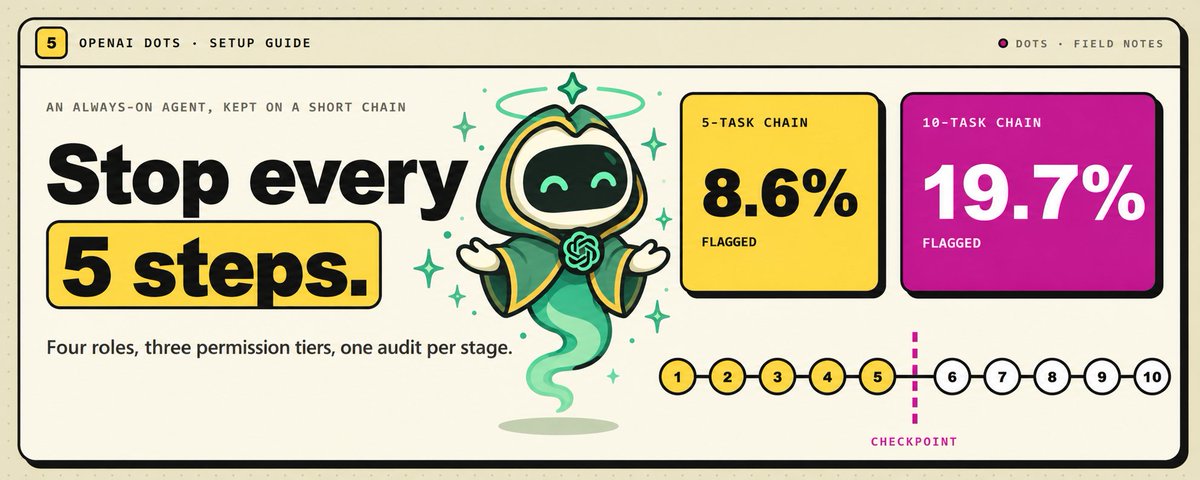
Dots went live at DevDay, 2026-09-29. Each one gets its own cloud computer and browser; you reach it through ChatGPT, Slack or Teams. Laptop shuts, the Dot keeps working.
Built-in rules split reversible from gated. Account actions and sharing hit auto-review first; monitoring can kill a Dot cold. You set what it does alone, when it asks, and what it must never touch.
Altman leaves a voice note before bed. By morning the Dot "did the next seven steps" and built versions to review (Every podcast). First Dot on Pro and Business Premium.
The 10-step blueprint floating around (orchestrator, isolated delegation, model routing, shared workspace) is one builder's map, not an OpenAI spec.
Wire the gate first, connect the apps second. Full Dots layout in the terminal ↓

$54 into $16,230 in one night, one builder's number: Opus 5.5, Jev and a wallet graph splitting the work on a memecoin launchpad
22:00. One instruction on a memecoin launchpad. Nothing else touched.
Opus studies the profitable wallets, learns each trader's habits. Who builds in small portions, who goes heavy. By 22:11 it is scanning the market, reading momentum against the chance of a clean exit.
00:48. First position closed. Size of the next recalculated. No all-in.
02:23. Jev runs checks before the entry. The graph records who entered after whom, which tokens the tracked wallets keep buying together.
04:36. Closes the rest. Won't buy back in. Price still f*cking climbing.
07:10. Next opportunity. Passes.
10:00. $16,230. From $54, one builder's overnight.
Second run, same builder. $89 at 16:05. The system bought small after one selected trader entered. At 17:18 two wallets from the usual group followed. The graph recorded the sequence. At 18:02 a buyer appeared who had rarely overlapped with the group. Jev flagged the shift. The system sized up.
Tracked wallets sold at 20:36. $470. One trader reduced, the system closed part. The second exited, the system sold the rest.
02:53. $2,940.
09:05. $13,400 across 17 hours, three trades, same builder.
Build your own wallet graph first. Full mechanics in the terminal below ↓
Ten websites repeating the same claim can look like ten confirmations when it’s really ONE source copied nine times
That’s why useful data analysis starts before the chart.
Save the original URL, publication date and collection time with every record. Normalize dates, units and currencies before comparing values.
Match entities across spelling variations, then remove duplicates without losing their source history.
Track missing fields, stale records and conflicting values separately. A complete dataset can still be outdated or wrong.
When a spike appears, check whether it reflects a real event, a delayed batch or a change in collection logic. Flag it for review before calling it a trend.
The video illustrates this workflow with simulated data: collection, validation, entity matching and anomaly detection.


i honestly don’t get why people still let their AI guess about code
220,000 stars on GitHub. the tool is called REA. Reverse Engineer Anything.
the week it dropped, Matthew Berman told 3.6 million people that software was finished. one camp said closed source was dead. the other camp called it piracy. almost nobody in either camp installed it.
both camps misread it. REA is a reader. it opens programs you already own and makes your coding agent explain them with evidence.
the idea is simple: you stop asking AI how things work from memory. it starts every answer by pointing at proof. file, function, call. anything it can’t prove goes on a separate list marked unproven.
what that changes:
→ without REA, a model asked how Windows Calculator handles 200 + 10% answers from training. it blends patterns from millions of programs and describes something that sounds right and behaves differently from the binary on your disk
→ connect REA and it reads the build, recovers the exact rule, and stamps it with the version it was read from. when percent follows a plus, it takes that percentage of the first number. when it follows a multiply, it turns into 0.1
→ nobody read source code to get there. someone asked a plain question and got the rule back
the receipts nobody puts side by side:
DX-Ball (1996). one function recovered and rewritten in C. the C version compiles to the same 63 bytes as the original. every one of them. 3,205 test cases clear.
Aegis authenticator. 3,077 classes read. the method that produces 6-digit login codes recovered. 133 of 133 test cases matched.
ArtCraft. seven open-source Rust apps, each aimed at one Adobe product. Photoshop, Lightroom, Illustrator, InDesign, Premiere, After Effects, Acrobat. three more for Office. all built under clean-room rules. early alpha. they exist.
at first I thought this was about cloning apps. it’s not. it’s about reading the ones you already run.
copy this tonight:
→ pick one Electron app you open every day. Slack, Obsidian, Discord. their whole bundle is readable JavaScript with no extra engine
→ choose one feature, never the whole app. "how does Discord decide a message is unread?" not "take Discord apart"
→ ask the agent to locate the modules, trace the click to the code, attach a file and a function to every conclusion, and keep a separate list of everything it inferred but could not confirm
→ read the reply. pick one claim. check it yourself. use the feature and see whether the file it named changes
→ one claim you verified teaches you more than ten pages of output
the engine: Opus 5.5. $4 per million tokens in, $20 out. cached reads cost one twentieth. stay in one session per target and after the first answer the bill drops to cents.
the catch: REA reads what sits on your machine. code running on someone else’s server never reaches your disk. anything that leans on server logic has parts you will never see. and the line that matters is what you carry out of the room and what you ship.
the people using this don’t post screenshots. they read their broker app and find every endpoint it contacts. they map an undocumented API in twenty minutes instead of an afternoon. they audit a binary whose source their company lost. they check a token contract before they touch it.
AI spent two years writing code from descriptions. you explained, it returned something plausible.
this month the direction flipped. the agent reads what already runs and demands receipts for every answer.
most people who saw the viral threads will decide they can clone Photoshop by Friday, give it one try, and quit.
the better use of tonight: one app, one feature, every answer backed by evidence, and a spec written before any code.
save this before your next prompt. save GUIDE ↓

at last... agents can use sites with no API
10 open-source GitHub projects for clicking and verifying real pages
staged for our video: an archerfish plays the agent, spitting at buttons above its tank
PICK THE DRIVER
01 Browser Use ★117.6k
▸ github.com/browser-use/brows…
→ plans + executes browser actions
02 Stagehand ★25.6k
▸ github.com/browserbase/stage…
→ sdk: act + observe + extract
03 Skyvern ★23.2k · AGPL-3.0
▸ github.com/Skyvern-AI/skyver…
→ vision + playwright, no site-specific code
WIRE IN TOOLS
04 Playwright MCP ★38.0k
▸ github.com/microsoft/playwri…
→ browser as mcp tools
05 Agent Browser ★43.8k
▸ github.com/vercel-labs/agent…
→ cli: open → snapshot → act
06 DevTools MCP ★53.2k
▸ github.com/ChromeDevTools/ch…
→ inspect + debug live chrome
RUN IT SAFELY
07 Steel ★7.8k
▸ github.com/steel-dev/steel-b…
→ self-hosted sandbox + api
08 Lightpanda ★36.2k · AGPL-3.0
▸ github.com/lightpanda-io/bro…
→ headless browser, speaks cdp
CHECK THE RUN
09 Midscene ★15.1k
▸ github.com/web-infra-dev/mid…
→ natural-language tests + evals
10 CUAWright ★6.0k
▸ github.com/microsoft/CUAWrig…
→ saves playwright scripts
task → plan → snapshot → tool call → act → browser → check → retry
uv add browser-use
uv run agent.py
366,597 stars, checked Oct 11
Lightpanda's own 100-page benchmark: 5s + 123MB vs headless Chrome's 46s + 2GB
no API
still clickable ⭣
filings, news, charts read by hand, and nothing logged
8 open-source GitHub projects for an AI research desk
four meerkat sentries watch the data panels in our video
FEED THE DESK
01 OpenBB ★ 74.1k
▸ github.com/OpenBB-finance/Op…
→ data: many sources, one python interface
02 FinGPT ★ 21.4k
▸ github.com/AI4Finance-Founda…
→ sentiment: open finance LLMs + fine-tuning
STAFF THE ANALYSTS
03 TradingAgents ★ 110.5k
▸ github.com/TauricResearch/Tr…
→ debate: analyst, researcher, trader + risk agents
04 ai-hedge-fund ★ 63.9k
▸ github.com/virattt/ai-hedge-…
→ risk: investor personas + risk manager, places no trades
GATE THE ORDERS
05 AgenticTrading ★ 770
▸ github.com/Open-Finance-Lab/…
→ paper-fill + log: sims, decision logs, live off by default
06 alpaca-mcp-server ★ 1.0k
▸ github.com/alpacahq/alpaca-m…
→ gate: quotes, positions, paper orders for agents
CHECK THE CALLS
07 bt ★ 3.0k
▸ github.com/pmorissette/bt
→ backtest: compare strategies from python blocks
08 FinRL ★ 16.6k
▸ github.com/AI4Finance-Founda…
→ benchmark: RL agents trained on market data
data → sentiment → debate → risk → backtest → gate → paper-fill → log
git clone github.com/TauricResearch/Tr…
pip install .
tradingagents
≈291k ★ combined · checked Oct 11, 2026
ALPACA_PAPER_TRADE=true by default · off → gate can place real trades
no remote authentication, its README warns
research tools, not advice ⭣
I don't understand why everyone isn't doing this yet. There's a free narrative radar that instantly shows which trending words are actually trading early on pump fun and GMGN.
Main Idea: Moth-radar, real-time narrative scanner for pump fun and GMGN
Instead of scrolling through endless new launches and guessing what's real, the tool tracks volume and filters tokens actually trading early in one dashboard:
Live Word Stream: Shows words appearing most frequently in new token names over the last hour and measures how fast each narrative is growing.
Real Trading Filter: For every word, it shows tokens actually trading with early volume on pump fun / GMGN -- not just spam-launched or empty mints.
Real Profit Proof: Caught $Tschuna early for +0.5 SOL in 4 minutes on one account, and entered cupsey much faster thanks to Moth-radar.
Install via browser (Chrome, Edge, Brave, Opera):
> Open chrome://extensions
> Enable Developer mode, toggle in the top right corner
> Click Load unpacked, select the moth-radar folder containing manifest.json
> Pin the icon: puzzle piece icon, pin next to Moth-radar
> Open any page on pump fun or GMGN, the radar tracks trading volume instantly.
> github.com/Ridarketh/Moth-ra…
I don't understand why everyone isn't doing this yet. There's a free browser extension that instantly pulls the full developer profile of any token creator, no more manual wallet tracing.
Main Idea: Dev Dossier, automatic creator history on pump.fun and GMGN
Instead of copying the deployer address, opening Solscan, scrolling through transactions and piecing together wallet history manually, the extension does it all in one second, right on the page.
Auto Dossier: Open any token on pump.fun/coin/… or gmgn.ai/sol/token/… and a panel appears on the right with the creator's wallet, past launches, and how each one ended: growth, silence, or rug.
Bug / Tell me more: Click the bug icon and it walks you through each previous token one by one. Serial ruggers are exposed instantly.
Copy image: Copies the dossier card as an image. Ctrl+V into Telegram and your group is warned in 3 seconds.
Address lookup: Through the extension icon you can pull up a dossier for any token or wallet address manually, without navigating to the page.
Install via browser (Chrome, Edge, Brave, Opera):
Open chrome://extensions
Enable Developer mode, toggle in the top right corner
Click Load unpacked, select the dev-dossier folder containing manifest.json
Pin the icon: puzzle piece icon, pin next to Dev Dossier
Open any token on pump.fun or GMGN, the dossier appears automatically.
Show configuration diffs before applying changes.
> github.com/Ridarketh/Develop…
Ridark retweeted

AI is already smart enough.
Real-world tasks are still slow, expensive and unreliable, because we hand AI a computer built for humans, then wrap it in a heavy harness.
AI doesn’t need to get smarter. It needs a computer built for it.
Today we’re releasing Pine Computer
Readers added context they thought people might want to know
Pine's highlighted SaaS-Bench v1.1 results show higher checkpoint score (78.3%) but lower resolved full-task completion (27.4%) than comparators (29.2%, 31.1%). Pine Computer is in private beta, not a full public release.
unipat.ai/benchmarks/Saa…
pinecomputer.io/blog/introduci…
your agents ran six steps. guess which call broke
10 open-source GitHub projects for running an agent team you can trace and test
BUILD THE TEAM
01 OpenRig ★6.5k
▸ github.com/mvschwarz/openrig
→ standing agent team, yaml roles
02 LangGraph ★43.0k
▸ github.com/langchain-ai/lang…
→ state graph, per-step memory
ADD MEMORY AND TOOLS
03 Mem0 ★66.9k
▸ github.com/mem0ai/mem0
→ agent memory layer
04 Graphiti ★31.6k
▸ github.com/getzep/graphiti
→ time-aware knowledge graph
05 MCP Python SDK ★24.5k
▸ github.com/modelcontextproto…
→ tool-protocol server + client
TURN ON TRACING
06 OpenLLMetry ★7.5k
▸ github.com/traceloop/openllm…
→ opentelemetry tracing
07 Opik ★22.5k
▸ github.com/comet-ml/opik
→ traces + evals + monitoring
TEST BEFORE LAUNCH
08 DeepEval ★18.7k
▸ github.com/confident-ai/deep…
→ pytest-style agent tests
09 Promptfoo ★25.8k
▸ github.com/promptfoo/promptf…
→ cli evals + red-teaming
10 Inspect ★3.0k
▸ github.com/UKGovernmentBEIS/…
→ model eval framework
one task, seven stops:
task → graph → memory → tool → trace → eval → fix
OpenRig README, after installing its cli:
rig setup --dry-run
~250k stars combined on Oct 10, 2026, all MIT or Apache-2.0
README claims: DeepEval 36 metrics, Inspect 200+ ready evals, Opik 40M+ traces a day
more agents won't show which call broke
the trace will ⭣
imagine swallows building a computer like a nest
10 open-source GitHub projects for rebuilding the whole stack from scratch
BOOT THE SYSTEM
01 Asterinas
▸ github.com/asterinas/asterin…
→ linux-compatible rust kernel, 230+ syscalls
02 SerenityOS
▸ github.com/SerenityOS/sereni…
→ unix-like os: kernel + apps + own browser
REPLACE THE TOOLS
03 uutils
▸ github.com/uutils/coreutils
→ gnu coreutils rewritten in rust
04 Nushell
▸ github.com/nushell/nushell
→ shell piping tables instead of text
05 Ghostty
▸ github.com/ghostty-org/ghost…
→ gpu-accelerated terminal + native windows
DRAW THE WORLD
06 Ladybird
▸ github.com/LadybirdBrowser/l…
→ browser on a from-scratch engine
07 Servo
▸ github.com/servo/servo
→ embeddable rust web engine
08 Bevy
▸ github.com/bevyengine/bevy
→ data-driven 2d + 3d game engine
RUN IT ANYWHERE
09 Wasmtime
▸ github.com/bytecodealliance/…
→ sandboxed webassembly runtime
10 v86
▸ github.com/copy/v86
→ x86 pc emulator in a browser tab
the build order:
boot → kernel → shell → terminal → page → render → sandbox → emulate
361,056 stars combined, checked Oct 8
oldest repo: uutils, 2013
youngest: Ladybird, about 2 years 4 months old, most starred at 66,446 ⭣
I don't understand why everyone isn't doing this yet. There's a free browser extension that instantly pulls the full developer profile of any token creator, no more manual wallet tracing.
Main Idea: Dev Dossier, automatic creator history on pump.fun and GMGN
Instead of copying the deployer address, opening Solscan, scrolling through transactions and piecing together wallet history manually, the extension does it all in one second, right on the page.
Auto Dossier: Open any token on pump.fun/coin/… or gmgn.ai/sol/token/… and a panel appears on the right with the creator's wallet, past launches, and how each one ended: growth, silence, or rug.
Bug / Tell me more: Click the bug icon and it walks you through each previous token one by one. Serial ruggers are exposed instantly.
Copy image: Copies the dossier card as an image. Ctrl+V into Telegram and your group is warned in 3 seconds.
Address lookup: Through the extension icon you can pull up a dossier for any token or wallet address manually, without navigating to the page.
Install via browser (Chrome, Edge, Brave, Opera):
Open chrome://extensions
Enable Developer mode, toggle in the top right corner
Click Load unpacked, select the dev-dossier folder containing manifest.json
Pin the icon: puzzle piece icon, pin next to Dev Dossier
Open any token on pump.fun or GMGN, the dossier appears automatically.
Show configuration diffs before applying changes.
> github.com/Ridarketh/Develop…
AI startups spent years forcing models to navigate software made for human eyes.
@PineAIAssistant flipped the core premise: what if the computer itself is the bottleneck?
One SDK gives your product a dedicated cloud workstation:
• Describe the task in plain language
• Run seamless execution across sites, files, and apps
• Monitor, intervene for high-stakes approvals, and yield control back
Result: 78.3% checkpoint score on SaaS-Bench v1.1 (highest benchmark recorded) -- delivered at ~1/26th the token cost of Opus 5 + Claude Code.
#PineComputer #ComputerUse

AI is already smart enough.
Real-world tasks are still slow, expensive and unreliable, because we hand AI a computer built for humans, then wrap it in a heavy harness.
AI doesn’t need to get smarter. It needs a computer built for it.
Today we’re releasing Pine Computer
Readers added context they thought people might want to know
Pine's highlighted SaaS-Bench v1.1 results show higher checkpoint score (78.3%) but lower resolved full-task completion (27.4%) than comparators (29.2%, 31.1%). Pine Computer is in private beta, not a full public release.
unipat.ai/benchmarks/Saa…
pinecomputer.io/blog/introduci…