

Follower of Christ; contributor, https://xitter.cf/t.co/phAqRAqyL6; blogger at https://xitter.cf/t.co/JWM1F5BpT1
Chandler, Arizona
Joined May 2009
- Tweets621
- Following454
- Followers300
- Likes751








Joyce Coronel retweeted

Pope Leo XIV at Mass in Uruguay, delivers a magnificent reflection to parents whose children no longer practice the faith despite their best efforts:
“When we wonder and ask, where our faith comes from, the name of a specific woman often comes to mind; a mother, a grandmother, a godmother, a religious sister, or a catechist.
We may not remember every word they said to us, but we do remember how they prayed, how they spoke to how they spoke of the Lord snd with what conviction they lived out, what they taught us.
Today, I would like to thank all of those women. Thank you for having believed, and for having kept open a path to God in so many families.
Some were able to do so, supported by a long standing family tradition, others had to sustain that faith with greater effort, perhaps without always finding understanding or support within their own homes.
I know that many of you carry a very specific sorrow; you taught your children to pray, and today, they no longer do so.
You used to attend Mass together, and it has been years since they entered the church. You spoke to your grandchildren about God, and now you do not know if those words left a mark. Sometimes you wonder if you did something wrong. Or if it was all future.
Allow me to recall St. Monica here, who knew that pain well. She prayed for years for a son who seemed to be drifting further and further from God. But she never stopped trusting in His grace.
Therefore, do not consider what you have sown to be lost. The Lord Himself taught us that the seed can grow without the sower, knowing how.
Mothers and grandmothers never tire of passing on the faith. Preach with your lives, as well as with your words. Insist on prayer, love and hope. Insist on them, in seasoning and out of season.
Do so with patience, without harshness or discouragement, even if your loved ones seem far from God continue to place them before Him. Do not stop blessing them, accompanying them, and simply reminding them of what they once received. There are doors that you cannot open, but God can.

Joyce Coronel retweeted

“The Catholic Church has been the driving force behind some of the major events of world history including the Christianization of Western and Central Europe and Latin America, the spreading of literacy and the foundation of the universities, hospitals, the Western tradition of monasticism, the development of art and music, literature, architecture, contributions to the scientific method, just war theory and trial by jury.”
- Timeline of the Catholic Church

Joyce Coronel retweeted

Melchizedek offered bread and wine to God in Genesis 14, and almost nobody asks the one question that passage demands: what kind of sacrifice is that?
Most Protestants assume sacrifice in Scripture always means blood and death. Burnt animals. Altars. Slaughter.
But Genesis 14:18 records a priest of God Most High offering bread and wine, and Scripture calls it a priestly act. The Psalms then declare the Messiah a priest "after the order of Melchizedek" (Psalm 110:4). A priesthood whose defining recorded offering was unbloody.
Hebrews 5-7 confirms Christ holds this exact priesthood, not the Levitical one. The Levitical priests offered animals. Melchizedek offered bread and wine.
So the question writes itself: if Christ is a priest forever after the order of Melchizedek, what does his priesthood offer?
A priest without an offering is a contradiction in terms. And the offering of his order, established in the first mention of a priest in the entire Bible, is bread and wine.
That is the Mass. Not a symbol borrowed from paganism. A priesthood older than Aaron, offering what Melchizedek offered, now transformed into the Body and Blood of the One who said "this is my body."
The early Fathers saw this connection immediately. So did the author of Hebrews, who spends three chapters on it.
If the Lord's Supper is only a memorial, then Christ's Melchizedekian priesthood has no visible offering at all. What is a priest who never sacrifices?
Joyce Coronel retweeted

What if your bishop sent a letter tomorrow that said all parishes have to shut down all programs, events, and classes.
What would your parish look like in the aftermath?
catholicmissionarydisciples.…


Joyce Coronel retweeted
God could have snapped His fingers and forgiven humanity. No blood required. So why the Passion? Aquinas answers this in Summa Theologiae III, question 46, and the answer dismantles two caricatures at once.
The first caricature comes from modern critics. They paint the Atonement as a cosmic hostage situation where an angry Father demands blood to cool His rage.
The second comes from well-meaning Christians who reduce the Cross to a strict legal necessity. As if God's hands were tied by some external rule.
Aquinas cuts through both.
God was not obligated to redeem us through suffering. He chose it. And He chose it because it was the most fitting way to restore a broken order.
The Cross achieves two things simultaneously that no other means could.
First, it satisfies justice. Human nature had rebelled. Christ, as the Head of humanity, offers a perfect act of obedience that repairs what our disobedience fractured.
Second, it operates as medicine. The Passion doesn't just wipe a legal slate. It heals the actual wound in our nature by providing a remedy for pride through Christ's profound humility.
This is why Aquinas frames the Atonement not as a transaction between an angry God and an innocent victim, but as an act of supreme charity flowing from the Hypostatic Union. The divine and human natures united in one Person making a meritorious offering on our behalf.
The Cross was not the minimum God could do. It was the most.
If the Atonement is medicine rather than a mere legal transaction, how does that change how we understand suffering in our own lives?
Joyce Coronel retweeted

The book of Hosea is about the pain of a God who is so deeply in love, but always the second or third choice of the object of His affection.
And yet it’s a book of Hope.
Gods love for you will triumph.
He will wear you down.
His love for you is so much greater than your sin, your pride, your anger and fear.
If today you are struggling with frustration at you and your inability to chose Him daily, then change your focus.
Look less at your lack of love for Him and rejoice in the purity, depth, intensity and unconquerable nature of His love for you.
#talkedtotheboss
Joyce Coronel retweeted

If you intentionally miss Mass on Sunday without a valid reason, you have committed mortal sin and put your soul in danger.
The Catholic Church is not here to make you feel good. The Church is here to tell you the truth. God commanded us to keep the Lord's Day holy, and Sunday Mass is part of that.
When you keep missing Mass, you slowly drift away from God. First of all, you will start thinking that Mass is not important. Next, you'll start believing you can get to heaven without worshipping God, as far as you live a good life. Before you know it, you start making your own rules instead of following God's rule - something you're already doing.
That is why the Catholic Church takes Sunday Mass so seriously, she wants to help save your soul, not make life harder for you.

Joyce Coronel retweeted

When I was a child we had neighbors whose daughter was a good few years older than me. Old enough to be dating. And her boyfriend would come by and they would spend entire afternoons talking, her at the window, him standing outside it, for hours, just talking, laughing, knowing. I could see them from my bedroom window, and I remember it vividly, it stuck with me for some reason, but my parents thought this was hilarious, “how old fashioned, how unnecessary, what a strange thing to make the poor boy stand there like that”, they would exclaim.
But my parents were wrong, and the neighbors, turns out, were right.
That girl married that boy. They are still together. Living right next door to that house where they spend hours knowing each other. I, on the other hand, was raised with considerably more modern sensibilities and considerably less supervision, went on to collect a long list of broken hearts.
There is something almost unbearably sad about that when I sit with it. The wisdom was right there. Literally next door, an arms reach away, and my parents were too busy laughing at it to ever try and understand it.
The neighbors weren’t punishing that boy, they instead were protecting the most important thing in that house — their daughter.

Joyce Coronel retweeted

Judas, unlike many, realized his sin. He repented bitterly, went to the high priests, threw the money at them, and said, "I have sinned; I have betrayed innocent blood." Everything was almost like a proper confession: awareness, confession, and even a refusal of gain. Yet, one detail was missing—the very one that is often missing after we have recounted our sins to the anointed one.
This detail was faith that God's love is greater than his fall.
Peter denied Christ three times. It was terrible, done with a vow before a simple servant. But he found in himself the courage not only to weep, but also to return to the apostles and wait for the Resurrection, knowing that Christ was alive and merciful.
Judas' despair is the blemish of pride.
It is the inability to accept oneself as forgiven, the inability to believe that you can still be loved after what you have done.
Often we go to confession and do not feel relief because we continue to punish ourselves.
But this is a rebellion against God! If the Lord forgives, who are we to cancel His decision?
Self-flagellation is not humility, but a refined passion.
Let us learn to weep bitterly like the apostle Peter, but to look not at the noose, but into the eyes of the Risen Saviour, who asks us not about the depth of our sin, but about the measure of our love.

Joyce Coronel retweeted

I'm a trauma therapist working with extreme kinds of trauma: suicide of a child/spouse, death out of order, murder victim's survivors. Long term SA etc.
If you're reading this and you can't afford therapy this post is meant for you. I've been in intense personal pain through the last 4-5 months and I want to share with you, what I've seen help my clients and myself.
1. If you have to compartmentalize so you can work, block out time to grieve. This is now part of your job. Aim for 4 hours minimum for this grief period. If you feel numb and/or dissociative, lie down, close your eyes, and listen to the psalms (I like the Dwell app). Allow yourself to feel, not feel, drift, focus, listen to the psalms, talk to God, breathe. Cry, don't cry. Notice your feelings.
2. Make it a priority to get enough sleep. If your anxiety/pain/fear is keeping you awake:
Listen to the psalms on low volume and pray to God. Just keep talking to Him. He's there with you.
Pray until you fall asleep.
If you're still struggling to fall asleep, give yourself
time to wind down before bed
Try to schedule meals so you don't go to bed feeling starving or stuffed full
3. Prioritize time with God, the Healer
While thinking about the goodness of God, journal for ten minutes every day, whether you want to or not (research supports this being helpful)
If you're able, spend ten minutes every day meditating: focusing all of your attention on Jesus. Try to imagine Him. Drift with thoughts about how it will feel when you see Him face to face. Immerse yourself in His love
4. Give yourself time. Try not to 'hurry up and move on'. You need time to heal. No pressure. Just give yourself time. Accept that you can be in pain during this season and God is with you right in the middle of it with you.
5. Try not to isolate but allow yourself alone time when you need it.
This was on my heart today, as I'm dealing with my own pain, and working with clients who are suffering. Take the parts that work for you, and take it one step at a time.
I'm talking to you not as a therapist, but as a fellow sufferer. This post is not meant as therapy, or meant to replace therapy. If you can find a good trauma therapist you can afford, I recommend finding someone you trust and talk with them.
God bless you, and remember that this, too, will pass.
With love,
Ronda
Joyce Coronel retweeted

If you think Catholicism is just about rules, you've never met St Bonaventure. He taught that the goal of theology isn't simply to know about God, but to be transformed by Him.
A brilliant scholar, a Franciscan, a cardinal and Doctor of the Church, Bonaventure united intellect with holiness in a way our age desperately needs. When others pursued knowledge for prestige, he insisted that pride blinds the soul. True wisdom begins on your knees. He famously wrote:
'No one knows Christ except him who follows Him.'
Knowledge without humility puffs up.
Truth without love becomes ideology.
Theology without prayer becomes noise.
Pray for us, St Bonaventure, that our minds may seek the truth, our hearts may love it, and our lives may bear witness to it. Happy Feast! ✝️

Joyce Coronel retweeted

I love this quote from Cardinal Robert Sarah......
Our world no longer hears God because it is constantly speaking, at a devastating speed and volume, in order to say nothing. Modern civilization does not know how to be quiet. It holds forth in an unending monologue. Postmodern society rejects the past and looks at the present as a cheap consumer object; it pictures the future in terms of an almost obsessive progress.
Its dream, which has become a sad reality, will have been to lock silence away in a damp, dark dungeon. Thus there is a dictatorship of speech, a dictatorship of verbal emphasis. In this theater of shadows, nothing is left but a purulent wound of mechanical words, without perspective, without truth, and without foundation. Quite often “truth” is nothing more than the pure and misleading creation of the media, corroborated by fabricated images and testimonies. When that happens, the word of God fades away, inaccessible and inaudible.
Postmodernity is an ongoing offense and aggression against the divine silence. From morning to evening, from evening to morning, silence no longer has any place at all; the noise tries to prevent God himself from speaking. In this hell of noise, man disintegrates and is lost; he is broken up into countless worries, fantasies, and fears. In order to get out of these depressing tunnels, he desperately awaits noise so that it will bring him a few consolations.
Noise is a deceptive, addictive, and false tranquilizer. The tragedy of our world is never better summed up than in the fury of senseless noise that stubbornly hates silence. This age detests the things that silence brings us to: encounter, wonder, and kneeling before God.
Even in the schools, silence has disappeared. And yet how can anyone study in the midst of noise? How can you read in noise? How can you train your intellect in noise? How can you structure your thought and the contours of your interior being in noise?
How can you be open to the mystery of God, to spiritual values, and to our human greatness in continual turmoil? Contemplative silence is a fragile little flame in the middle of a raging ocean.
The fire of silence is weak because it is bothersome to a busy world.”
—Cardinal Robert Sarah

Joyce Coronel retweeted

"I think if you were to ask somebody when you die and you get to heaven, you're going to be confronted with the question Jesus or Saint Peter's going to ask you,
"Why should we let you into heaven?"
And I think most people would start listing good things they've done or bad things that they restrain themselves from, but there's only one legitimate answer.
If when you're asked why should you be allowed into heaven, there's only one correct answer:
"The blood of Jesus. I can't merit heaven. I did nothing to give myself life. I did nothing to give myself the strengths and qualities and opportunities that I've been given. I did nothing.
I'm on a rock that's spinning 10s of 1000s of miles per hour in an empty void around a thing called the sun. I'm in control of nothing."
But if we live with Jesus, united to His mission, and allow that blood to fill us and guide us, it changes everything.
It might even help you see yourself the way God sees you, and if you could see yourself the way God sees you, it would change everything."
Fr. Fernando Camou
Diocese of Phoenix - @PhoenixDiocese
Steubenville St. Louis Mid America
Steubenville Conferences - @go2steubenville
Click here to listen to the entire homily: youtu.be/dbLFHb-6qGE
Joyce Coronel retweeted
We don’t know when but one day, we will wake up to our last morning.
It is imperative that we remember this so that we do not go about the day enslaved to the random movements of our heart.
The devil will bait you. He wants you to react instead of respond, to chase the shiny things, and to save all of your passion for earthly things that will pass.
Not today. Today you rise anew, embracing the truth that you were not made for the petty or the transitory; You were made for heaven.
Pray for the grace to live this truth well.
#talkedtotheboss
Joyce Coronel retweeted
God the Lover pursues us knowing our weak love, knowing we will break His heart, knowing we will chose another over Him.
He loves us knowing that we tend to love Him for what He does and gives, but rarely for Who He Is.
He loves us knowing that the moment He heals us and rebuilds us, we will move Him to the back burner.
He loves us knowing we will run back to Him when He seems the only option left to us.
Yet for God, our love is the prize worth the heartbreak, the abandonment and the sorrow.
This Love defines us over all things; it makes us special in all of creation, it is terrifying and elevating.
God loves you.
He pursues you.
While you and I love him second, third or fourth, He loves us here and now, bleeding on the cross with your name on His lips.
Strive to receive, believe and trust that love with every cell in your body.
He will never abandon you, He will never give up.
He gave all His blood and breath to clear the pathway between your love and His.
Walk that path.
#talkedtotheboss
Joyce Coronel retweeted

You know what shook me when I was Muslim?
The story of Hosea. God tells a prophet to marry a woman He knows will betray him.
She does. She runs to other men. She ends up enslaved, sold, used up, worthless to the world.
And God tells Hosea to go BUY HER BACK.
To pay money for his own wife who cheated on him, and love her again. Hosea 3.
I thought it was the most humiliating command in the Bible. Why would any man do that?
Then I realized I was the wife.
I gave my heart to everything but God. I chased other masters. I sold myself cheap. I made myself worthless.
And God looked at me, the betrayer, and didn’t say “you’re not worth it.”
He said, “Name the price. I’m buying her back.”
That’s the Gospel. God doesn’t wait for the unfaithful to come crawling back clean.
He pays to redeem them while they’re still dirty.
Islam told me to make myself worthy of God.
Hosea showed me a God who pays to redeem the unworthy.
The cross was Him naming the price.
Praise the Lord.
Joyce Coronel retweeted

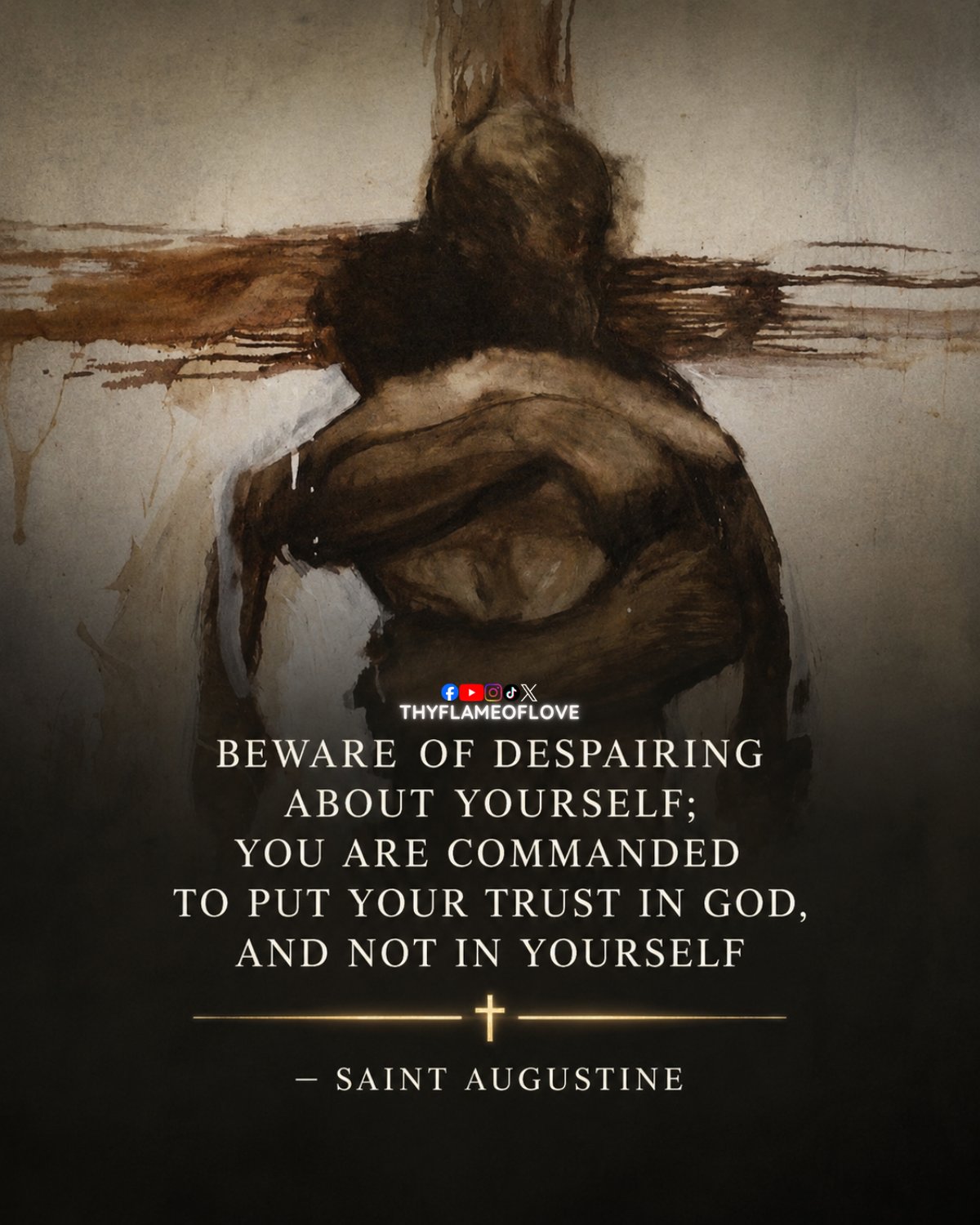
“Beware of despairing about yourself; you are commanded to put your trust in God, and not in yourself"
— Saint Augustine
St. Augustine is reminding us of something many people struggle with today: we can become so focused on our own failures that we forget God's mercy. There is a difference between being sorry for our sins and giving up on ourselves. God calls us to repent, but He never calls us to despair.
When we only look at our weaknesses, mistakes, or past sins, we start believing that everything depends on us. We think we have to fix ourselves before God can love us. But Scripture tells us to put our trust in the Lord with all our heart (Proverbs 3:5). Our hope is not in our own strength. Our hope is in God's mercy.
St. Peter denied Jesus three times, yet Christ restored him. The prodigal son wasted everything, yet the Father ran to meet him. The saints became holy not because they trusted themselves, but because they trusted God even after they fell.
The devil wants us to believe we are too broken, too weak, or too far gone. God says, "My grace is sufficient for you" (2 Corinthians 12:9). When we fail, we should not look inward with despair. We should look upward with trust.
Some people never come back to God because they think they have failed too many times. But what if the greatest sin is not falling, but refusing to believe that God can still lift you up?
If someone you know needs to be reminded that God's mercy is greater than their worst mistake, may these words reach them at the right time.
Joyce Coronel retweeted

The first time my cousin went to Mass, her toddler laughed maniacally during the homily
When she tried to shush him, the priest said, "He can laugh!" Then he looked directly at the little boy and said, "This is your Father's house. You are free here."
They're all Catholic now.
Joyce Coronel retweeted

Steadfastness in Suffering
1. We are all obliged to suffer in soul and body. Suffering begins at birth and ends at death. "The whole life of a Christian is a cross," (Sermon 31) says St. Augustine. For this reason we have to develop the virtue of patience. “Let patience have its perfect work,” says St. James, “that you may be perfect and entire.” (James 1:4) If we are to be perfect, we must accept sufferings and trials from the hands of God and offer them to Him in a spirit of harmony with His holy will. In this way all our actions become valuable, for they are acts of reparation and of love which will be rewarded in Heaven. Both our joys and our sorrows are sanctified if we offer them to God, Who arranges everything for our own good. The Saints longed to suffer because they loved God and knew that suffering is the only true way in which we can prove our love. Suffering is the best medicine for the soul, for when it is endured with patience it purifies us and prepares us for Heaven. "If God does not punish you for your sins," says St. Augustine, "it is a sign that you are no longer counted among His sons." (Lib. de Pass., c. 5.) “Whom the Lord loves, he chastises,” St. Paul writes, “and he scourges every son whom he receives.” (Heb. 12:6)
Suffering is in fact a gift from God. It reminds us that we have not been created for this world, but for Heaven, in preparation for which we must carry our cross with patience in the footsteps of Jesus. No matter what we do, we must suffer. Either we bear trials patiently and gain an increase of merit, or we rebel against them and gain no merit at all. When we suffer, let us think of the two thieves, both of whom were tortured in the same way. But the good thief accepted his torments with patience in reparation for his sins and was saved, while the bad thief rebelled against his sufferings and was most probably damned forever.
2. When we feel depressed, or when we are tempted to strike out angrily against human injustice and misunderstanding, there are two considerations which should help us to be patient. (1) The first is the reflection that everything comes to us from God or is at least permitted by Him. Why should we rebel against the will of God? Jesus was innocence itself, yet He willed to suffer for love of us. Are we unwilling to suffer for love of Him? (2) The second is the realisation that we are sinners who have offended God many times and deserve to be punished. It is necessary to accept patiently all the sufferings which God sends us in expiation of our sins. “We are receiving what our deeds deserved.” (Luke 23:41) Above all, we ought to resolve never to give way to anger in word or in deed when we are offended. On these occasions we should wait until we have calmed down and have asked God for peace of mind. Before we do anything we need time for reflection and prayer. If we act in this way we shall not have to be sorry afterwards. Patience can help us to achieve anything and will eventually help us to gain Heaven.
3. “Christ has suffered for you, leaving you an example that you may follow in his steps.” (I Peter 2:21)---Antonio Cardinal Bacci