

@JonathanRaym
Account based inUnited Kingdom
About this account
- Account based in
- United Kingdom
- Connected via
- United Kingdom App Store
Account-level information from X, not a live location or the device used for a specific post.
Welsh. Investment Manager at @QuilterCheviot. Farmer's son and sports lover. Tweets not investment advice
Berkshire
Joined February 2012
- Tweets11.7K
- Following642
- Followers1.1K
- Likes12.2K


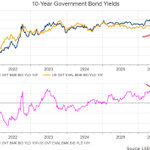


Today’s better GDP data and lower bond yields (10-year down 0.1%) underline Kallum’s conclusion here.
Counterintuitively, stronger growth should bring down yields due to less need to raise taxes and choking the economy.


Encouraging UK growth figures this morning. Quoted in the Sun.
thesun.co.uk/money/40687256/…

“The other problem is that much of this decarbonisation was achieved through deindustrialisation. In the face of higher energy costs and rising environmental taxes, many manufacturers relocated overseas”
Chickens coming home to roost after 20 years of bad policy.

FOOL BRITANNIA by @EdConwaySky
While many countries face higher energy costs due to the events in the Middle East and Russia, few have seen quite as big a spike as Britain has. Industrial power costs are comfortably higher than in most developed nations, with domestic costs not far behind. To some extent, this is a function of bad luck and geopolitics. Britain is particularly dependent on natural gas to provide the critical baseload power for its electricity, not to mention much of its domestic heating.
But higher energy costs are also the product of policy. Britain pushed faster and further towards net zero (the goal of diminishing carbon emissions to close to nothing in net terms) than most of its peers. The ambition, held by Labour and Conservative governments, was that the UK should be the global leader in decarbonisation – the flag-bearer for net zero. In one respect, the enterprise was a stunning success – Britain is one of the fastest-decarbonising major economies in the world.
The main catch in – and the cardinal sin of – the make-things-cheap economy is how it affects energy bills. For all that Boris Johnson and Ed Miliband insisted (and as far as I can tell, sincerely believed) that renewables would mean lower costs, the opposite has happened. Unlike solar power, the cost of which fell precipitously as the Chinese mastered the mass production of arrays, wind power has remained comparatively expensive. And so Britain’s ambitious offshore wind programme happened largely thanks to a complex web of subsidies and price guarantees. Those interventions will lock in higher power costs in this country for years.
There is a point – most likely a decade and a half in the future – at which the savings from net zero (less spent on gas and fuels) should outweigh the costs of building all the necessary infrastructure. But for the time being, the policy is expensive – nearly £30bn a year for the next five years, which is the equivalent of an extra 5p on the basic rate of income tax. One of the main reasons net zero is becoming so controversial (and will likely get more controversial) is that the majority of those costs end up on consumer bills.
The other problem is that much of this decarbonisation was achieved through deindustrialisation. In the face of higher energy costs and rising environmental taxes, many manufacturers relocated overseas. Indeed, more than half of Britain’s carbon footprint is now accounted for by imported goods. Paradoxically, the more steel mills and chemicals plants shut down, the better the UK’s environmental credentials, since net zero plans ignore the embedded carbon in our imports and focus solely on what is puffed out of domestic flues and chimneys.
Cover art by Doug Chayka

Simon hits the nail on the head here. The incentives skewing the wrong direction as for most people, there assets but be more liquid as they get older not less.

The combination of pension pots being brought into scope for IHT from next April (Reeves) and this proposal from the Leader of the Opposition would have the impact of massively increasing the incentive to hold property wealth over more liquid and (historically) higher return financial assets.
Not sure looking at the current breakdown of UK wealth (and comparing to the US) that is the direction policy from both main parties should be leaning.
You either get very, very bullish on equity release, or conclude that end of life assets are going to be very illiquid and will amplify financial planning/ social care challenges.

Lloyd made the point that it's not oil per se that's the issue for inflation, but refined oil products ie diesel and jet fuel.
The gasoil price (benchmark for refined oil products, blue line) has risen a lot more than oil (white line) due to shortage of refining capacity.


Taking Stock: After The Bell 🛎️
Episode 71: Bonds Behaving Badly 📉
Hughesy and I are joined by Premier Miton's Lloyd Harris to discuss rising bond yields, sticky inflation, energy markets, AI-driven borrowing and the opportunites in fixed income.
quiltercheviot.com/news-and-…

Taking Stock: After The Bell 🛎️
Episode 71: Bonds Behaving Badly 📉
Hughesy and I are joined by Premier Miton's Lloyd Harris to discuss rising bond yields, sticky inflation, energy markets, AI-driven borrowing and the opportunites in fixed income.
quiltercheviot.com/news-and-…
Also on YouTube as a video or on Apple Podcasts and Spotify as audio only.
youtu.be/Xn1STI5SY4w?si=IWT9…
In the triple lock discourse, this is perhaps one of the most important points in a thread of important points:
The state pension is not meant to provide a “decent retirement” in and of itself.
That would be truly unaffordable.

Every pensioner deserves a "decent" retirement.
But the agreement of the welfare state isn't universal basic income! It has always been to provide a "basic foundation" so that "individuals may build freely upon it".
More: 🔗 thetimes.com/article/152ddcf…

It might not have escaped your notice that interest rates and governmnet bond borrowing costs have been going recently (top pane)
Encouragingly though, UK yields have gone up by less than US yields (bottom pane), so this is less a UK-specific issue.


Jonathan Raymond retweeted

This is increasingly (for me) the most relevant chart for understanding UK vs US macro.
2/3rds of US household wealth sits in financial assets. In the UK, just 1/3rd.
If there is a large, positively correlated asset price correction then US consumption spending is likely to see an outsized hit. But the recent history of Britons pouring free cash flow into low return assets (cash & property) has been a UK growth headwind.

🔔Taking Stock - After The Bell 🔔
Episode 70: Why Are Americans Buying Our Sheds?
We discuss the improving outlook for UK commercial property, the blockbuster takeover of Segro, house prices, gilt yields and developments in the AI space
quiltercheviot.com/news-and-…

Also available as a video on YouTube (below or as an audio on Apple Podcasts and Spotify
youtu.be/O0mr_NxriAE?si=tKws…
Headlines galore about bond yields going higher. Scary stuff.
But when the noise is this loud, it usually marks a peak in the narrative.


Full @FT article here with some interesting charts.
giftarticle.ft.com/giftartic…

Jonathan Raymond retweeted

On the day that 10-year gilts hit an 18-year high, Cabinet ministers were told that 'cutting costs of essentials like childcare and mortgages' was one of their three priorities. But there are few signs the govt understands what is making mortgages more expensive (1/?)


