

Research Economist @bundesbank (previously @bankofengland). PhD from @EUI_ECO. All views are my own
Frankfurt
Joined December 2013
- Tweets301
- Following439
- Followers255
- Likes57


Johannes Fischer retweeted

Ich habe von Freunden in Deutschland Fragen zur düsteren Finanzprognose bekommen. Es ist beunruhigend, wie wenig die prekäre Lage in der breiten Öffentlichkeit verstanden wird.
Also: Deutschland steuert auf eine massive Haushaltsklemme zu. Die Kosten für Renten, Aufrüstung und die Bedienung der rasant wachsenden Staatsschulden explodieren, während es Wachstum nur noch auf Pump gibt. Schlimmer noch: es gibt gar keinen offiziellen Plan, wie die Wirtschaft wieder wachsen könnte.
Zwischen 2027 und 2030 dürften die jährlichen Ausgaben für diese drei Posten um 145 Milliarden Euro steigen, die Steuereinnahmen des Bundes hingegen nur um 43 Milliarden Euro. Bis 2030 würden sie damit 98 % (sic!) der gesamten Bundessteuereinnahmen verschlingen.
Allein die jährlichen Zinszahlungen steigen voraussichtlich auf 81 Milliarden Euro und könnten bei anhaltend hoher Neuverschuldung bis 2035 auf über 110 Milliarden Euro klettern.
Obwohl der Bund zwischen 2026 und 2030 neue Schulden von mehr als einer Billion Euro plant – einschließlich der Sondervermögen – klafft in der Finanzplanung für 2030 weiterhin eine Finanzierungslücke von 48 Milliarden Euro.
Dieser immer engere finanzpolitische Spielraum dürfte Deutschlands Fähigkeit, die Ukraine zu unterstützen, zunehmend einschränken – ausgerechnet während Kyjiws und aber auch EUs Finanzbedarf wächst (und wachsen wird).
Gerade erst wurde bekannt, dass der Ukraine 2027 weitere 70 Milliarden Euro fehlen – zusätzlich zu den bereits zugesagten Hilfen. Sollte Deutschland davon wie immer rund ein Viertel schultern müssen, entspräche das weiteren 17,5 Milliarden Euro an Finanzierungsverpflichtungen oder Risiken. Noch ist aber die Finanzierungsform nicht beschlossen.
Die eigentliche Frage ist gar nicht mehr, ob Deutschland sich diese Verpflichtungen leisten kann, sondern welche Ausgaben reduziert werden müssen – oder wie viel mehr Schulden Berlin noch aufnehmen will. Und - bei der miserablen Wachstumsperspektive - wie lange die Bonität so erhalten bleibt.
🤖 Made with AI


Johannes Fischer retweeted

Slides for a new paper are now on my site (and below).
"Shockingly simple monetary shocks".
Joint work with Mu-Chun Wang.
Abstract: We identify monetary policy shocks by imposing that they produce a positive, monotonically declining path for nominal rates. We impose no restrictions on other variables, nor do we rely on external information. Nonetheless, this produces IRFs closely resembling those produced using high frequency instruments, with no price puzzle. We justify these restrictions by showing both that they are satisfied in a benchmark medium-scale DSGE model, and by showing that they are satisfied under optimal policy in simple models. Our shocks produce a large, immediate drop in the price level. Thus, the rapid response of prices to monetary shocks observed in recent studies is not an artefact of high frequency identification.

Johannes Fischer retweeted

On today's FT- Gold has replaced US Treasuries as world’s top reserve asset(!) Fantastic excuse to advertise our new WP "Fool's Gold" with the great @KaiArvai @NunoCoimbra (both sadly✝️on X) where we rationalise the rise of gold via theory&empirics👉cepr.org/publications/dp2157… 1/6


Johannes Fischer retweeted

"Well, I’m glad that the EC has a pre-prepared “toolbox” of terrible ideas so that Member States don’t have to come up with terrible ideas all on their own."

How to turn a price shock into inflation. grumpy-economist.com/p/how-t…

Johannes Fischer retweeted

The famous Diamond–Dybvig (DD) model sees bank runs as panics. Evidence from 4,000+ historical runs says otherwise. Another empirical nail in the DD coffin. (1/2)

New paper on bank runs with Correia and Luck:
"Bank Runs With and Without Bank Failure"
Questions:
- What are the determinants of runs?
- When do bank runs result in bank failure?
- Can runs trigger the failure of healthy banks and amplify small shocks into large crises?
- Are runs themselves the initial cause of financial distress or are they a symptom of deeper fundamental solvency problems in the financial system?
What we do:
- Apply LLMs to historical newspapers to uncover over 4,000 runs on individual banks in the pre-FDIC US banking system from 1863 to 1934. Capture the most famous runs (Bank of the US
- Merge data on runs and other bank-level events discussed in newspapers (suspensions, failures) to bank-level fundamentals (harder than it sounds!)
What we find:
(1) Runs are considerably more likely in weak banks, but can also occur in strong banks, especially in response to negative news about the real economy or the broader banking system.
(2) However, runs typically only result in failure for banks with weak fundamentals [see figure below]. Strong banks survive runs through various mechanisms, including interbank cooperation, equity injections, public signals of strength, and suspension of convertibility
(3) At the local level, poor fundamentals necessary for runs to translate into large declines in lending. Moreover, bank failures (with and without runs) translate into substantially larger declines in deposits and lending than runs without failures.
Overall takeaways:
- Poor fundamentals are key for whether runs pass through into failure and have severe consequences for the broader economy.
- The findings temper the view that small shocks can result in large jumps to bad equilibria via runs on demandable debt.
Full paper here. Comments welcome. Given the methodology and evolving AI tools, we expect to make refinements to the runs database over time. Any input is welcome.
static1.squarespace.com/stat…

Johannes Fischer retweeted

👇 I am biased (by more than the BoE’s forecasts!) but do give the Bank’s new Forecast Evaluation Report, written by my excellent colleagues, a read

Worth getting to grips with the Bernanke-inspired analysis of @bankofengland inflation forecasting performance. A useful statement.
@NIESRorg @EconSteveM
@HPesaran @CamEcon
@MMF_research @CFMUK
bankofengland.co.uk/paper/20…
Johannes Fischer retweeted

Decline is a choice, not a fate.
Today, with @LuisGaricano (@LSEnews) and Bengt Holmström (@MIT), we launch The Constitution of Innovation - a manifesto for a new European renaissance.
We make 6 concrete proposals.
Read them at constitutionofinnovation.eu/
#Europe #Innovation 1/6


Johannes Fischer retweeted

📢 Hiring for a fully funded #PhD position in Behavioral #Macroeconomics at Uni Groningen, NL.
Work on expectations, biases & policy with lab/survey experiments & DSGE models with me, yanxu-econ.github.io/, @chrisvdkwaak
Start: Sept '25
Deadline: 25 May
🔗 Apply: rug.nl/about-ug/work-with-us…
#econjobs #econtwitter #economicscareers #EconPhD #RAJobs @EconJobs_com @Econ_jobs_ @FindAPhD @Studyportals @econ_ra

Johannes Fischer retweeted

Sharing an updated @BoE_Research version of my working paper with Niki Anesti & Vania Esady showing that food prices matter most for household inflation expectations. Many new results including uncovering persistent, non-linear, and asymmetric dynamics.
bankofengland.co.uk/working-…


Johannes Fischer retweeted
Also, one should only "look through" supply shock inflation when inflation expectations are well anchored. That is not case for U.S. public right now given the scarring from the pandemic inflation. U.S. public is far more allergic now to inflation. I will expand on this in newsletter. Sign up here: macroeconomicpolicynexus.sub…
Johannes Fischer retweeted

Huge demand shock as perceived by markets:
- Bund surge is matched by risk-free OIS rate
- higher real rates and higher inflation compensation matter
- term premium surge due to higher duration risk; slight increase in swap spread; no change in credit risk indicators
- Euro up

Die Euro-Aufwertung (aber auch Aktienmarktreaktion und Zinskurve) nach der Einigung von Dienstag sprechen für höhere Wachstumserwartungen als Faktoren hinter dem Zinsanstieg auf Bunds. In jedem Fall muss man genauer hingucken. @MartinGreive
Danke @farzado
👇🏻👇🏻
Johannes Fischer retweeted

In this thread, I will explain why we are much closer to war with 🇷🇺 than most people realize and why our time window for rearmament is shorter than many believe. In my opinion, we have at best 2-3 years to re-establish deterrence vis-à-vis 🇷🇺. Here's why 👇 1/20



Johannes Fischer retweeted

It's high time to have another look at interesting papers like this one!
"To what extent are tariffs offset by exchange rates?" by Olivier Jeanne and Jeongwon Son John.
Article in the J. Int. Money Finance:
sciencedirect.com/science/ar…
Working paper:
econ2.jhu.edu/jobmarket/2023…

Johannes Fischer retweeted
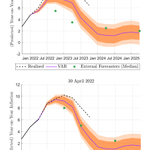
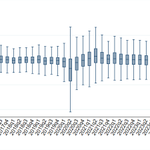
Happy to report (@ChrisGiles_ & others interested) that we have now published the underlying database containing key data outturns, forecast vintages, and resulting forecast errors (link in next tweet). Our paper has also been updated

🧵SWP 1078 by Derrick Kanngiesser (BoE) + Tim Willems (BoE) develops a systematic approach for central banks to leverage past forecast errors in a way that generates insights on the structure and functioning of the underlying economy…bankofengland.co.uk/working-…

Johannes Fischer retweeted

Europe needs to wake up NOW:
The US races ahead with regulatory flexibility and a huge ($500bn!) investment in AI infrastructure.
AI is a horizontal technology that will serve as the basis of all future R&D. Without AI, Europe will fall behind in innovation in every sector.

Announcing The Stargate Project
The Stargate Project is a new company which intends to invest $500 billion over the next four years building new AI infrastructure for OpenAI in the United States. We will begin deploying $100 billion immediately. This infrastructure will secure American leadership in AI, create hundreds of thousands of American jobs, and generate massive economic benefit for the entire world. This project will not only support the re-industrialization of the United States but also provide a strategic capability to protect the national security of America and its allies.
The initial equity funders in Stargate are SoftBank, OpenAI, Oracle, and MGX. SoftBank and OpenAI are the lead partners for Stargate, with SoftBank having financial responsibility and OpenAI having operational responsibility. Masayoshi Son will be the chairman.
Arm, Microsoft, NVIDIA, Oracle, and OpenAI are the key initial technology partners. The buildout is currently underway, starting in Texas, and we are evaluating potential sites across the country for more campuses as we finalize definitive agreements.
As part of Stargate, Oracle, NVIDIA, and OpenAI will closely collaborate to build and operate this computing system. This builds on a deep collaboration between OpenAI and NVIDIA going back to 2016 and a newer partnership between OpenAI and Oracle.
This also builds on the existing OpenAI partnership with Microsoft. OpenAI will continue to increase its consumption of Azure as OpenAI continues its work with Microsoft with this additional compute to train leading models and deliver great products and services.
All of us look forward to continuing to build and develop AI—and in particular AGI—for the benefit of all of humanity. We believe that this new step is critical on the path, and will enable creative people to figure out how to use AI to elevate humanity.
Bundesbank ditches X before it ditches fax

We have decided to discontinue our activities on X. This account will continue to exist only as an archived account. We remain active on LinkedIn, Instagram, Facebook and YouTube. You are also invited to visit our website and find out all you need to know about the Bundesbank. #goodbyeX
Johannes Fischer retweeted

Treasurys are on sale. It used to be the case that if you compared US Treasurys to other securities, the US Treasury would always be expensive, compared to:
1/ foreign bonds: actual Treasury were typically more expensive than synthetic US Treasury constructed from e.g. a German Bund using currency risk hedges (i.e., the yield on Treasury lower than yield on synthetic Treasury).
2/ corporate bonds: actual Treasury were typically more expensive synthetic US Treasury constructed from AAA corporate bonds using credit risk default swaps (i.e., the yield on Treasury lower than yield on synthetic Treasury constructed from AAA corporate).
3/swaps: actual Treasury were typically more expensive than synthetic US Treasury position using swap (i.e., yield on Treasury lower than swap rate or positive swap spread).
All of these yield spreads have now flipped signs at longer tenors. Actual Treasurys are now typically cheaper than the synthetic versions (or, equivalently, actual yields are higher than synthetic yields).
You can construct 'plumbing' explanations for each of these, but taken together, they suggest that the increased Treasury supply has pushed down the convenience yields investors get from the safety and liquidity of US Treasurys.
As global government bond supply increases and central banks have stopped buying, US Treasurys are now cheap relative to equivalent instruments.
Demand for the safety and liquidity of Treasurys is downward sloping. That was always a key problem with the r<g view. As you increase supply, the convenience yields disappear (see, e.g. @AtifRMian , @ludwigstraub and Sufi, 2024).
🧵 with some pictures.