
Postdoc at @UniofOxford. Exploring how the melanocytic lineage can go wrong. Development | Pigmentation | Melanoma.
Oxford, England
Joined August 2021
- Tweets19
- Following162
- Followers15
- Likes123
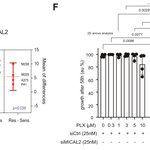


For years β-catenin has been a paradox in melanoma - some studies say it protects, others say it drives the disease. In our new paper published in Cell Death and Differentiation, we show it's firmly on the tumour's side, and we found the effector doing the work: MICAL2. 🧵
β-catenin itself is famously "undruggable." MICAL2 is an enzyme - its activity can be targeted. That makes it a real therapeutic opening in β-catenin-driven melanoma!
Paper: nature.com/articles/s41418-0…
Huge thanks to all my coauthors from the Larue lab at @institut_curie, to our collaborators and to our funders
Why does stress turn hair grey? New preprint from the Larue lab IDs BRN2 (POU3F2) as a key guardian of melanocyte stem cells. Without it, cells enter a senescence-like state instead of replenishing the niche — draining the stem cell pool!
doi.org/10.21203/rs.3.rs-102…
Jeremy Raymond retweeted

New preprint from the Hernando lab!
biorxiv.org/content/10.64898…
Combining 3D genome profiling and high resolution imaging we demonstrate how chromatin architecture cooperate with mechanical confinement in conferring melanoma mesenchymal cells high migratory capacities.
Jeremy Raymond retweeted

Richards, Devenport et al. @princetonmolbio show that #melanocyte precursors form dynamic E-cadherin based attachments to surrounding #keratinocytes that stabilize migratory protrusions and sustain long-distance #migration as they colonize the #epidermis. hubs.ly/Q03ZxpHr0
Jeremy Raymond retweeted

#JournalClub 🚨
Basurto-Lozada & Robles-Espinoza @UNAM_MX discuss a study that challenges the prevailing view of a monoclonal origin of cancer by showing that early lesions in mouse models of colorectal cancer are polyclonal.
📖⬇️
bit.ly/3JZfOTR
Jeremy Raymond retweeted

Thrilled to share with you all that our paper is now online in Nature. Many thanks to all the collaborators and mentors throughout the journey 😀
nature.com/articles/s41586-0…
Jeremy Raymond retweeted

We excited for Ben Hogan's (Peter Mac, Uni of Melbourne) talk at #ZDM18! Ben will sharing his lab's work on using sc-genomic approaches to explore lymphatic development, regeneration and the blood brain barrier. Don't miss his talk on Oct. 13th at 14:30 in Boston or online!

Jeremy Raymond retweeted

🧬 August’s most-read #genetics paper shows how a new zebrafish tool (mitfa:Cas9) can reveal the genes driving melanocyte and melanoma development: elifesciences.org/articles/1… #CRISPR
Have a paper people should see? See what our Editors look for: elifesciences.org/about/aims…

Jeremy Raymond retweeted
How do genes that keep melanocytes alive affect #melanoma?
Using a #zebrafish line with mitfa-driven Cas9, researchers show that knocking out survival genes can sometimes fuel more aggressive tumour traits.
elifesciences.org/reviewed-p…

Jeremy Raymond retweeted

Now out in @elife, @SarahPerlee’s Ph.D. work developing a powerful way to knock genes out in #melanocytes and #melanoma cells. She created #zebrafish that allow for efficient CRISPR editing, and found unexpected things about genes required for these cells to thrive: elifesciences.org/articles/1…

Jeremy Raymond retweeted
Cancer cells are notoriously plastic, but what triggers the changes in cell state? In our new @nature paper, Miranda Hunter found that mechanical pressure is a key to this switch. Check it out here: go.nature.com/47iwDm2

Jeremy Raymond retweeted

🧠 Why does glioblastoma always outsmart treatment? In our paper, we identified proneural–mesenchymal hybrid glioblastoma cells that are resistant to therapy and dependent on nuclear import.
doi.org/10.1093/neuonc/noaf1…
Short walkthrough below. Let’s dive in! 🧵 (1/9)

Jeremy Raymond retweeted

Nature research paper: Targeting GRPR for sex hormone-dependent cancer after loss of E-cadherin
go.nature.com/449wj6V