

I work for NASA exploring the Solar System, occasionally get paid to write D&D adventures, and whitewater kayak when I can.
Joined April 2011
- Tweets617
- Following251
- Followers230
- Likes484



I was just glad to not be working in my home office in my basement.

At the entrance to Valentine Cave, @NASAGoddard's Jared Espley and Yasmina Martos take one final set of measurements--for this worksite, anyway! Jared, Yasmina, Dave, and the rest of the magnetism team will investigate at least 6 more lava tunnels this week.
4
Jared Espley retweeted
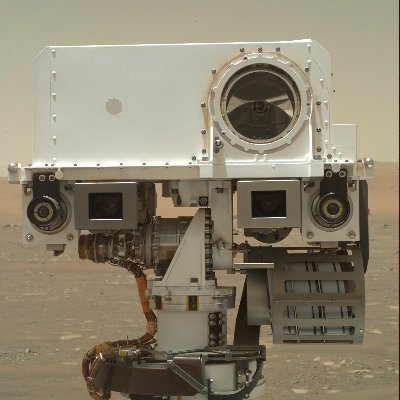
Truly fascinating. I zoomed in with my Mastcam-Z camera on a Phobos solar eclipse. This detailed video can help scientists on my team better understand the Martian moon’s orbit and how its gravity affects the interior of Mars, including its crust & mantle. go.nasa.gov/3OqRl73
Excellent thread about true colors of objects in our Solar System. Scroll through to see the other objects.

The true colors of the solar system, a short thread. * First, let's start with the Sun. Can we all agree it's white to the eye?
* inspired by James O’Donoghue & Marina Koren, with some color corrections by me.

Jared Espley retweeted

"We remember Piers as an exceptional scientist and leader, but most importantly as an inspiring human being."
Piers Sellers is best known for being an astronaut, but his true legacy was in Earth science, a big focus during his career at Goddard. nasa.gov/feature/goddard/201…

Meet our next #Cygnus spacecraft, the S.S. Piers Sellers, launching to the @Space_Station Saturday, 2/19 from Wallops Island, Virginia. Learn more: ms.spr.ly/6012Zfioq
Jared Espley retweeted

NASA SENIOR REVIEW IS IN! Getting excited for Extended Mission 5 (EM5). @MAVEN2Mars will be observing #Mars during the peak of #solarcycle25 AND dust storm season 🤯🚀⚡️🌪 #PI_daily

Jared Espley retweeted

🧵One of my very favorite #JWST science stories concerns the mirror gold. This seem like a good time to tell it. As with all good stories, it has been told before, but I think it is worth a rant. And at the end, there will be a twist. 1/

Jared Espley retweeted

🚨 Interested in a PhD in space physics? 🚨
I am advertising a PhD project exploring the impact of complex turbulent fluctuations on Earth's solar wind - magnetosphere interaction using spacecraft observations and numerical simulations!
More info here 👉 imperial.ac.uk/space-and-atm…

ALT Artists representation of complex turbulent fluctuations in the plasma surrounding the Earth's magnetic field.
Jared Espley retweeted

***PhD offer*** at @PhysicsUoL to study Mars’ ionosphere with myself and the amazing planetary team @uniofleicester with several missions such as Mars Express @esascience, MAVEN @MAVEN2Mars and MRO. le.ac.uk/-/media/uol/docs/st…

Jared Espley retweeted

Hello, old friend. Yesterday our #JunoMission made the first close flyby of Jupiter’s giant moon Ganymede in more than 20 years, and the first two images have been received on Earth. 📸 More to come. See details at: go.nasa.gov/3zeoTh6

ALT large portion of the surface of Ganymede, with craters and long fissures visible

ALT close-up of surface with craters and linear features
Jared Espley retweeted

Stratigraphy and Volumes of the Units Within the Massive Carbon Dioxide Ice Deposits of Mars doi.org/10.1029/2020JE006767 Radar soundings measurements of the thickness, extent, and volume of alternating H2O and CO2 ice units help constrain the last the past 500 kyr of climate history

Jared Espley retweeted
Where are Mars’ Hypothesized Ocean Shorelines? Large Lateral and Topographic Offsets Between Different Versions of Paleoshoreline Maps doi.org/10.1029/2020JE006486 The placements of hypothesized shorelines on maps are both inconsistent and inaccurate with offsets in excess of 1000 km

Jared Espley retweeted

Here's how the Sun's magnetic field intensity, B, varies from minutes to millennia.
This uses data from spacecraft, Victorian-era compasses, sunspot records, tree trunks and ice cores.
Jared Espley retweeted
Impact of the 2018 Mars Global Dust Storm on the Ionospheric Peak: A Study Using a Photochemical Model doi.org/10.1029/2021JE006823 The altitude of the ionospheric peak increased by 7–10 km over 22–26 days during the onset phase of the global storm in 2018.

Jared Espley retweeted
Jupiter’s Great Red Spot: Strong Interactions With Incoming Anticyclones in 2019
doi.org/10.1029/2020JE006686 Anticyclones interacted with the Great Red Spot, eroding and distorting it. The interactions are not necessarily destructive but can even transfer energy to the Great Red Spot

Jared Espley retweeted
The Physics of Falling Raindrops in Diverse Planetary Atmospheres doi.org/10.1029/2020JE006653… a wide range of planetary conditions, only raindrops in a relatively narrow size range can reach the surface from clouds. See also press release at news.agu.org/press-release/a… #agupubs

Jared Espley retweeted

Love it. Took me a while to find @TheRealBuzz...
Sometimes it is so hard to get a good appreciation of the spatial and temporal scales of nature. Good job, @JPMajor! #findBuzz

Boulders of all sizes on the surface of the asteroid Bennu, imaged by @OSIRISREx two years ago on March 22, 2019. I inserted a Buzz Aldrin for comparative scale size.

Jared Espley retweeted
INTERSTELLAR OBJECT ‘OUMUAMUA IS LIKELY A PIECE OF A PLUTO-LIKE PLANET A new study resolves the not-quite-comet-like character of a strange visitor from beyond our solar system news.agu.org/press-release/i… A joint press release about two papers just available at JGR: Planets! #AGUpubs


So proud of my colleagues who made this discovery. Some discoveries are easy if you're in the right place but this one required very careful analysis of unexpected data and dogged persistence in getting it peer reviewed and published.

The #JunoMission to Jupiter has made an unexpected discovery about a different planet – Mars. Juno scientists have found evidence that dust from the Red Planet may be the source of a luminous sky phenomenon known as the zodiacal light: missionjuno.swri.edu/news/ju…
1
Jared Espley retweeted
A New Large‐Scale Map of the Lunar Crustal Magnetic Field and Its Interpretation doi.org/10.1029/2020JE006667 Magnetic anomalies are consistent with iron from the Imbrium impactor mixed into ejecta and deposited downrange in groups radial to the basin and concentrated in its antipode

Jared Espley retweeted
Magnetic Induction Responses of Jupiter's Ocean Moons Including Effects From Adiabatic Convection doi.org/10.1029/2020JE006418 Electrical conductivity variations change the magnetic fields by >1 nT. Europa Clipper and JUpiter ICy moons Explorer (JUICE) missions can resolve that!
