

Canon Theologian & Chair of Westminster Abbey Institute. Visiting Prof KCL. Bye Fellow, Clare College, Cambridge.
Joined February 2013
- Tweets10.1K
- Following1.8K
- Followers2.6K
- Likes20.4K




Jamie Hawkey retweeted

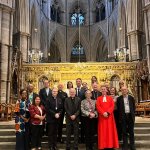
…and while ambitiously trying to attend everything…but failing, I was at least able to catch up with two very dear brothers, in @WAbbey’s Canon @Jamie_Hawkey and @IOCS_Cambridge’s Father Dragos Herescu, at the Abbey at the tail end of this year’s Anglican and Eastern Churches Reception.

Jamie Hawkey retweeted
Following the cancer diagnosis of Pope Leo XIV, the Archbishop of Canterbury, the Most Revd and Rt Hon Dame Sarah Mullally, has invited Anglicans to join with Catholic sisters and brothers in prayer for the Holy Father.
#Anglicans

My daily prayers remain with Pope Leo XIV following his cancer diagnosis, and I assure the Holy Father and the Catholic faithful of the prayers of the Church of England and the Anglican Communion.
I pray that the Holy Spirit – the Comforter, Healer and Giver of Life – will sustain him in the days and weeks ahead, and that his recovery will be swift and complete.
Jamie Hawkey retweeted

Pulling for @Pontifex, the most thoughtful and impactful moral leader on the planet today. The world, not just Catholics, need his voice, his kindness, his decency and his wisdom.

Pope Leo XIV's surgery confirmed that he has lung cancer and he had the lower lobe of his right lung removed, the Vatican said Tuesday.
The tests confirmed a diagnosis of lung adenocarcinoma, the Vatican said in a medical bulletin after the surgery. It said the diagnosis had been suspected by preoperative tests and was confirmed during surgery.

Jamie Hawkey retweeted

Thank you to Fr Martin Browne from the Vatican Dicastery for Promoting Christian Unity for this brief report summarising our 60th anniversary course - 'Heirs to the treasure of the Gospel of Jesus Christ'. More will follow over the coming weeks!
christianunity.va/content/un…

ALT Participants in the Anglican Centre in Rome's 60th anniversary coursen in October 2026.
Jamie Hawkey retweeted

Anglican Centre hosts course on the history of Anglican-Catholic dialogue
christianunity.va/content/un…


Jamie Hawkey retweeted

The death penalty is inadmissible because it is an attack on the inviolability and dignity of the person. The common good can be safeguarded and the requirements of justice can be met without recourse to capital punishment: effective systems of detention have been developed that protect citizens while at the same time do not completely deprive those who are guilty of the possibility of redemption. #NoDeathPenalty
A fantastic week at the Anglican Centre in Rome leading a 4 day course on 60 years of Anglican/RC dialogue with participants from Canada, US, Ireland, UK, & Nigeria. It’s wonderful exploring the vision & energy of our joint documents with some for the first time! @AnglicanCentre

Jamie Hawkey retweeted

BREAKING: Alarming record-high 58% of anti-Christian harassment in Jerusalem's Old City disproportionately targeted the Armenian Quarter.
In its latest quarterly report (Q3), Incidents Against Christians in Israel, the Religious Freedom Data Center (RFDC) revealed that 45 out of the 77 incidents in Jerusalem's Old City between July and September 2026 occurred on Armenian Patriarchate Street, in the heart of the Armenian Quarter.
The documented harassment includes throwing objects, physical assault, verbal abuse, spitting, threats, defacement of signage, and vandalism.
Among the most disturbing incidents was the pepper-spraying of a 9-year-old Armenian boy by a 22-year-old Israeli Jewish settler in Mamilla, outside Jerusalem's Old City.
During the third quarter of 2026 (Q3), 35 police complaints were filed, most supported by photographic and/or video evidence identifying the crime and suspects. By comparison, 12 police cases were opened during the previous quarter (Q2), 10 of which were subsequently closed.
In conclusion, the RFDC report draws particular attention to the Armenian community's vulnerability:
"Thousands of people walk through its streets on their way to the Western Wall, and it has the highest number of documented incidents of harassment. Regrettably, the [Armenian] community has received no specific attention, response, or action plan to put an end to its suffering."
The Armenian community of Jerusalem traces its origins to the 4th century, maintaining an uninterrupted presence in the Holy Land for 1,700 years. Today, the community numbers approximately 2,000 Jerusalemite Armenians, a population that has dramatically declined since 1948.
Founded in 2023 by Israeli activist and interfaith scholar Yisca Harani, the Religious Freedom Data Center (RFDC) is an Israeli watchdog organization that monitors and archives anti-Christian attacks in Israel.

Jamie Hawkey retweeted

A typically compelling clarion call from @RichmoMusic in @thetimes. As Richard says, the audience for Choral Evensong @BBCRadio3 is "roughly the same number of people who attend all the West End’s theatres in any week". Here's to its next 100 years on-air. thetimes.com/culture/music/a…

Wonderful afternoon celebrating with Rowan Williams as he received his hon DD from @ITOSaintSerge. What an extraordinary blessing he is for the whole oikoumene. There’s a real need for younger Anglican scholars to engage with Orthodox theology, and sustain rich, creative dialogue

Jamie Hawkey retweeted

رسالة جلالة الملك تشارلز الثالث الى فخامة الرئيس @nizarAmede بمناسبة اليوم الوطني العراقي.
كل عام والعراق والعراقيين بألف خير.

Jamie Hawkey retweeted

Pope Leo XIV has just made one of the most interesting distinctions I have heard in the debate about artificial intelligence: a machine may be able to generate an image, but that does not mean it has made art in the human sense. Speaking to artists and cultural figures at the Vatican today, Leo argued that there is an “ontological difference, prior even to the aesthetic, between art and what a machine can generate through statistical calculation based on millions of images created by others.” The use of the word ontological is important here I think.
The Pope is not arguing that AI-generated images must necessarily be ugly, crude or obviously artificial. Quite the opposite problem is rapidly emerging. They can be extraordinarily beautiful. AI can produce an image in seconds which might once have required days of human labour, just as it can produce music, prose and increasingly convincing film. Pope Leo's point is that technical quality does not settle the question because something fundamentally different has taken place.
When Caravaggio painted The Calling of St Matthew, a human being had looked at darkness and light, sin and grace, bodies and faces, and attempted to communicate something he had perceived about reality.
When Bach composed the St Matthew Passion, the music emerged from a particular human consciousness, formed by faith, suffering, intellect, memory, craftsmanship and experience.
A machine experiences none of those things.
It can recognise patterns within an enormous inheritance of human creativity and generate something new from them with astonishing sophistication, but it has never stood before a sunset, buried somebody it loved, experienced shame, fallen in love, prayed, doubted, forgiven an enemy or wondered what happens when we die...and this leads into what I think was the most penetrating part of Leo's address. He warned that in the technological age “the great danger is no longer just censorship, but homogenisation; not merely imposed silence, but the noise that makes listening impossible.” That is very deep and well worth considering carefully.
We have a tendency to imagine the cultural danger of technology as somebody preventing us from speaking. The Pope identifies another possibility: that we become surrounded by such an enormous quantity of instantly generated content, tailored to what algorithms already know we like, that genuinely original human voices become increasingly difficult to hear. The problem would not be silence but saturation, it would be a culture filled with images, words and music which are technically accomplished, immediately consumable and endlessly reproducible, but increasingly detached from the mysterious encounter between one human consciousness and another.
This does not mean that we must become frightened of AI. Leo himself has repeatedly rejected that simplistic conclusion, writing in Magnifica Humanitas that technology is not inherently antagonistic to humanity and can serve genuine human flourishing. Perhaps it does require us to recover a distinction we are in danger of losing. Generating something and creating something may not ultimately mean the same thing & as machines become better at the first, we may finally be forced to think much more seriously about what is uniquely human about the second. vaticannews.va/en/pope/news/…

Absolutely delighted to welcome the inaugural meeting of the Anglican Communion Schools network for a talk and rich discussion on AI, Christian formation and human education, before praying together at Evensong @wabbey @ArchbishopSarah @AnglicanWorld

Jamie Hawkey retweeted

May he rest with the saints.
Fr. Ioustinos, the guardian of Jacob’s Well in the occupied West Bank of Palestine, has passed away.


Jamie Hawkey retweeted

Archbishop of Canterbury meets UN Secretary General and hosts roundtable on protecting healthcare in conflict
[Link below]

Jamie Hawkey retweeted
Europe as we know it, with its spiritual and moral heritage, is rooted in the lives and work of men and women who lived, preached, and shared the teachings of the Gospel. From this heritage, the moral foundations of the world in which we live have been handed down to us: principles such as the primacy of the person and the sacred and inviolable nature of human life; the protection of freedom; the primary importance of the family; care for the poor and those most in need; welcoming the stranger; and respect for the elderly. #ApostolicJourney #France
Jamie Hawkey retweeted
We cannot speak of #Europe without mentioning Christianity. Robert Schuman was well aware of this when he stated: “Christianity has taught that all people are equal by nature, children of the same God, redeemed by the same Christ, without distinction of race, colour, class, or profession. The universal law of love and charity has made every person our neighbour, and it is on this law that social relations in the Christian world have been based ever since.” #ApostolicJourney #France vatican.va/content/leo-xiv/e…
Jamie Hawkey retweeted

Tonight's harvest moon, the first full moon after the autumnal equinox, has a special history. This is what Sir Gawain and the Green Knight calls the 'Michaelmas moon', and in the old Anglo-Saxon calendar it was the herald of winter.
patreon.com/clerkofoxford/po…


Jamie Hawkey retweeted

Remembering Our Martyrs
All Saints’ Church, Peshawar — 22 September 2013
Thirteen years ago, on 22 September 2013, our brothers and sisters gathered at All Saints’ Church, Peshawar, for worship, prayer and fellowship. They could never have imagined that this peaceful Sunday would become a day of profound sorrow.
Children, young people, mothers, fathers and grandparents lost their lives, leaving families with wounds that remain to this day.
Thirteen years have passed, but we have not forgotten. We remember our martyrs, the wounded and survivors, and every family that continues to carry their loss. You are not forgotten, and your loved ones are not forgotten.
As Christians, we hold firmly to the words of our Lord Jesus Christ:
“I am the resurrection and the life.” — John 11:25
And we remember the ancient Christian witness expressed in the words, “The blood of the martyrs is the seed of the Church.” — Tertullian
Those who attacked the church could take lives, but they could not destroy our faith, silence our witness, or take away our hope in Christ.
Today, we pray for Pakistan—a country where every person can worship without fear and live with dignity, security and mutual respect.
May the memory of our martyrs lead us not to hatred or revenge, but to faith, courage, justice, reconciliation and peace.
Our martyrs are gone from our sight, but never from our hearts. May their witness strengthen us, and may God grant eternal rest to the departed, comfort to their families, healing to the wounded, and peace to our beloved Pakistan.
The Most Rev. Dr. Azad Marshall
Moderator/President Bishop, Church of Pakistan
Bishop of Raiwind
22 September 2026
Jamie Hawkey retweeted
The Church does not exist for herself, but to lead every person to an encounter with the Lord. It is therefore not enough to ask whether an activity is well organized, well attended, or has been running for many years. We must ask whether it truly leads people to Christ and brings the Gospel into contact with the concrete realities of people’s lives.