

Japan-focused shareholder activist. Buying stakes in Japanese small caps for ~30c on the $ and engaging with them to realise the embedded value . DMs open
Sydney, New South Wales
Joined April 2012
- Tweets4.5K
- Following966
- Followers6.6K
- Likes3.9K


Pinned Tweet
Japanese stocks are rallying to heights not seen since the 1990s. Back then it was the aftermath of bubble valuations. Now, there is a solid foundation of earnings growth, corporate governance improvements, and increasing cash returns to shareholders! 1/n

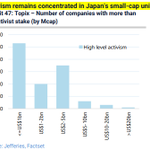
Where do activists find the most opportunity in Japan?
As Jefferies points out, it is in the <$1bn market cap range.
Does this mean this part of the market has been saturated by activist funds?
Hardly.
Jefferies identifies 50-odd >5% positions held by activists in companies <$1bn.
This compares with ~35 positions in companies with $2bn-$5bn market caps.
There are around 3,000 companies in Japan with a market cap <$1bn.
So on Jefferies' data, <1.7% of companies have an activist involved as a substantial holder.
Between $2bn-$5bn market cap there are ~200-250 companies, so ~14%-17.5% have an activist with a substantial holding.
That is 8-10x more penetrated than the <$1bn small caps.
The differential likely becomes even more pronounced when you look at the ~2,500 companies with a trading value <$500m.
If you are a wholesale/sophisticated investor and would like to learn more about the opportunity in small-cap activism in Japan, visit Senjin Capital's website, sign up to our newsletter, and book a call with us.

With the AI-related stocks that have led the market experiencing major volatility, it is timely to look at how the boom has affected the composition of the market indices and market performance.
Will Main of @AntipodesInvest and I discuss this dynamic in this clip from our discussion back in August.
The full video is available on Senjin Capital's Youtube channel.
If you are a wholesale/sophisticated investor and would like to learn more about relatively uncorrelated opportunities outside the major indices, visit our website, sign up to our newsletter, or book a call with us.
Thinking of adopting a sumo show participation requirement for all new hires.

To many investors, speaking with Japanese management teams around corporate strategy can feel like being an audience member at a sumo show attempting to move a professional sumo wrestler!
Sumo wrestlers are not just difficult to move because of their weight.
Their rigorous training builds hugely powerful leg muscles, and a low centre of gravity.
Techniques learned over years leverage these advantages to create what feels like a brick wall to a novice attempting to push through it.
Similarly, investors and fund managers new to Japan are often frustrated by the apparently immovable management culture.
Strategy and policy can seem to lack reason.
Decision making is opaque, and explanations confusing.
To the experienced though, it is all part of the process.
Like sumo wrestlers, trained over years, learning the techniques of those who came before and building their own muscle-memory, experienced Japanese fund managers know how to win.
Activism is a particular school of investing. Much like the hugely creative (and relatively diminutive) Mainoumi, who achieved great success via his use of unconventional techniques against opponents with huge natural advantages, the well-schooled activist has a much better chance of producing strong returns than the average investor.
Individual Alts.co investors on the inaugural Japan investor trip were able to experience both worlds today.
This morning Senjin Capital presented and answered Q&A on the opportunity for shareholder activism in the Japanese stock market.
This afternoon, they attempted to move the immovable!
A huge well done for getting in the sumo ring. But I have to say, better you than me!
If you are a wholesale investor and would like to learn more about the opportunity for shareholder activism in Japan, visit our website, sign up to our newsletter, and book a call with us.
Who could possibly have seen this coming?
To a commodity memory producer, a type of stock that typically trades in a range of 0.5x-3x book value depending on the point of the cycle.
Surely trading at 42x price/book was a great example of market efficiency?
The possibilities of AI are endless, and NAND memory is key to the buildout!
Kioxia was a great buy at any price! Surely?
If you are a wholesale/sophisticated investor, believe valuation matters, like to buy at big discounts to value, and like your investments to have a strong asset base that supports the stock price - then visit Senjin Capital’s website, sign up to our newsletter, and book a call with us to learn more.
Link to full article in the comments.

Japan's Kioxia sheds two-thirds of peak market value as China chip rivals emerge
asia.nikkei.com/business/tec…

Who gave @Channel7 the rights to the Rugby league World Cup in Oz?!
In this day and age, if you miss the start of a game due to other commitments. You should be able to load up the app and watch it from the beginning while it’s still going.
Oh no, not with 7.
Even now the game has been over for an hour, I still can’t watch a replay of the Kiwis v Kangaroos WC opener.
Lift your game Channel 7!

Still waiitng for the replay to be available. @Channel7 is proper cooked.
Massive congrats to the University of Sydney team for winning the CFAS research challenge for the NSW/ACT region.
They’ll go forward to compete in the regional final with the best teams from Australia and New Zealand.
All the student teams put a tonne of work into analysing and presenting their stock pitches on Atlassian.
People who worry about the work ethic of the next generation have not attended events like this.
USYD were the winners in a close fought competition.
Thank you to all our judges, the other CFAS volunteers, and the CFAS staff for making this a great event.
It is one all the students will never forget.

With Sydney prices still not down all that much and stats like this pointing to an all-out crash, might Australian investors start looking a bit further afield for investment opportunities vs the typical bricks & mortar?
If so, I happen to know of an interesting fund for wholesale investors that is focused on buying things in Japan for a lot less than their actual market value...

According to the latest data from @SQMResearch , Sydney auction clearance rates are lower today than at any other time since their records began (ex-holiday season).
They are even lower than the absolute height of the pandemic.
On these numbers the market is in major trouble.

Japan is opening to global capital and management practices like never before.
This is a huge tailwind for public markets investors, as well as PE funds seeking to deploy capital.
Where public markets investors can have an advantage over their PE counterparts, is in buying at the "undisturbed" price - before a premium bid, and buying parts of unloved overlooked companies on-market - rather than in competitive auctions.
Many PE funds do try to avoid competitive auctions, but when you are seeking to deploy large amounts of capital in a specified timeframe, they are often unavoidable.
For wholesale/sophisticated investors wanting to learn more about the opportunities in deeply undervalued publicly-listed companies in Japan, visit Senjin Capital's website, sign up to our newsletter, or book a call with us.

Would you sell your company for $5m if you knew it owned a piece of real estate that was worth $35m? A piece of real estate you already had offers for from developers?
Of course you wouldn't. Why would anyone?
In Japan this kind of thing happens much more often than you would expect, and can result in huge transfers of value to the buyer. It is one reason PE funds have done so well there.
In one specific case we are aware of (a deal from within the last 5 years), a company founder sold his 60% stake in his business to a public company.
He sold at a valuation of around A$5m for the entire company.
The company owns a factory & attached office in central Tokyo, bought decades ago, and carried on the books for A$4.4m.
Today, that land is in a pricey residential neighbourhood, is surrounded by apartment, and is valued at around A$35m.
So why would the founder sell cheaply when he had received large offers for the land from developers?
A few reasons.
Japanese founders tend to be much less motivated by money than elsewhere in the world - or at least by making very large amounts of money.
Greater motivations include a feeling of responsibility for employees, attachment to the company and its operations as part of the fabric of a community the founder has created, and being seen to do right by others & not greedy.
There is also great prestige attached to being employed by a publicly listed company. Mortgage & lease forms will ask if your employer is a public company.
So in this case, rather than sell his employees' place of work to developers and disrupt their lives, the founder chose to sell at a huge discount to a public company, on the understanding that the company would let the company continue to operate as-is.
Note that "understanding" is the typical way of doing business in Japan. Contracts, where they exist, are not detailed. Litigation is very rare. Dispute resolution is via compromise.
Many people will find the founder's actions to be noble and admirable.
Even ardent capitalists, who may think his actions somewhat strange, will respect his right to do with his property as he wishes.
The major issue in Japan is that many publicly-listed company managers, with minimal or no ownership stake, adopt a similar philosophy with how they use company assets!
In the latter situation, managers have an implicit duty (note: not and explicit duty in Japan) to use company assets to the economic benefit of shareholders.
What is perfectly fine, or even admirable behaviour for a private company founder, can appear as negligence or malfeasance for a public company executive.
But, this managerial approach creates many opportunities to buy assets very cheaply in the public markets, and use shareholder activism to realise the embedded value.
What are your views on this dynamic?
If you are a wholesale/sophisticated investor and would like to learn more, visit Senjin Capital's website, sign up to our newsletter, and/or book a call with us.

How does a global equities manager with tens of $billions under management break down the investment universe and identify the stocks it wants to own?
Will Main sets out @AntipodesInvest's process in this clip.
The full video, where we discuss the opportunities in Asia & Emerging Markets is available at the link in the comments.
To learn more about Senjin Capital and the opportunity we see in Japan, if you are a wholesale/sophisticated investor - visit our website, sign up to our newsletter, and/or book a call with us.

The great corporate value unlock in Japanese equities is underpinned by one major ongoing trend.
The continued unwind of cross shareholdings.
Cross shareholdings have entrenched underperforming management teams, insulating them from the market discipline imposed when there is accountability to outside shareholders.
Almost every day new sales of cross holdings are announced as major companies face pressure from institutional shareholders to use their balance sheets more efficiently.
This opens an ever increasing swathe of the market to economic forces, that demand credible policies (and actions) around capital allocation, operational efficiency, and growth strategy.
This is a key reason the opportunity in Japan can persist for an extended period.
Even now, 13 years since the start of Abenomics, probably as many as half of Japan’s public companies are still well insulated by large cross shareholdings, family ownership, or other allegiant holdings such as business associations or foundations.
Every year though, a steady stream of these companies enter a more economically rational world.
This is great news for Japanese stock investors.
To learn more about the investment opportunity in Japan, if you are a wholesale/sophisticated investors visit Senjin Capital’s website, sign up to our newsletter, and book a call with us.
(Full article is in the comments)

Japan firms unwind $56bn in cross-shareholdings, 2nd most on record
asia.nikkei.com/business/mar…

If this is true, these companies are terribly bad at it. Profitability in Japan beer is not exactly great.

Global stock markets have long enjoyed a major tailwind from companies that choose to go private, and that in the process, offer shareholders a premium to do so.
However, this dynamic largely did not exist in Japan - until recently.
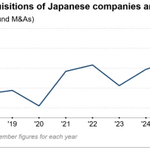
2026 is on track to be the third record year in a row for stock de-listings in Japan.
The number of public companies in the US has roughly halved since the year 2000. In Japan, total listings only started to fall from 2025.
This trend has a long way to run as there are many public companies in Japan that are far better suited to private equity or other private ownership due to small scale, illiquidity, lack of a coherent growth strategy, and poor capital management.
Investors in Japan should benefit from an ongoing tailwind as a growing number of companies continue to go private at strong premiums.

I sat down with @AntipodesInvest PM Will Main to talk about Asian and Emerging Markets, and his investing career.
Will has a wealth of experience and is well worth listening to.
Full podcast is available now on Senjin Capital's page on everyone's favourite video site.