

Director, PLAN Lab @iSchoolUI · NeurIPS'26 & ICML'26 Organizing Committee · GenAI, VLMs, Embodied AI, robots 🤖 | PhD @illinoisCDS 🇬🇷 https://xitter.cf/t.co/i6SwwVvUwK
United States
Joined September 2013
- Tweets432
- Following166
- Followers484
- Likes574




Pinned Tweet
I am honored and grateful to receive an 𝗡𝗦𝗙 𝗖𝗔𝗥𝗘𝗘𝗥 award “𝘚𝘩𝘢𝘱𝘪𝘯𝘨 𝘌𝘮𝘣𝘰𝘥𝘪𝘦𝘥 𝘐𝘯𝘵𝘦𝘭𝘭𝘪𝘨𝘦𝘯𝘤𝘦 𝘛𝘩𝘳𝘰𝘶𝘨𝘩 𝘓𝘢𝘯𝘨𝘶𝘢𝘨𝘦-𝘎𝘶𝘪𝘥𝘦𝘥 𝘐𝘯𝘵𝘳𝘰𝘴𝘱𝘦𝘤𝘵𝘪𝘰𝘯.” 🎉
This project will support our work in the 𝗣𝗟𝗔𝗡 𝗟𝗮𝗯 toward more reliable, self-improving embodied AI systems. I am deeply thankful to @NSF, my students, whose creativity and hard work inspire me, as well as my collaborators, mentors, and @iSchoolUI colleagues for their support. I am also grateful to my former academic home @VT_CS where this work began to take shape. Excited for the work ahead!
Learn more about our lab 👉 plan-lab.github.io
#NSFCAREER #NSFfunded #EmbodiedAI #MultimodalAI #ResponsibleAI #iSchoolUI #PLANLab

#iSchoolUI Assistant Professor Ismini Lourentzou has received a $600K @NSF CAREER award for her project, “Shaping Embodied Intelligence Through Language-Guided Introspection,” which aims to build safer and more reliable AI systems. 🤖
Congrats, Ismini! ▶️ bit.ly/42QoWjn

ALT Assistant Professor Ismini Lourentzou
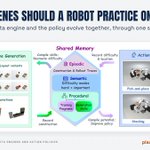
🤔Simulators can generate endless robot training scenes. Which ones help the policy learn?
🤖 Meet CoDA: the data engine and the policy evolve together, driven by the policy's own failures. 🔗
📈 π0.5 on LIBERO-Pro
CoDA generates variants of the source tasks and trains π0.5 on them. After 15 rounds:
25% → 84% (position shifts)
1% → 76% (instruction changes)
+7 and +9 pts over ASPIRE after 15 rounds.
🧵👇 1/7
🔁 The memory transfers
We collected memory while training π0.5, then reused it as-is to train OpenVLA-OFT.
OOD success: 3.8% → 21.1%, with zero new environments generated.
🌱 Failures become lessons. Lessons become skills.
🧵👇6/7

🌐 Project: plan-lab.github.io/coda
🤗 Paper: huggingface.co/papers/2610.2…
Led by @yu_tianjiao with Zhilin Ou, @SivanShen, @xinzhuo_li, @yuanzhel0903, @onkar_s_13, and Fan Wang @AmazonScience 👏
🧵🔚 7/7

Ismini Lourentzou retweeted

I’m rethinking what we should optimize for in robot generalization.
The central question is: what data and pretraining would make a model fast at learning almost any new task? The tasks it already performs, and the demonstrations it was trained on, tell only part of the story.
Consider learning tennis. Coding knowledge is not directly needed to hit a ball. Yet humans bring a broadly developed efficient learning system that supports acquiring unfamiliar skills compared to monkeys. My intuition is that diverse experience improves learning efficiency beyond the specific skills it teaches.
That makes labels like “spatial intelligence” or “cat-level intelligence” less central to me than understanding how to build a more capable learner.
It also changes how I think about System 1/System 2. A sufficiently general world model might eventually handle manipulation efficiently on its own. A world model as System 1, paired with an LLM agent as System 2, could still offer practical advantages in latency, compute, and deployment.
But today’s binding constraint in robotics is generalization. Efficiency becomes much more valuable once the system can reliably adapt.
My current bet is that multimodal foundation models offer broader pretrained knowledge and visual understanding than the video backbones we currently use for WAMs. I suspect a key advantage lies upstream: their training pipelines can draw on a much larger pool of high-quality visual data and egocentric manipulation data, while highly diverse pretraining—whether in language or vision—equips them to learn brand-new tasks efficiently.
Robotics agents offer a way to turn that foundation into learning through interaction, feedback, and experimentation.
That is why prioritizing Agent for Robotics now could be a good idea. I expect rapid progress over the next 6–12 months. The question is: How broad pretraining can make robots substantially faster learners?
Apprecite the insights shared by @RunhanH!

Robotics has spent years scaling demonstration data and model size. What happens when we scale EXPLORATION for robot agents?
We're incredibly excited to share RAX, an agentic robotics system that learns by scaling online exploration.
A coding agent connects directly to the robot’s perception and control APIs, learns from feedback, and builds programs that perceive, plan, and act. The model stays frozen. As exploration scales, the agent improves its programs and builds up reusable skills.
The results:
• ZERO teleoperation or action demonstrations on real robots—from insertion with 0.1 mm clearance and air-fryer manipulation to deformable objects and long-horizon mobile whole-body control.
• +37 percentage points on average over leading learned policies across five simulation benchmarks: RoboDojo, BEHAVIOR-1K, HumanoidArena, DexJoCo’s bimanual tasks, and LIBERO-Pro.
• One framework spanning single-arm, bimanual, dexterous, humanoid, and mobile robots, with new embodiments connected through APIs.
The craziest part: on each real-world embodiment, going from scratch to mastering the tasks took roughly two hours. No teleop. No model finetuning.
We’re open-sourcing the full framework AND every experiment session. We can’t wait to see what people build with it!
Project + sessions: robot-agent-exploration.com/
Paper: assets.robot-agent-explorati…
GitHub: N
Project fully led by @RunhanH and @xczhangxx who are absolutely awesome.
How it works, experiments, and robot videos below 🧵
(1/N)
Dream it. Generate it. Edit it—part by part. ✨
DreamPartGen (#ECCV2026) brings language-guided inter- and intra-part modeling to 3D creation and part editing.
@yu_tianjiao has been on a roll! ⚡
From creating worlds to learning in them… 👀
Ismini Lourentzou retweeted
That’s exactly what we do in VTAM and DexTacWAM at @berkeley_ai: without any tactile pretraining, we transfer world-modeling capabilities learned from vision to the tactile domain—supporting not only grippers, but also distributed tactile sensing on @SharpaRobotics dexterous hands.
Take a look!
VTAM: plan-lab.github.io/projects/…
DexTacWAM: dextacwam.github.io/

🧩 Introducing ELSA3D, a new unified 3D model that generates 3D assets and describes them in language, in one backbone.
🌐 plan-lab.github.io/elsa3D
Led by @Tianjiao_Yu and accepted at #NeurIPS2026 👏
Instead of dumping text + 3D tokens into one flat sequence, sparse Anchor Tokens route each word to the right geometric scale, and an elastic router concentrates cross-modal capacity where semantic–geometric alignment is most needed.
→ SOTA on image-to-3D, text-to-3D, and 3D captioning, at ~half the FLOPs and latency
How can robots understand our intentions, read social cues, and collaborate with us? 🤖 wacv27seai.synoring.ai
Excited to co-organize the 1st Workshop on Social Embodied AI (SEAI) at #WACV2027 with Yuanzhe Liu, @IrohXu, @RehgJim, @mengdixu_, @SynoRing, and the rest of our fantastic organizing team!
Join us in shaping the next generation of socially intelligent agents.
Ismini Lourentzou retweeted

🤝 Call for Papers: SEAI @ #WACV2027, 1st Workshop on Social Embodied AI
Intention & belief understanding, collaborative adaptation, social norms & affect. Speakers incl. Peter Stone & Ziwei Liu.
📅 Deadline: Oct 20 (11:59 PM CDT)
🔗 wacv27seai.synoring.ai/

Ismini Lourentzou retweeted

I am co-organizing this new workshop with Yuanzhe Liu, @Ismini_L, @RehgJim and the team in @SynoRing. Making robots interpret human's social behavior like gaze, gesture, and emotion will be very interesting topics in the near future. This is a nice crossing of Social AI to the HRI community.

🤝 Call for Papers: SEAI @ #WACV2027, 1st Workshop on Social Embodied AI
Intention & belief understanding, collaborative adaptation, social norms & affect. Speakers incl. Peter Stone & Ziwei Liu.
📅 Deadline: Oct 20 (11:59 PM CDT)
🔗 wacv27seai.synoring.ai/
✨ SILSA at #NeurIPS2026. Detailed high-res 3D shapes from a single image, preserving thin structures and holes with just 384 slice tokens.
Led by @yu_tianjiao 👏
🌐 plan-lab.github.io/silsa
🤗 huggingface.co/papers/2610.0…
The world won't hold still for your robot. 🤖
Move the target. Shift the camera. Block the path.
Our LIBERO-MAX benchmark tests what happens when the world changes mid-task. Across all 14 tested robot policies, success drops by 11–26 percentage points.
👀Can your model adapt?

A robot reaches for a cup. The cup moves. Can it still finish?
Introducing LIBERO-MAX: 8,000 paired cases of mid-task change.
Across all 14 tested robot policies, success drops by 11.0–25.7 percentage points.
liberomax.github.io/
1/12 🧵

Had so much fun sharing our work on 3D generative models, video generation, and robot learning! Thank you to IMMERSE for hosting 🙏
🚀Next stop: Capital One! Looking forward to exchanging ideas and exploring collaborations on multimodal reasoning and generation.
#iSchoolUI Assistant Professor Ismini Lourentzou will give a talk on “Generative Models for Interactive Worlds” today from 4-5 PM, as part of the IMMERSE Seminar Series. This event is hybrid. More details here ▶️ bit.ly/4hPFoHC

ALT Assistant Professor Ismini Lourentzou
Ismini Lourentzou retweeted

Thanks for highlighting LIBERO-MAX, @DJiafei! MolmoAct2 leads our 14-policy evaluation with 66.9% success under mid-task changes.
8,000 matched pairs, one question: can robots still finish the task when the world changes?

Even in this latest LIBERO-Max benchmark, we see that MolmoAct2 still generalize gracefully and performed!
liberomax.github.io/

🧩 DreamPartGen (#ECCV2026): semantically grounded part-level text-to-3D via collaborative latent denoising.
Led by @Tianjiao_Yu 👏
🌐 plan-lab.github.io/dreampart…
📄 arxiv.org/abs/2603.19216
Two synchronized latents:
🟦 Duplex Part Latents (per-part geometry + appearance)
🟪 Relational Semantic Latents (text-derived, encoding inter-part functional & spatial relations).
Intra- and inter-part attention handles within-part geometry–appearance alignment and language-guided assembly across parts.
+ PartRel3D: 300K functional/spatial part-relation triplets, 175 categories.