

AI-Native Commercial Real Estate Operator. I help busy professionals invest in commercial real estate. $230M+ built in LA, Houston, and SF.
Get deals in your inbox 👉
Joined March 2009
- Tweets4.6K
- Following782
- Followers4.1K
- Likes4K






Pinned Tweet
As requested:
Underwriting 101 for non-finance folks
If you know how to design or build a building, but don’t how to judge whether a project is a good financial investment or a waste of time, read on!
1.The Proforma
2.Underwriting
a. Market Study
b. Yield Study
c. Profitability Metrics
d. Sources and Uses
3.Fundraising
a. Debt – Local/regional banks vs private lenders
b. Equity - Self Funding vs taking on investors
Section 1 – The Proforma
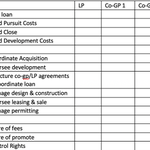
Below is a simplified proforma for a small development project. Don’t let the numbers scare you – we will break it down section by section, using simple examples.
To start, let’s pause and understand the mechanism for value creation in real estate development:
Yield on Cost - Cap Rate = the Development Spread
(Net Operating Income aka NOI / Cap Rate) - (NOI / Yield on Cost) = Value Created
Here’s a simplified example showing the development spread in action–
1.You build a $600k project all cash, lease it up, and clear $60k per year (10% yield)
2.You find a buyer who is willing to pay $1mm for a leased building that clears $60k per year (6% cap)
3.Congratulations, you created $400k of value.
(60k NOI / 6% cap rate) - (60k NOI / 10% Yield on Cost) = 1,000,000 - 600,000 = $400,000
For those who haven’t seen these terms before, they are defined below:
Stabilized Net Operating Income is the annual net income received from your rentals after deducting vacancy costs and operating expenses.
Stabilized Net Operating Income = Rent at full
occupancy (aka Gross Potential) – Stabilized Vacancy - Expenses
Yield on Cost measures the investment yield of the asset to the developer, or how much annual profit the stabilized project will generate relative to its Total Cost.
Yield on Cost = Stabilized Net Operating Income /
Total Project Cost
Cap Rate measures the investment yield of the asset for the end buyer, or how much annual profit the buyer is receiving relative to their Purchase Price.
Cap Rate = Net Operating Income /
Purchase Price
Was this worth the headache? That ultimately depends on what you and your investors are looking for. But here are a few metrics we use to determine that:
Section 2 - Underwriting
Underwriting is the process of running the numbers to gauge the profitability of a potential investment and see if it's worth the brain damage and the risk
Your goal in underwriting is to identify all of the assumptions necessary to make a profitable project that is worth the brain damage and risk it takes to do it.
The first step in underwriting a development project is to calculate the yield on cost and compare it to the cap rate.
Calculating Yield on Cost
The first step for calculating the yield is defining your rent and occupancy assumptions by commissioning a market study. This report should define the boundaries of your market and assess the rents and occupancy within it. If the market study shows there’s a ton of vacancy, then you may want to skip that project.
Once you’ve confirmed the rents and determined you have a reasonable chance at leasing up, the next step is to define how much square footage you can build by commissioning a massing study. This study should determine how much rentable square footage (rsf) you can squeeze out of the site. Generally speaking for infill markets - the more density you can build, the more your property will be worth.
Next, get out in the market and talk to people. The fun part about real estate is that it’s a people business – you have to talk to people to learn the market. Here are some things you’ll need to find out to complete your underwriting:
1.Vacancy and expense assumptions for your asset
type in your market.
2.Total cost to build (including fees).
3.Cap rates for similar projects
With this info in hand, you can finish your underwriting. Multiply rent by total rsf to get gross potential rent, then subtract vacancy and op ex to calculate NOI (Net Operating Income).
Divide NOI by Cap Rate to get your projected sales price, and compare to your all in cost. This is your total projected profit. Is it worth your time? That depends – to learn how to answer this question, please read on below.
Determining if a project is worth pursuing
To determine if a project pencils, you need to consider the following things
1.Who will the investors be (if any) and how long are
they comfortable holding the asset for?
2.How long is the holding period?
3.What are the returns?
4.What is the risk?
Defining your Hold Period
Your business plan can vary dramatically depending on you and your investors goals. Here are the two primary plans:
1.Long term hold – Hold the property for cashflow,
enjoy the tax benefits, and ride out long term rent
growth. This is best for HNW folks who don’t need
their equity back anytime soon. This maximizes
total proceeds.
2.Merchant build – Sell the property as soon as it’s
leased up (or sooner). You will be selling for a lower
price / ft than if you hold it a long time, but you will
get your money sooner.
Calculating the returns
Once you know your goals, here are 3 metrics you can use to gauge the profitability of your project.
1. Cash on Cash: Net Cashflow / Total Investment.
This is your actual cash yield from the asset. You can
compare this to owning a bond – it’s the actual %
return you are earning on your money while it’s tied
up in the asset. Depending on your situation, you
may be able to include tax benefits in the numerator,
further driving cash on cash for your investment.
2. IRR: total cashflows annualized over the hold
period. The shorter your hold, the higher your IRR.
Shortening hold period drives IRR more than
increasing sales proceeds does. Most Real Estate
Private Equity Firms derive their compensation from
how well they perform on this metric.
Most investors want to see 16%+ IRR for
development projects, but some huge developers
find investors willing to accept as low as 12% for
trophy assets.
3. Equity Multiple: Total Distributions (net cashflow
+ proceeds from sale) / Total Investment. Generally
speaking, the longer you hold the larger your
multiple will be. Fully leased and seasoned
properties generally command a higher price per
square foot than newly delivered product because
they have less lease up risk. Rents also tend to go up
over the hold period, and each $1 of net rent can add
$10 or more in sales value. (Remember, NOI / Cap
Rate = Sales Price)
Most investors want a 1.4 minimum multiple, or else
it’s just not worth the brain damage and the risk.
You can compare this figure to 10 year treasuries.
Most investors want to earn a spread over
the treasury (T+ 1% at least) to make development
worth the risk.
For long term holds, you are focused on maximizing
cash on cash return and total multiple.
For merchant builds, you are focused on IRR subject
to a minimum multiple.
Risk analysis
Here are some questions I like to ask in order to determine if the returns are worth the risk
1.How much is my total investment?
2.How conservative are my underwriting assumptions?
3.How long will the project take to reach profitability?
4.In a worst case scenario, how bad can the deal get?
Be careful when you are underwriting high IRR projects with big budgets and short holds. The total multiple might be low, meaning there’s a risk of asset value being lower than your total cost to build should the market turn on you.
Section 3 – Fundraising
Once you’ve underwritten a project that appears to meet your team’s goals, the next step is putting together the Sources and Uses. This table summarizes the total project budget as well as the total sources of capital for funding the budget.
Sources, AKA total budget:
You can put a bracket on these figures by asking for data points from architects, loan brokers, and GCs.
Uses, AKA capital stack used to fund the total budget:
Generally, development projects are funded using a combination of both debt and equity. A loan broker can provide data points on how much you will be able to borrow to fund your deal.
Sources of Debt
1. Local bank / Credit Union – lowest rates but will
require you to personally guarantee repayment of
the loan (aka recourse).
This is typically the best execution available for
loans of under $5 million, but they aren’t always
open to funding construction costs.
2. Private lenders – high rates and high fees. This is
sometimes the only group willing to make small
construction loans.
Sources of Equity - the example attached proforma assumes you are self-funding. Many sponsors raise Other Peoples Money (OPM) through syndications or joint ventures (JV), which greatly reduces the sponsor’s total capital investment. Structures using OPM could be the topic of their own post, but I will provide a simple comparison of OPM vs self funding below
1. OPM: spread the risk, spread the reward. This
requires complicated legal documents and a higher
admin/accounting workload than if you fund the
deal yourself.
2. Self-Funding: all your money, all your risk, all your
reward. Simplest execution, least amount of legal
and admin headache.
If you liked what you read I’d appreciate if you gave me a follow, retweet, or signed up for my newsletter
Follow me @DeveloperDude_ for frequent content on development, deal structures, and running an SMB
Sign up for my newsletter for longer pieces like this: masonequitypartners.com/news…
Hope that helped you better understand how to analyze real estate investments. Thank you for reading to the end!
@MasterStudent9
@beingjameson
@AmandaBuildsUp
@SMBfella
@k_thos
@scarrolsean
@sjwpeaceful

AI (artificial intelligence) talking to AI (actual Indian) to cancel a 9.99 charge from Adobe on an account I don't recognize. What a world lol

Everyone's linkedin is so carefully curated, but twitter is kinda unhinged
which is why I like it so much
Spent half a day updating my personal branding, including laser engraved 0.8 mm anodized aluminum business cards.
My wife says I should have added a bottle opener, so folks can do something useful with it lol
I'm spending about $3 a card all in and I distribute them strategically.
What do you all think of business cards in 2026?


Want to read stories about buildings like this? Check out my newsletter masonequitypartners.beehiiv.…

Newsletter post just went out: "From Sausage Packing to Rack Stacking: Data Center Development in San Francisco"
This was a fun one. 22 yearssaga of building a data center, repositioning it three times, then selling 3 weeks before Covid.
Enjoy!
Pleasure finally meeting you @JohnJBlatchford
Cohorts is cool. If you're a CRE operator looking for a peer group, def recommend checking it out!

Developing and Selling a Data Center in San Francisco, a story spanning the first Dot-Com rush to the end of Web 2.0
Coming to an inbox near you. Newsletter sign up link in my profile.
Astra may speak clearer, but it still has no clue how to be concise. It may even be more longwinded than Claude and that's saying something.
Switched from Claude to Astra a week ago. The desktop app is a buggy piece of crap. How can OpenAI not ship a stable desktop client for Chat GPT?
Liking it so far though. It communicates more clearly, has just as many integrations, and astra computer use is an unparalleled beast.
Short form video is the devil incarnate. Stop giving google your precious attention! Here's how to block shorts on desktop and mobile:
Mobile:
Open the YouTube app on your phone.
Tap your profile icon (U button) in the bottom right corner.
Tap the Settings gear icon in the top right corner.
Go to Time Management (on iPhone under Family Center, on Android under Languages & time management).
Scroll down and toggle on Shorts Feed Limit.
Set the limit to 0 minutes.
Pull down on the home screen to refresh, and Shorts will be hidden
Desktop:
Block shorts on desktop using an adblocker

Who else is working this weekend?
Not a flex. Working weekends is harder than it used to be now that I have a wife and kid.
It’s not just me depriving myself of leisure- it puts a real burden on my wife as well and robs me of precious moments with my little dude.
but when a potential investor gives you a weekend slot to pitch your project, you have to jump.
if you’re at your desk today, what are you working on?
Shane Mason retweeted

Since Trump Took Office:
Gas +39%
Diesel +69%
Utilities +15%
Jet fuel +100%
Health care +13%
Ground beef +25%
Elon Wealth: +122%
Wall Street Profits +22%
CEO Pay: +14%
Real Wages: +.5%
Trump Wealth: Doubled.
Trump Cabinet: 8 members worth $100M+
Do you fucking get it yet?
Week of Sep 21 on the radar:
- Connect Apartments 2026, Connect CRE — 9/22
- 2026-27 YPG Kick Off, NAIOP SoCal — 9/23
- Real Estate Investor Network of West LA — 9/27
radar.masonequitypartners.co…

There are more bankruptcies than billionaires in the real estate development business. We've managed to keep the lights on since 1996.
Successful developers closely manage cash flow to survive until their projects sell.
Here are the six main sources of cash for developers:
Property Cash Flow
Sale Proceeds
Promote Distributions
Syndication Proceeds
Fee income
Lines of Credit
Property cash flow [1] is small prior to stabilization, at which point most developers are going to want to sell. Unless your partners are long-term holders, it’s hard to hold on to assets long enough as a developer for the property-level cash flow to be a significant source of income for your business.
Development promotes [3] are a function of sale proceeds [2], and you can’t control the market. It’s risky to rely on exits and promotes alone to keep the lights on.
Syndication proceeds [4] provide a boost to funding and enable us to undertake larger and more ambitious projects. This collaborative partnership enhances financial resilience and is great for long-term projects like self-storage buildouts.
Development deals have 3 primary fees [5] - Development (% of hard + managed soft costs), Asset Management (% of LP equity), and Acquisition (% of purchase price).
• Developers can charge GC (% of hard cost) or PM
fees (% of gross revenue) if they self-perform in
those functions.
• The larger your check size, the smaller your fees
generally - institutional joint ventures typically
pay the lowest fees because they provide a single
point of contact that funds 100% of the equity
needs of the deal.
Some shops smooth their cashflow positions with credit lines [6] from various lenders, but syndicating equity and charging fees have been the most reliable sources of cash for our business.
Added 20 subs to my newsletter this week. 30% Open Rate, 0.6 - 2% Conversion Rate. Here's what's working and what I'd improve :
What Works:
- wonky development content rooted in my experience, written in my voice (no AI)
- Catchy Headlines - Why We Hired a Museum Architect to Design a Self Storage Facility; Have you Beautified your CityLately?
- consistent posting on twitter and linkedin w/ engagement by big accounts. I have better relationships on twitter so my posts do better there. if your post doesnt get engaged by someone with 10k+ followers in the first 30 min, it's not gonna do very well.
- shameless newsletter plugging - i have sign up links on my website, my linkedin profile, my twitter profile, and on every high performing twitter post (thank you typefully autoplug!)
- a clean website that builds authority and has clear CTAs
What I'd do differently:
- check the platforms less often - its a dopamine hit opening up the app and seeing if the little notification button has a number next to it. my screentime is up 50 - 100% week over week before I started this media blitz and it's cutting into my productivity
- build better relationships with big accounts on linked in - i like to troll all the ai slop posters on linked in quite a bit, makes sense they dont like me. but that doesnt help engagement so that may need to change
- connect twitter, linkedin, typefully, and beehiiv to one unified dashboard using AI
- create a content factory - reuse long form posts across socials and newsletter, have ai chunk longform posts into short form posts
- get on more podcasts