

Find us on https://xitter.cf/t.co/gVetbL8YZd IPL generates evidence-based immigration policies and programs for partners worldwide.
- Tweets449
- Following112
- Followers2.8K
- Likes250









ALT Screenshot of the Dataset of World Refugee and Asylum Policies dashboard showing a line chart with years (1952 to 2022) along the x-axis and Index Score (0-1) along the y-axis. Six trend lines (DWRAP Index, Access, Services, Livelihoods, Movement, and Participation) show an upward trajectory, indicating increases in all six areas over time.


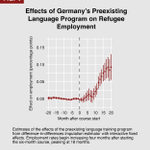
ALT Figure titled Effects of Germany's Preexisting Language Program on Refugee Employment shows a scatter plot with month after course start on the x-axis and effect on employment in percentage points on the y-axis. Beginning at 20 months prior to the course start, employment remains around 0, increasing around 4 months after and reaching a high just under 0.10 percentage points at 18 months after the course start.

ALT Figure: Effect of Germany's Ad Hoc Language Program on Refugee Employment, showing four scatter plots (depicting outcomes after 7, 12, 17, and 22 months). The two months before and after the ad-hoc language program registration cutoff (Dec 31, 2015) are plotted on the x-axis and percent employed on the y-axis. Trend lines mapped over the data points indicate employment level and direction of movement is very similar across all four charts.

ALT Adults sitting in rows of tables in a classroom reading and writing in notebooks.


ALT Bei Teilnehmenden von Integrationskursen (angeboten seit 2005) zeigte sich 12 Monate nach Kursbeginn eine um 4,4 Prozentpunkte höhere Beschäftigungsquote als bei Nicht-Teilnehmenden (12 Prozentpunkte nach 18 Monaten). Quelle: Marbach, M., Vallizadeh, E., Harder, N., Hangartner, D., & Hainmueller, J. (2024, October 4). Does Ad Hoc Language Training Improve the Economic Integration of Refugees? Evidence from Germany's Response to the Syrian Refugee Crisis.

ALT Deutsch-Einstiegskurse (angeboten von Oktober bis Dezember 2015) hatten jedoch keinen messbaren Einfluss auf die Beschäftigungsquote Geflüchteter. Die Einstiegskurse wurden Ende 2015 auf dem Höhepunkt der Fluchtmigration von der Bundesagentur für Arbeit rasch aufgesetzt und waren weniger umfangreich und strukturiert als die Integrationskurse.


ALT Aerial shot of people walking over a large world map painted on the ground

ALT Buildings on the ETH Zurich campus on a sunny day


ALT People crossing a busy city street


