

Economist and macroeconomic modeller, working mainly on climate change. Advocate of economic pluralism. #CambridgeTradition #Complexity
Cambridge, England
Joined October 2017
- Tweets1.8K
- Following239
- Followers1.7K
- Likes4.4K






Must-read for anyone using climate-economy models
Here we go again: the misuse of models and the looming climate crisis
academic.oup.com/imaman/adva…

This is a critically important thread. The thoughtful response from @PeterMcCrory is great and I have sympathy with the challenge.
But the critique from @modestproposal1 is also spot on - the possibility of collapsling demand leading to lower gdp is ruled out by assumption.

Really nicely laid out points, and indeed a great quote.

"The immense accumulations of fixed capital which, to the great benefit of mankind, were built up during the half century before the war, could never have come about in a Society where wealth was divided equitably."
-John Maynard Keynes
I love this Keynes quote because if you follow the argument through Keynes and then Kalecki, you end up somewhere very different from where it starts.
Before WWI, wealth was incredibly concentrated. Rich households obviously couldn't consume all of their income, so a huge amount was saved while factories, railways, machinery and other capital were being built.
And from the outside that makes it look pretty simple. The rich had the money, the rich saved it, those savings financed investment, therefore you needed rich people and inequality to get capital accumulation.
But... Investment doesn't have to sit around waiting for somebody to save first. Banks can create the credit to finance investment, firms spend that money, that spending becomes somebody else's income, and out of the higher income comes the saving.
So investment can create the saving needed to account for it. Then Kalecki makes this even more interesting because the same thing happens with profits.
Capitalists aren't just sitting on some pile of previously accumulated profits and deciding how much of it they can afford to invest. When they invest, that spending itself helps generate profits across the capitalist sector.
That's where Kalecki's great line comes from: workers spend what they earn, capitalists earn what they spend.
And once you put those two ideas together, the old argument that we need massive inequality because rich people need to save enough money for society to invest starts falling apart.
We don't need to wait for someone to become incredibly wealthy and graciously stop consuming before we can build a factory.
We need real resources, financing, demand and someone willing to actually make the investment.
The saving shows up as a consequence of the income we create along the way.

Hector Pollitt retweeted

Time to make all the armchair yappers mad again...🖕
"Economics has always been preoccupied with equilibrium. That's like analyzing how a car works by studying a parked vehicle."
-Jay Forrester

Hector Pollitt retweeted
John Maynard Keynes spent much of his career trying to explain something economists still argue about today: how capitalism can be incredibly productive and still periodically fall apart. Nearly a century later, a lot of people attacking Keynes seem to be attacking a version of him that never existed.
The General Theory was not a blueprint for central planning or unlimited government spending. Keynes wanted to understand why millions of people could be looking for work while factories, machines, and other resources sat unused. He argued that cutting wages could make a slump worse by cutting incomes and spending. He also rejected the idea that saving automatically turns into investment. Businesses invest when they think future sales will justify it. When those expectations collapse, investment can collapse with them.
Somehow this has been reduced to Keynes saying the government should just spend more money.
Keynes certainly supported government spending when private demand collapsed. But he was not calling for the government to run the entire economy. He thought private enterprise should remain the foundation of the system. His point was that capitalism could work extremely well without always being able to pull itself quickly out of a major downturn.
This is also why bringing up the Soviet Union as a rebuttal to Keynes makes little sense. Keynes was not Oskar Lange. He wasn't trying to abolish private property or replace markets with government planning boards. The calculation debate between Mises, Hayek, Lange, and others was a different argument. The failure of Soviet planning does not somehow prove Keynes wrong about unemployment, investment, or recessions.
The claim that Keynes captured economics because governments wanted economists who would justify bigger government doesn't hold up very well either. Keynes became influential because the Great Depression happened. Investment collapsed, banks failed, businesses closed, and millions of people remained unemployed. Economists had to explain what they were watching.
And Keynesians hardly took permanent control of economics. Friedman and monetarism became enormously influential. Then came Lucas, rational expectations, New Classical economics, and eventually DSGE models. If governments were secretly paying economists to keep Keynesian economics dominant, they did a terrible job of it.
There is also some irony in blaming Keynes for economists building beautiful mathematical models that have little connection to the real economy. Keynes himself was skeptical of treating economics like physics. Expectations, institutions, history, and genuine uncertainty were central to how he thought about the economy. A lot of the highly formalized macroeconomics that came later looks nothing like Keynes.
There are plenty of legitimate reasons to disagree with Keynes. You can argue that fiscal policy works poorly, that governments waste money, or that markets recover faster than Keynes thought. But Keynes was not a socialist central planner trying to replace markets with government bureaucrats. He was trying to understand why capitalism could create enormous wealth and still leave millions of people unemployed and huge amounts of productive capacity unused.
You don't have to agree with Keynes. It would just help to argue against the Keynes who actually existed.


Hector Pollitt retweeted

At 35:00 in this @dwarkesh_sp podcast, they discuss the possibility that job losses from #AI could cause a recession. This is something I devoted an entire chapter to in #RiseoftheRobots, and @Citrini made a similar case in their viral scenario a few months ago.
The economist acknowledges that elevated unemployment is possible, but suggests there is little or no concern this could lead to negative economic growth. He almost seems to suggest that negative economic growth is somehow extraordinary. This seems very complacent. We have negative economic growth in every recession, and recessions occur every 6-7 years or so on average. A commonly used rule is that a recession is defined as two consecutive quarters of negative GDP growth.
Recessions can begin for many reasons, but rising unemployment along with falling consumer confidence are certainly among them.
Try asking your favorite AI model this question:
"If workers/consumers become worried that they might lose their jobs, could psychology alone cause a recession?"
The answer, of course, is Yes. In other words, you don't even necessarily need large numbers of actual job losses. Fear alone could generate a recession--a self-fulling prophesy.
It is also the case that a recession could begin as a result of something other than job losses from AI--for example, an energy shock if the Iran deal falls through and/or the popping of the AI investment bubble--and it will be during the downturn that businesses will have the greatest incentive to cut costs. They may lay workers off for economic reasons and then find that AI allows them to avoid rehiring those workers in the future.
This is exactly what happened with the permanent loss of many middle class jobs in the past. In "Rise of the Robots," I cite a 2012 paper by Jaimovich and Siu that points out that fully 92 percent of the job losses in
mid-range occupations have occurred within a year of a recession.
I don't think economists should just dismiss these concerns.

Economics of AGI episode w Alex Imas and Phil Trammell.
There's a bunch of important questions about how we deal with AI that only economics can answer.
What is the optimal way to tax and redistribute the wealth that will be generated? How should countries not in the AI supply chain index into the gains? Is there any world where inequality doesn't explode?
It might seem like these questions have obvious answers, but the first thing economics teaches you is that your intuitions can often be entirely wrong.
It was very helpful to chat through these things with Alex and Phil.
Look up Dwarkesh Podcast on Apple Podcasts, YouTube, or Spotify. Enjoy!
00:00:00 – Will capital share increase?
00:19:36 – Messy Middle scenario
00:25:57 – How to tax and redistribute AI wealth
00:30:02 – Why demand collapse is unlikely
00:39:26 – Human employees would be hard to integrate into the machine economy
00:43:08 – What if some humans (or AIs) value wealth accumulation intrinsically?
01:01:28 – What should developing countries do?
Maybe things will be ok. I doubt it for the reasons well put here. But we don’t know - it’s new technology and by definition is different to before. The one thing we must not do is *assume* everything will be ok - and it seems to be only economists doing that.

Perhaps economists should spend less time focusing on what is happening with #AI and jobs RIGHT NOW, and more time thinking about where we may be 3, 5 or 10 years from now. Three, five or even ten years is a very short period of time relative to our ability to make major reforms to our economy and social contract.
It is only about three and a half years since the introduction of LLM-based chatbots. And for most of that time, the systems were clearly not capable of displacing much human work. It's really only within the past six months or so that agents have started to become truly capable. It should be unsurprising that data collected up to this point does not show a significant impact on jobs. I would argue that the past 3 and half years are likely an extremely poor predictor of what is to come.
#RiseoftheRobots
Yes now published!

How do you achieve a zero-carbon economy? View and buy your copy here to find out cup.org/4fXMMBo. Use 20% discount code RECP2026 at the checkout @JFMercure @HectorPollitt

ALT How do you achieve a zero-carbon economy? View and buy your copy here to find out https://cup.org/4fXMMBo. Use 20% discount code RECP2026 at the checkout @JFMercure @HectorPollitt

Good find by @noahqk. Have the economists learnt from the experience?
@terry_barker21


I have to admit I didn't realize my work was cited this widely... I've never worked for a university and climate is not exactly a fashionable field within economics - so this is quite unexpected.
landecon.cam.ac.uk/news/memb…

Reporting on a new working paper about the risks Mongolia faces from climate change.
devdiscourse.com/article/oth…

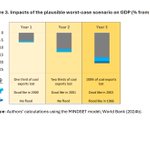
Coal dependence is a big risk on its own. But as disasters become more common the possibility of simultaneous events rises. From this we develop the plausible worst case scenario.

Hector Pollitt retweeted

Passionate about building Msia’s climate resilience? But ever wonder what should 🇲🇾 prioritize?
My colleagues crunched the numbers & found:
1. RoN95 reform & carbon pricing, by far, give the max benefit: 5 to 1
2. Mangroves & peatlands: 4 to 1
3. Ag & irrigation: 2.5 to 1

ALT Link to report: https://documents.worldbank.org/en/publication/documents-reports/documentdetail/099042326042519641

@yinshaoloong at a climate event in Putrajaya today made an important point that the “green jobs” narrative is oversold
I (broadly) concur. Once a solar panel factory is set up, you need minimal labor to run it. And as noted by Shao Loong, even the construction phase is getting increasingly automated. This can lead green tech to be *less* labor intensive, (EVs assembly, for example)
But looking at jobs in specific sectors can also be misleading. One has to look at *net* job creation & destruction in the economy
In that context, primary focus of climate policy (imho) ought to be on:
1. D-ecarbonization
2. A-dapting to a changing climate
3. M-anaging the transition
(Frankly my dear, I do give a dam..😅)
If in meeting these objectives, there is an overall increase in productivity, then net job creation can be still +ive, even if “green jobs” are fleeting & transient
And *this* is the correct metric to measure the impact of climate policy on jobs. Hope more politicians would see climate action & green jobs thru this more nuanced lens…