
https://xitter.cf/t.co/Jz2Ow5wRNf Grad student at @ruth_stassart and @rfledrich’s lab interested in the neuropathology of peripheral nerves from bench to count matrix
Leipzig, Germany
Joined February 2021
- Tweets188
- Following453
- Followers110
- Likes4.2K

Niko Fleischer (hal4k.bsky.social) retweeted

For the new kids in back: If you hate statistics, you'll love my free lectures. Putting science before statistics, from basics of inference & causal modeling to multilevel models & dynamic state space models. It's all free, made with love and sympathy. youtube.com/playlist?list=PL…
Synthetic, cheap, thermostable RNAse inhibitors for scRNAseq.

Excited to have published our work on #SEQURNA, a next-generation RNase inhibitor transforming #scRNAseq & other applications.
➡️Introducing synthetic thermostable RNase inhibitors to single-cell RNA-seq 🚀 🌕
nature.com/articles/s41467-0…
🧵…
Niko Fleischer (hal4k.bsky.social) retweeted

So... Preprint #2.
In which InstanSeg is extended to output nucleus & cell boundaries - and also to handle arbitrary combinations of image input channels.
xitter.cf/petebankhead/status/18…

So to summarize Preprint #1:
We introduce InstanSeg as a novel nucleus segmentation method that combines state-of-the-art accuracy with being open-source, fast and portable, accelerated on different hardware, and integrated into user-friendly software.
To be continued...
Niko Fleischer (hal4k.bsky.social) retweeted
Let me introduce: InstanSeg 🦠🔬💻👩🔬
This *would* have been a short thread about Thibaut Goldsborough’s PhD work… but he solved too many problems.
Now it's a long thread about 2 preprints, a whole new approach to cell segmentation & #opensource software to make it easy to use
Niko Fleischer (hal4k.bsky.social) retweeted

I am often invited to review papers on deep learning for medical images. Unfortunately many papers do the same mistake; they split data into training/validation/test on the slice/image/patch level instead of on the patient level. This will lead to inflated test scores, as images from the same patient then can appear in both training and test sets. Since these images can be very similar, the network will perform extremely well on the test images.
If you use 2D networks on 3D data, the 2D slices have to be split on the patient level, not on slice level.
If you use 2D networks on a dataset where each patient has several 2D images, the images have to be split on the patient level, not on image level.
If you use deep learning for digital pathology, the patches have to be split on the patient level, not on patch level.
nature.com/articles/s41598-0…
link.springer.com/chapter/10…
nature.com/articles/s41597-0…
Niko Fleischer (hal4k.bsky.social) retweeted

We report many proteins not predicted by the genetic code.
They are stable & abundant O( 10³ ) copies / cell.
Generative mechanisms include codon-anticodon mismatches & RNA modifications.
Their abundance depends on codon frequency & protein stability.
biorxiv.org/content/10.1101/…

Niko Fleischer (hal4k.bsky.social) retweeted
A new preprint:
While analyzing proteomes of cells from mammalian tissues, @_AndrewLeduc identified protein leakage from permeabilized cells.
We identified clear patterns that can be used to detect & mitigate this issue:
biorxiv.org/content/10.1101/…

Niko Fleischer (hal4k.bsky.social) retweeted

Import and export Markdown in Google Docs workspaceupdates.googleblog.…
Niko Fleischer (hal4k.bsky.social) retweeted

Then we repeated the experiment, but we dehydrated the tissue first. The architecture was fine. We left it at room temperature for a year. Still fine. Ran over it with a car, had a former Astros starting pitcher throw a fastball at it, fired a shotgun at it. Still fine. (15/18)

Niko Fleischer (hal4k.bsky.social) retweeted

Excited to launch our cloud-based image analysis platform today at nimbusimage.org! Analyze and interact with your data, all in the browser. Follow sign-up instructions to request an account.

Niko Fleischer (hal4k.bsky.social) retweeted

Which dimension reduction method should you use for data visualization? Check out our blog post on this topic!
sites.duke.edu/dimensionredu…
Having to make a quick presentation and don't have raw images at hand? Need to Invert the background color of any fluorescent image (or graph!) to match the rest of your presentation? you can do that online in the blink of an eye Oo

Happy to announce our preprint "EzReverse - a Web Application for Background Adjustment of Color Images" that reports a web app generated by @s_xinwei
biorxiv.org/content/10.1101/…

Niko Fleischer (hal4k.bsky.social) retweeted

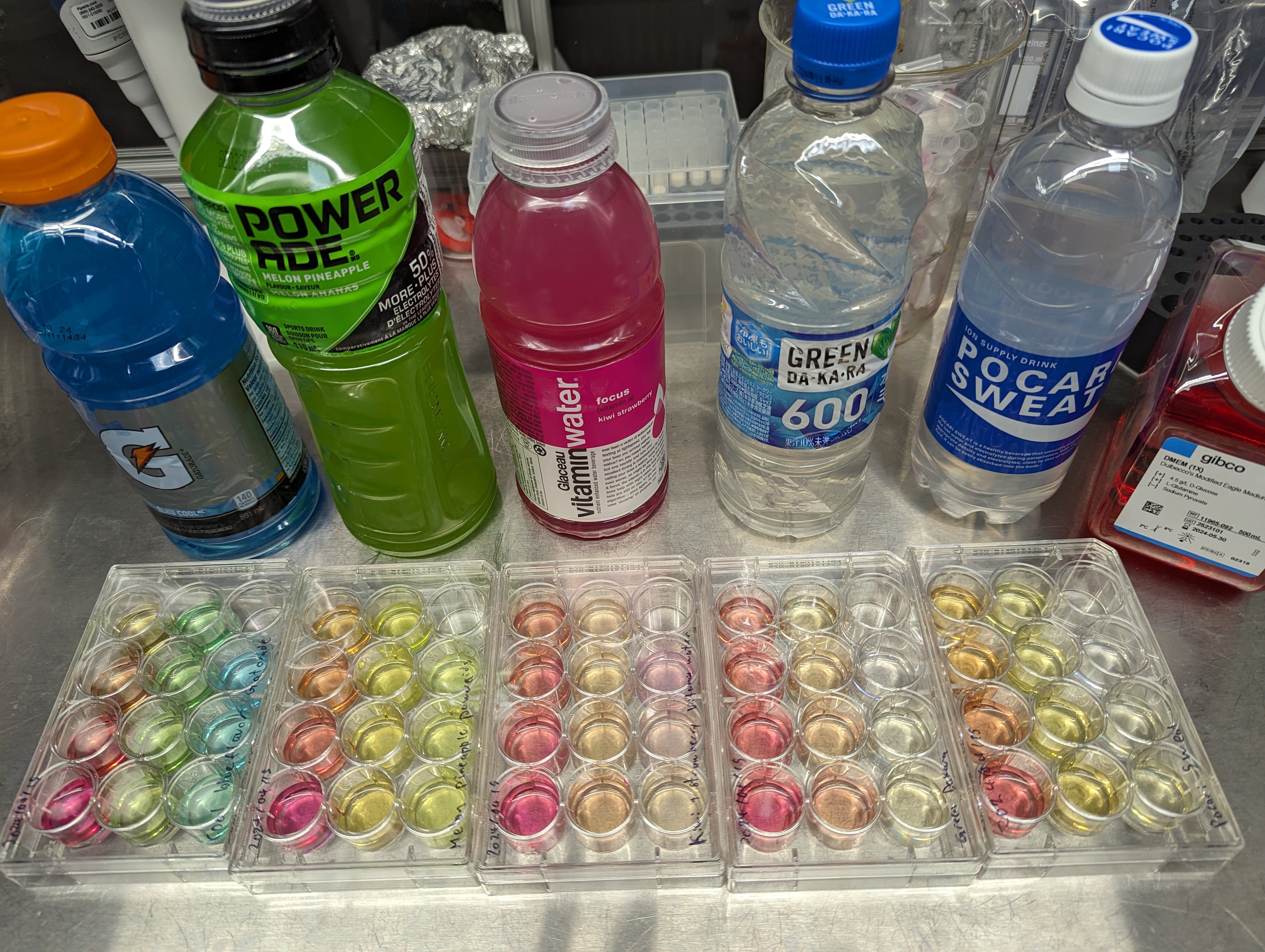
48 hours: here's the cells stained using calcein AM, a dye that should only be metabolized by live cells. This is 90% *mystery sports drink*, 10% DMEM.
I'd say they're doing fine. Not perfect but way better than expected. Tomorrow we get our FBS replacement results! Stay tuned!


Niko Fleischer (hal4k.bsky.social) retweeted

Wanna do standard 3’, 5’ etc @10xGenomics applications-seq without stress? No worries! FixNCut it baby!
@ljimenezgracia YOU are the best! @hoheyn @DrJasPlummer @cnag_eu @OmniscopeAI genomebiology.biomedcentral.…

Niko Fleischer (hal4k.bsky.social) retweeted

File over app
File over app is a philosophy: if you want to create digital artifacts that last, they must be files you can control, in formats that are easy to retrieve and read. Use tools that give you this freedom.
File over app is an appeal to tool makers: accept that all software is ephemeral, and give people ownership over their data.
In the fullness of time, the files you create are more important than the tools you use to create them. Apps are ephemeral, but your files have a chance to last.
The pyramids of Egypt contain hieroglyphs that were chiseled in stone thousands of years ago. The ideas hieroglyphs convey are more important than the type of chisel that was used to carve them.
The world is filled with ideas from generations past, transmitted through many mediums, from clay tablets to manuscripts, paintings, sculptures, and tapestries. These artifacts are objects that you can touch, hold, own, store, preserve, and look at. To read something written on paper all you need is eyeballs.
Today, we are creating innumerable digital artifacts, but most of these artifacts are out of our control. They are stored on servers, in databases, gated behind an internet connection, and login to a cloud service. Even the files on your hard drive use proprietary formats that make them incompatible with older systems.
Paraphrasing something I wrote recently:
> If you want your writing to still be readable on a computer from the 2060s or 2160s, it’s important that your notes can be read on a computer from the 1960s.
You should want the files you create to be durable, not only for posterity, but also for your future self. You never know when you might want to go back to something you created years or decades ago. Don’t lock your data into a format you can’t retrieve.
These days I write using an app I help make called Obsidian (@obsdmd), but it’s a delusion to think it will last forever. The app will eventually become obsolete. It’s the plain text files I create that are designed to last. Who knows if anyone will want to read them besides me, but future me is enough of an audience to make it worthwhile.


Niko Fleischer (hal4k.bsky.social) retweeted

New paper from our group: we show that PCR, not sequencing, is the main source of error in bulk and single-cell expts and we correct these experimentally using UMI homoblock design. nature.com/articles/s41592-0…
Niko Fleischer (hal4k.bsky.social) retweeted
Do you like bibtex? Do you doi? Do you want to get bibtex refs from doi on the command line? Yes you do, you wonderful monster. Try this line (adjust doi as needed):
curl -LH "Accept: application/x-bibtex" doi.org/10.1002/evan.10110

ALT Shell output: curl -LH "Accept: application/x-bibtex" https://doi.org/10.1002/evan.10110 @article{Henrich_2003, title={The evolution of cultural evolution}, volume={12}, ISSN={1520-6505}, url={http://dx.doi.org/10.1002/evan.10110}, DOI={10.1002/evan.10110}, number={3}, journal={Evolutionary Anthropology: Issues, News, and Reviews}, publisher={Wiley}, author={Henrich, Joseph and McElreath, Richard}, year={2003}, month=jan, pages={123–135} }
Niko Fleischer (hal4k.bsky.social) retweeted

Hello there, a reminder from this post by @lh3lh3 from 6+ years ago: the first step of your gene expr analysis (or the like) is to choose the right "version" of the ref genome. By "version", I mean the set of sequences in the ref. What's the big deal? 1/7
lh3.github.io/2017/11/13/whi…