



Geoffrey Angus retweeted

A statement on the comments from Secretary of War Pete Hegseth.
anthropic.com/news/statement…

Geoffrey Angus retweeted

They're burying a lot here. There's a 66% price cut from Opus 4.1 to $5/$25, it uses fewer tokens to solve problems, upgrades to Claude Code in the app, no more length limits on conversations, no more Opus-specific plan caps...


Geoffrey Angus retweeted

GOOD MORNING NEW YORK CITY
COME DO YOUR BEST THINKING AT OUR THINKING SPACE IN THE WEST VILLAGE
SAY NO TO SLOP


Geoffrey Angus retweeted

@StanfordHAI just ran this story on self-study and cartridges -- it's a really nice overview for those curious about our work

Geoffrey Angus retweeted

I had some early access to Sonnet 4.5. It is a really good model. I saw especially big jumps in doing finance and statistics, which tend to get overlooked in the focus on coding.
Geoffrey Angus retweeted

Incredible work - this should immediately become one of the most important metrics for policy makers to track.
We’re probably only a few months from crossing the parity line.
Huge props to OAI for both doing the hard work of pulling this together and including our scores. Nice to see Opus on top :)


Geoffrey Angus retweeted

Tri Dao says Claude Code makes him 1.5x more productive and that it's quite helpful at writing Triton kernels




Geoffrey Angus retweeted

Introducing ❄️ @snowglobe_so, the simulation engine for AI chatbots.
Magically simulate the behavior of your users to test and improve your chatbots.
Find failures before your users do.


Geoffrey Angus retweeted

Announcing DeepSWE 🤖: our fully open-sourced, SOTA software engineering agent trained purely with RL on top of Qwen3-32B. DeepSWE achieves 59% on SWEBench-Verified with test-time scaling (and 42.2% Pass@1), topping the SWEBench leaderboard for open-weight models.
Built in collaboration with the @Agentica_ team.
💪 DeepSWE is trained with rLLM, Agentica’s modular RL post-training framework for agents. rLLM makes it easy to build, train, and deploy RL-tuned agents on real-world workloads — from software engineering to web navigation and beyond.
🤗 As always, we’re open-sourcing everything: not just the model, but the training code (rLLM), dataset (R2EGym), and training recipe for full reproducibility.
🔥 Train DeepSWE yourself. Extend it. Build your own local agents. No secrets, no barriers.
DeepSWE and rLLM mark our major shift: from training language reasoners to building language agents that can truly learn from experience.
We believe the future of AI lies in experience-driven learning — and we’re here to democratize it.
Welcome to the era of experience. 🌍

Geoffrey Angus retweeted

Text diffusion models might be the most unintuitive architecture around
Like: let's start randomly filling in words in a paragraph and iterate enough times to get something sensible
But now that google's gemini diffusion is near sota, I think we need to take them seriously
Geoffrey Angus retweeted

The Nvidia Tensor Core is the most important evolution of computer architecture in the last decade
We explain why / how it's evolved
Shout out to collaborators @spectorb @tri_dao @colfaxintl @charles_irl @ia_buck Neil Movva Jonah Alben
esp @simonguozirui for the cutest cover pic

NVIDIA Tensor Core Evolution
From Volta To Blackwell
Amdahl’s Law, Strong Scaling
Asynchronous Execution
Blackwell, Hopper, Ampere, Turing, Volta
semianalysis.com/2025/06/23/…

Geoffrey Angus retweeted

This looks super cool. Our own research team was exploring similar ideas for building an internal corpus of context for our content generation tasks. Now we just got a huge head start on it!

When we put lots of text (eg a code repo) into LLM context, cost soars b/c of the KV cache’s size.
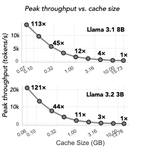
What if we trained a smaller KV cache for our documents offline? Using a test-time training recipe we call self-study, we find that this can reduce cache memory on avg 39x (enabling 26x higher tok/s and lower TTFT) while maintaining quality. These smaller KV caches, which we call cartridges, can be trained once and reused for different user requests!
Github: HazyResearch/cartridges

Geoffrey Angus retweeted

Excited to introduce #CollabLLM -- a method to train LLMs to collaborate better w/ humans! Selected as #icml2025 oral (top 1%)🏅
New multi-turn training objective + user simulator👇

Even the smartest LLMs can fail at basic multiturn communication
Ask for grocery help → without asking where you live 🤦♀️
Ask to write articles → assumes your preferences 🤷🏻♀️
⭐️CollabLLM (top 1%; oral @icmlconf) transforms LLMs from passive responders into active collaborators.
Website: aka.ms/CollabLLM
Github: github.com/Wuyxin/collabllm
Blog: wuyxin.github.io/collabllm/#…
Paper: arxiv.org/pdf/2502.00640
🎯 Key insight: Rewards responses not by immediate helpfulness, but by their long-term impact on the conversation trajectory.
@MSFTResearch @StanfordAILab @stanfordnlp

Geoffrey Angus retweeted

Cartridges, powered by Tokasaurus! 🤝⚡️🦖

