



Calling Cartridge training “sleep-time compute” tracks reasonably well with a core mechanism underlying sleep– the transfer of recent experiences (context) into long-term memory (weights). You can imagine
1
2
160
Struggling with context management? Wish you could just stick it all in your model?
We’ve integrated Cartridges, a new method of leveraging sleep-time compute for learning long contexts, into Tokasaurus, an inference engine optimized for high-throughput 🧵

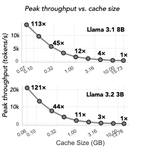
A Cartridge is a fixed-length, trainable KV cache optimized offline, or at “sleep-time.” They retain much of the same information as KV caches computed on-the-fly at test time, but achieve 26x higher tokens/sec, lower TTFT, and 39x lower memory usage!
xitter.cf/EyubogluSabri/status/1…


When we put lots of text (eg a code repo) into LLM context, cost soars b/c of the KV cache’s size.
What if we trained a smaller KV cache for our documents offline? Using a test-time training recipe we call self-study, we find that this can reduce cache memory on avg 39x (enabling 26x higher tok/s and lower TTFT) while maintaining quality. These smaller KV caches, which we call cartridges, can be trained once and reused for different user requests!
Github: HazyResearch/cartridges


Apple's new AI stack significantly improves model reliability (LoRA fine-tuning) while maintaining high versatility (multi-LoRA serving)
I think it's exactly this approach that gets us from chatbots to agents. Want to try it yourself today? Check out @w4nderlus7's thread below

@Apple is using #LoRA #finetuning for making their on-device 3b small language model outperform competitors and hot-swap multiple LoRAs on the fly depending on the task. It's a great approach! You can do exactly the sme with @predibase leveraging your data and tasks! (1/4)

8
136