Princeton Geniza Lab retweeted
New Syriac AI translator!
The results are surprisingly accurate and good for AI translation. There’s still room to improve, but this tool is already a major step forward.
It won’t be long before Syriac can be translated as seamlessly as other languages—a huge development for the future of Syriac preservation and accessibility.
oromoyo.ai
Princeton Geniza Lab retweeted
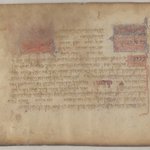
Absolutely charming view of Ottoman Cairo from an 18th c. copy of Pirî Reis' 16th c. atlas Kitāb-i baḥriye, love the little pyramids in the top right corner (Walters Ms. W.658):
Princeton Geniza Lab retweeted
On the Virtues of the Flea
[الطرثوث في فوائد البرغوث]
A delightful treatise by al-Suyūṭī (d. 1505 CE) in which he expands on a similar earlier work by Ibn Ḥajar (d. 1449).
Link to complete manuscript [Azhariyya, 249/130]
upload.wikimedia.org/wikisou…
Princeton Geniza Lab retweeted
Can you help identify this Arabic inscription in a Hebrew Bible printed in Venice in 1566, now at Stapleton Library, Indiana University of Pennsylvania?
#fpcanyouhelpchallenge @Footprints_Heb @adam_shear
Princeton Geniza Lab retweeted
We have dense honey pudding like cornelian. It wearied the hands that stirred!
Awestruck diners will, when first they see it, fall prostrate for it. 🍯
Glad to see classical Arabic food poetry translated by @iraqicuisine in venues like @atlasobscura atlasobscura.com/articles/ab…
Princeton Geniza Lab retweeted
Henry Wadsworth Longfellow wrote a magnificent poem “The Legend of Rabbi Ben Levi” in 1863 which recounts one the ‘companion of Elijah’s’ journeys, this on his trip to Paradise. Jewish history is part and parcel of American history.
Princeton Geniza Lab retweeted
1/
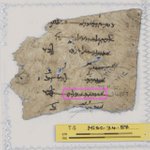
🌞⏳ Ever wondered what it was like to get paid 800 years ago? The Invisible East team has deciphered a fascinating document from the Bamiyan Papers: Ms.Heb.8333.144. It reveals the ins and outs of ministry staff salaries in medieval Afghanistan! 🏛️✨
Princeton Geniza Lab retweeted
No Jewish symbol is more misunderstood than the Magen David, "The Star of David." A thread on the actual connection between the Magen David & Jewish magic:
Princeton Geniza Lab retweeted
A poem, reflecting on the death of the scribe and the survival of their books.
Appears at the end of several manuscripts by Ibrāhīm ibn Khidr, an 18th c. scribe-priest from Mosul (Iraq), commissioned by the Syriac Catholic Church to copy religious works for their new library.
Princeton Geniza Lab retweeted
1/
☀️🌿 Summer's here and people are enjoying their gardens, planning their next big projects and working on their allotments. This is exactly what Kamal was thinking about when he wrote a letter to his friend Amin al-Dawla in Afghanistan 800 years ago! 📜✉️
Princeton Geniza Lab retweeted
1/ Being able to translate Mongolian in the 13th-16th centuries was an important skill to have. In addition to having numerous texts in the Mongolian language, we also have a number of dictionaries/glossaries which provide translations of Mongolian into other languages.
Princeton Geniza Lab retweeted
"Even the most perfect PDF is lacking in one element: its presence in time and space, its unique existence at the place where it happens to be."
—Walter Benjamin, on my book (which is now present in time and space)
Princeton Geniza Lab retweeted
4th century BCE in Central Asia: someone used Aramaic to write "In the year 1. Vishtaspa Karanya. The disbursement from Kaufadata: sheep came out 2 to my lord Vaidyura, 40 sheep".
Princeton Geniza Lab retweeted
spun up a quality of life tool today for searching all name permutations based on a kunya, ism+nasab, and nisbas to save time. atm it uses ansāb, buldān, tārīkh, and ṭabaqāt/tarājim texts from al-shamela up to ~1100AH. will add more texts (esp shia) and polish UI. input welcome!
Princeton Geniza Lab retweeted
Replying to @GenizaLab
On which see Geoffrey Herman's article here (academia.edu/41536752/Back_t…) and my own article here (academia.edu/74226899/The_Cu…)!
Princeton Geniza Lab retweeted
Rare 13th century representation of an early version of Tetris from an Islamic manuscript
Princeton Geniza Lab retweeted
Another doodle with a scene from Sirat 'Antar! This time depicting Hani' ibn Mas'ud and Dhu l-Khimar duelling each other. I wonder whether visual culture here is connected to the experience of performance of the epic alongside the reading experience.
Princeton Geniza Lab retweeted
In addition to being used as gravestones and the recording of law codes, stele can also be used to mark land boundaries. This stele was part of a land survey that was conducted in Egypt for the Abbasid caliph Harun al-Rashid by the treasurer for the governor of Egypt.
Princeton Geniza Lab retweeted
1/6
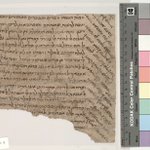
This lovely #manuscript fragment is a really good example of the various life cycles of many documents from the #Genizah.
It started off life, perhaps as early as the 800s, as an unvocalised scroll of the #MinorProphets (much like the Wadi Murabba'at Scroll 700 years before)
Princeton Geniza Lab retweeted
Excited to share my first piece for the @JRBooks—a review of The Oxford Annotated Mishnah, an ambitious translation that brought together dozens of scholars. I try to place the OAM in the context of Mishnah translations & to ask, what is Jewish studies? jewishreviewofbooks.com/jewi…