

Associate Professor of Ancient Jewish History @Penn @UPennNELC. Author of Babylonian Jews and Sasanian Imperialism @CambridgeUP
West Philadelphia
Joined November 2012
- Tweets3.6K
- Following994
- Followers5.1K
- Likes4K






Simcha Gross retweeted

سیمخا گروس، پژوهشگر تاریخ یهودیان، روز ۱۵ اکتبر در دانشگاه مکگیل سخنرانیای با عنوان «یهودیان در مرز روم و ساسانی: سیاست وفاداری» ارائه میکند. موضوع سخنرانی به این دغدغه میپردازد که چگونه رقابت دو شاهنشاهی، تعلق دینی جوامع مرزی را به مسئلهای سیاسی و امنیتی تبدیل کرد.
هنگامی که روم به امپراتوریای مسیحی تبدیل شد، مسیحیان ساکن قلمرو ساسانی ممکن بود به همدستی با امپراتوریِ همکیشِ آن سوی مرز متهم شوند. یهودیان نیز که در هر دو شاهنشاهی حضور داشتند، هنگام جنگ با این سوءظن روبهرو بودند که وفاداری آنان نه به دولت محل زندگی، بلکه به همکیشانشانشان در قلمرو رقیب تعلق دارد.
این سخنرانی بخشی از پژوهش کتاب تازۀ گروس با عنوان Communities, Empires, and Loyalty on the Roman–Sasanian Frontier است که در اوایل ۲۰۲۷ از سوی انتشارات دانشگاه کمبریج منتشر میشود. پرسش اصلی کتاب یادآور این نکته است که از چه زمانی وفاداری بهجای رفتار یک فرد، به صفتی برای یک جامعۀ دینی یا قومی تبدیل شد.
یکی از نمونههای شاخص، آزار مسیحیان در روزگار شاپور دوم است. گروس در پژوهشهای قبلی خود نشان داده که اتهام وابستگی به روم همیشه به سرکوب یکسان همۀ مسیحیان نمیانجامید؛ گاه خشونت انتخابی بود و گاه حکومت ساسانی با حمایت از برخی کلیساها میکوشید آنها را از روم جدا کند.
نمونۀ دیگر به فتح اورشلیم به دست ساسانیان در سال ۶۱۴ میلادی بازمیگردد. بعضی منابع مسیحی، یهودیان را همدستان سپاه ایران و عامل خشونت علیه مسیحیان معرفی کردهاند. اما چه مقدار از این گزارشها شرح واقعه است و چه مقدار محصول هراس از «دشمن درونی»؟
گروس میکوشد رخدادهای تاریخی را از شایعات و روایتهایی جدا کند که بعدها در متون مسیحی و سپس اسلامی تکرار شدند.
موضوع کتاب در نهایت تاریخ شکلگیری یکی از ماندگارترین اتهامهای سیاسی است: «وفاداری دوگانه»؛ این تصور که پیوند دینی با مردمان آن سوی مرز، لزوماً به معنای خیانت به جامعۀ محل زندگی است.
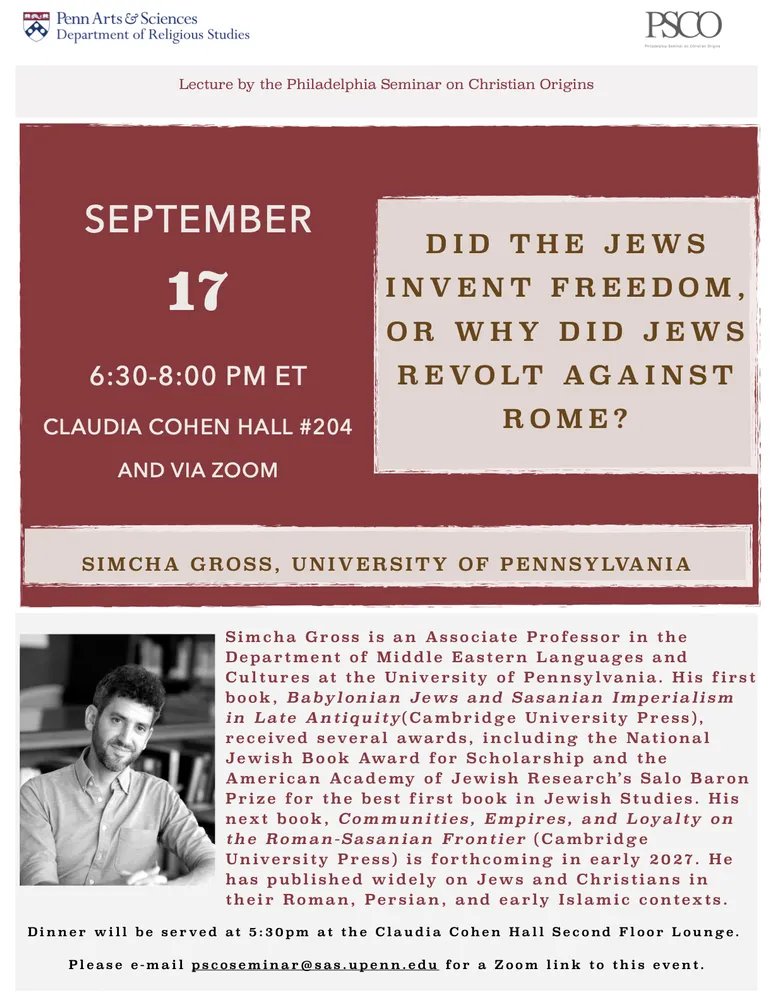
"Jews on the Roman-Sasanian Frontier: The Politics of Loyalty" with Simcha Gross (University of Pennsylvania) mcgill.ca/jewishstudies/chan…


Anyone looking for some last minute Passover reading, check out my article on the odd Aramaic opening "invitation" of the Haggadah:
academia.edu/44600798/Whoeve…

For anyone interested, a historiographic retrospective on the state of the historical study of the Babylonian Talmud, @ancientjew :
ancientjewreview.com/read/20…


Simcha Gross retweeted

The first book in our new @EdinburghUP series "Critical Approaches to Arabic Historiography" is published next month! Congratulations Prof. Borrut!
edinburghuniversitypress.com…

Great episode of Byzantium & Friends w/Aaron Butts!
While centering on Aksum, it engages key questions in the study of ancient empires, such as how to historicize religious imagery in imperial self-presentation, & the proxy war model (e.g. Bowersock)
open.spotify.com/episode/4gk…

A 2nd article is out today, w/Michele Scarlassara!
We present a previously unpublished Syriac incantation bowl from the Penn Museum, w/a formula paralleling several Mandaic bowls, w/intriguing social-historical implications
This is the 1st bowl published using spectral imaging!


Link to the original here, or message me if you'd like a copy: brill.com/view/journals/arst…
My article “Does an Arrow a Day Keep Satan Away? Late Antique Magical Subtexts in Babylonian Rabbinic Narratives” is now OA in HTR!
It argues that a Talmudic story about a rabbi’s encounter with Satan adjudicates between competing incantations in late antique Iraq
Great images!


Article available here: cambridge.org/core/journals/…


Simcha Gross retweeted

My most recent article, "The Arabs and the Ummah of Muhammad," has just been published online with Der Islam.

ALT https://www.degruyterbrill.com/document/doi/10.1515/islam-2025-0018/html
Simcha Gross retweeted

New pod! Matthew D. C. Larson and Mark Letteney on Ancient Mediterranean Incarceration
You can now subscribe to the show too.
Apple: podcasts.apple.com/us/podcas…
Spotify: open.spotify.com/episode/2Vy…

Simcha Gross retweeted

Why do Jews cover their heads?
In JQR 115.3, @Simcha_Gross looks at norms of Jewish male head covering as a proxy for cultural assimilation and difference in rabbinic Rome and Sasania.
Learn more on the blog and read his essay FREE thru September 5!
katz.sas.upenn.edu/resources…

Simcha Gross retweeted

Excited to share the article that @MinasMonier and I wrote on the Introduction to the Gospels by ibn al-Assal and its Arabic and Ethiopic traditions 🤩
brill.com/view/journals/jecs…

Simcha Gross retweeted
Our summer issue is out and two essays are free for a limited time. Don't forget to peruse the TOC! 🌻
muse.jhu.edu/issue/55233
For anyone actually interested in the question of the conversion of the Khazars, there is more recent and methodologically sound research on the subject by Shaul Stampfer:
Read his lengthy article here: muse.jhu.edu/pub/3/article/5…
Or watch him here: youtube.com/watch?v=PYbycYgj…

And for the most recent research on Ashkenazi DNA, see the recently published muse.jhu.edu/pub/56/article/….
For a study of the politics and preconceptions driving the question of Jewish origins and genetics more broadly, see Steven Weitzman's book here press.princeton.edu/books/pa…