

Understand your DNA. Optimize health, diet, & longevity with Genetic Lifehacks. #Biohacking
Small town, MT
Joined February 2015
- Tweets7.6K
- Following791
- Followers2.2K
- Likes3.5K



Pinned Tweet
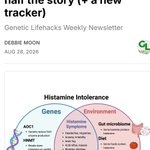
Mast cells have estrogen receptors.
When estrogen rises or swings (cycle, perimenopause), those cells can degranulate more easily and dump histamine. BPA and some PFAS can bind the same receptors and add to the effect. That helps explain hormone-linked migraines, allergy flares around the cycle, and why some people feel “histamine-y” when hormones shift.
DAO and HNMT variants still matter for clearing histamine. Estrogen is one more lever on the production side.
geneticlifehacks.com/estroge…

GABA is the main brake pedal in the brain and it helps stop neurons from firing nonstop.
Your brain makes GABA from glutamate using GAD1 and GAD2 enzymes, and that step needs vitamin B6 in its active form. Low GABA has been linked in studies to anxiety, PTSD and rough sleep, which makes sense if the brakes feel weak.
Receptor genes matter too. Two people can make similar amounts and still respond differently because their GABA receptors work a little differently.
This is one reason B6 status and GABA genes are worth checking together if anxiety or wired but tired sleep is your pattern. 👇
geneticlifehacks.com/gaba-ge…

Debbie @ Genetic Lifehacks retweeted

Read this #preprint on @researchsquare: Semaglutide reduces proteomic organ-specific biological age across randomized clinical trials researchsquare.com/article/r…
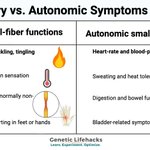
POTS is defined by your heart rate jumping 30+ beats per minute within 10 minutes of standing up. It has overlapping symptoms with long Covid, ME/CFS, MCAS, and hypermobile EDS, making diagnosis more difficult.
There isn't one cause. Some people have low blood volume, some have leg blood vessels that don't tighten enough, and some have a hyperadrenergic form where norepinephrine runs high when they stand.
Genetics points at norepinephrine. SLC6A2 makes the transporter that clears norepinephrine. Rare mutations are strongly linked to POTS, a common variant adds a little risk, and epigenetic changes that turn it down show up in POTS patients.
Fluids, salt, and compression have research behind them. So does ear-clip vagus nerve stimulation, including a 2025 long Covid trial where the benefit lasted a year.
geneticlifehacks.com/genetic…

Debbie @ Genetic Lifehacks retweeted

Our new work using virus-specific T cells as biosensors in Long COVID. These data point to viral persistence detected by T cells and some level of T cell exhaustion. Excellent work by @markmpainter biorxiv.org/content/10.64898…

Debbie @ Genetic Lifehacks retweeted

Protect your tribe
One of the best things I did was to run my kids DNA raw data through
@GeneticLifehack
I can now support their nutritional needs with much more clarity
L-theanine is the amino acid in tea that softens caffeine's bitter taste. A cup has about 25 mg.
It looks a lot like glutamate and nudges GABA up. In one trial, 200 mg a day lowered anxiety traits and improved sleep in healthy adults. However, it didn't help people with generalized anxiety disorder in an 8-week trial.
Some people say it gives them vivid dreams. An animal study found GABA plus theanine almost doubled REM sleep, which might explain it.
Has theanine done anything for you? Or is it just tea?
geneticlifehacks.com/l-thean…

Debbie @ Genetic Lifehacks retweeted

A promising new rejuvenation factor discovered by @geochurch et al. 🚀
Using a transcriptomic screen they found SRSF1, an RNA-processing and splicing factor that restores youthful profiles in cells.
In a small mouse study, activating SRSF1 extended median lifespan by 14%.
nature.com/articles/s43587-0…


TRPM3 is a heat-sensing ion channel, and it keeps showing up in ME/CFS, long Covid, and migraines.
It's part of why everything hurts when you have a fever (sometimes even your hair). Natural killer cells also need it to let in the calcium they use to kill virus-infected cells.
Two 2026 studies found reduced TRPM3 calcium flow in NK cells from ME/CFS patients, and some long Covid patients show the same thing. Mu-opioid receptors hold TRPM3 shut, and in lab studies low-dose naltrexone restored TRPM3 function in those NK cells.
Progesterone also puts the brakes on TRPM3. When it drops before a period, the brake comes off in the trigeminal nerve, CGRP gets released, and that's one path to a migraine.
Several TRPM3 variants are tied to ME/CFS risk.
geneticlifehacks.com/trpm3-t…

Debbie @ Genetic Lifehacks retweeted

Two bacteria, injected into the bloodstream of mice, wiped out tumors without help from the immune system. A new study shows how they do it, and the mechanism is not what most people would expect.
Researchers at the Japan Advanced Institute of Science and Technology, with the University of Tsukuba and Daiichi Sankyo, tested a pair of naturally occurring bacteria called AUN. One is Proteus mirabilis (called A-gyo), isolated from inside a tumor. The other is Rhodopseudomonas palustris (called UN-gyo), a purple photosynthetic bacterium. No genetic engineering was used.
The idea of using bacteria against cancer is old. In the 1890s, William Coley noticed that some patients improved after infections and began injecting bacteria on purpose. Most modern versions still depend on the immune system to finish the job.
That is a problem.
Chemotherapy and radiation suppress immunity, and solid tumors have a low-oxygen core (hypoxia) that immune cells struggle to enter.
Checkpoint inhibitors and CAR T cells, the newer immunotherapies, also rely on those immune cells.
This study asked whether bacteria could kill tumors on their own.
Key findings:
• Tumors disappeared completely in the treated mice, and the mice lived longer. This held in mice with normal immune systems, mice with weakened immune systems, and mice carrying human tumors
• The mice showed no visible signs of toxicity. There was also no cytokine storm, a dangerous overreaction where the immune system floods the body with inflammation, which is a known risk with some cancer immunotherapies
• The two bacteria were mixed at about 3 parts A-gyo to 97 parts UN-gyo. In the lab, they settled back into that same balance within a week, even when researchers started them at very different ratios
• Inside tumors, the balance reportedly flips to about 99 parts A-gyo to 1 part UN-gyo, according to the institute's press release
• A-gyo was missing the genes for the sticky surface structures bacteria normally use to attach to tissue and cause infection. That likely makes it less harmful than its commercial cousin
• Treated tumors were full of blood clots and showed widespread tissue death
So this is what seems to be happening from mechanistic angle:
First, the bacteria reach the tumor. Tumors are a hospitable place for bacteria. They have low oxygen, leaky blood vessels, and a suppressed local immune response. The bacteria grow there, form biofilms (sticky bacterial communities), and also kill cancer cells directly.
Second, they trigger clotting inside the tumor. Cytokines (inflammatory signaling proteins) rise, platelets aggregate, and fibrin (the protein mesh in blood clots) builds up. This is thrombosis, the formation of clots within vessels.
Third, the vessels collapse. Think of cutting the water supply to a building. A tumor needs a dense network of new blood vessels to bring in oxygen and nutrients. Clot them off, and the tissue behind them starves and dies.
The partnership also appears to act as a safety system. UN-gyo dampens A-gyo's pathogenicity, reduces its ability to rupture red blood cells (hemolysis), and helps push A-gyo into a long, filament-like form in the presence of cancer metabolites. In other words, the second bacterium keeps the first one in check outside the tumor.
Big caveats, though.
This was all done in mice. Mouse tumors, mouse blood clotting, and mouse immune responses differ from ours, and complete remission in mice has a poor track record of translating to people. Injecting live bacteria into the blood, in people who may already be sick, carries infection risks that mouse studies can't fully capture. The same clotting mechanism that destroys tumors could be dangerous if it occurred outside them. And the study was led by a group that is preparing to launch a startup, which is worth keeping in mind when reading the safety claims.
This is, however, a new way to think about cancer, one of the leading causes of death in older adults. The rate of cancer rises steeply after 50, and most current treatments depend on an immune system that also weakens with age and with treatment. A therapy that works without immune cells would matter most for exactly the people who need it most.
The broader point is that the tumor itself is an ecosystem, and bacteria that live there may be turned into a tool. Whether that tool is safe enough for people is the question that remains.

Debbie @ Genetic Lifehacks retweeted
@GeneticLifehack is a great tool. Completely changed how I supplement with health.


Tryptophan from your food can go two ways. It can become serotonin and melatonin, or it can head down the kynurenine pathway.
Inflammation pushes it toward kynurenine. That's a double whammy, less serotonin and more quinolinic acid, which overstimulates NMDA receptors and in excess can kill brain cells. Depression scores track with higher quinolinic acid in the blood.
Being low on niacin tilts the same way, and magnesium is needed to turn quinolinic acid into niacin. IDO1 variants can also skew the balance toward kynurenine.
Interesting that it all comes back to which way one amino acid gets routed.
Two places to look at your genetic variants - geneticlifehacks.com/is-infl… and geneticlifehacks.com/tryptop…

I learned something today that I wanted to share.
I admit - I always thought those IgG food sensitivity tests were kind of bogus.
I hadn't seen much in terms of research to convince me. Until now...
This study on IgG food sensitivities and migraines seems well-designed - testing dietary changes against a sham diet group.
The participants were 98 adults with migraines who had at least one positive food-specific IgG result.
They were randomized to two groups:
~True diet group (n = 52) that avoided foods testing IgG-positive.
~ Sham diet group (n = 46) who avoided alternative foods that tested IgG-negative, matched by food type and dietary difficulty. (E.g. if the true IgG response was to corn, the sham diet switch took out soybeans instead)
Participants followed the assigned diet for 12 weeks.
The researchers measured migraine disability, headache frequency and pain, gastrointestinal symptoms, sleep, anxiety, and depression, plus serum food-specific IgG, IL-6, TNF-α, CGRP, IL-10, serotonin (5-HT), and VIP.
The true IgG diet group had statistically fewer migraines. It wasn't a cure-all. They went from avg. of 5 migraines per month to 4.
But the part that I found interesting was the decrease in TNF-alpha levels. The true IgG diet group cut their TNF levels in half, while the sham diet group didn't have much of a change.
My takeaway - the IgG food sensitivities were likely stimulating chronic, low-level TNF-alpha.
Some people are genetically going to produce more TNF in response to a trigger.
Some people are going to have something noticeable, symptom-wise, when TNF is elevated (e.g. more migraines, bleeding gums, depression, more joint pain, etc.)
Here's the study (open access, read it for yourself): pmc.ncbi.nlm.nih.gov/article…
If you're a Genetic Lifehacks member, go check your TNF variants here: geneticlifehacks.com/tnf-alp…

Some people seem to react to everything, but their allergy tests still come back clean.
One reason is MRGPRX2. It's a receptor on mast cells that sets them off without IgE, so it never shows up on a standard allergy test.
Triggers include cipro and other fluoroquinolones (even eye drops), some opioids, CT contrast, a paralytic used in anesthesia, bee venom, and substance P from your own nerves.
A couple of MRGPRX2 variants in 23andMe and AncestryDNA data turn the receptor down a bit. Worth knowing before your next CT scan or round of antibiotics. 👇
geneticlifehacks.com/mrgprx2…


Psychiatrists are pushing to add an inflammation subtype of depression to the DSM.
The pattern looks a lot like being sick. Sleep problems, low energy, appetite changes, and anhedonia (that "meh, nothing matters" feeling). Researchers see higher TNF-alpha, IL-6 and CRP in some people with depression and anxiety, and anti-inflammatory treatments help some of them but not everyone.
Common sources include gut barrier problems, autoimmune disease and allergies, chronic stress, a high omega-6 to omega-3 ratio, and extra body fat. About 39% of people with rheumatoid arthritis have depression.
Does that cluster sound familiar to anyone?
Here's a nice overview for anyone wanting to dig into the research: psychiatryonline.org/doi/ful…
And you can check your genetic susceptibility here: geneticlifehacks.com/is-infl…

Estrogen turns up PEMT, the liver enzyme that lets you make some of your own choline.
It's likely a pregnancy safeguard. On a low-choline diet, men and postmenopausal women showed signs of organ damage faster than premenopausal women.
At menopause, estrogen drops, PEMT drops, and less choline is available for the brain. A 2026 study tied choline to the working memory changes a lot of women notice in menopause. Some PEMT variants make you even more dependent on dietary choline, and about 90% of people in the US don't hit the adequate intake anyway.
Eggs are the easy fix. In one study, egg yolks raised blood choline about four times more than the same dose of choline bitartrate.
If menopause brain fog is a thing for you, this one is worth a look.
geneticlifehacks.com/which-t…
