

The official twitter account of GRID, the Global Repository of Income Dynamics.
Princeton, NJ, USA
Joined April 2022
- Tweets169
- Following288
- Followers695
- Likes43






Pinned Tweet
Today, GRID gets bigger and better.
grid-database.org/
Decades of GRID data are now interactive.
Our coverage has grown by 14 countries, our research has expanded, and the website has been completely redesigned.
This is our biggest update yet. Here's the overview. 🧵

Only about half of Colombian workers are formal in any given month. But follow Colombians over time and formality looks… fragile. Few workers are persistently formal and even fewer hold a formal job for an entire year.
New research by @LeoMoralesZur, @socampdi & @Brenda_Sama👇

These results are possible because of admin panel data that broaden our view relative to cross-sectional statistics of the labor market. Following workers over time reveals patterns of formal attachment that shape the distribution and volatility of earnings in Colombia.
Read more at grid-database.org/research-p…

Congratulations to Robert Hall and Michael Woodford on receiving the 2026 Nobel Prize. Connecting microeconomic data and macroeconomic outcomes is central to our mission at GRID, and their work is a huge inspiration for our research agenda.
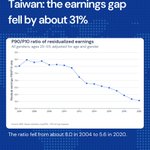
Taiwan is often in the headlines for geopolitics and chips. Here’s a different story: its earnings inequality fell considerably between 2004 and 2020.
New GRID research by Kuan-Ming Chen, @YuTingChiang4 , @ming_jen & Hsuan-Li Su investigates this trend 🇹🇼🧵
So what happened in Taiwan?
Lower earners pulled closer to the middle, and rising minimum wages appear to have contributed most around P10–P30.
The very bottom is different: there, how much people work matters as much as the wage itself.
Read the full paper at grid-database.org/research-p…

How can inequality in hourly wages fall while inequality in annual earnings barely moves?
New GRID research by @bozaistvan , Martin Neubrandt, and Rita Pető follows Hungarian workers from 2004 to 2021. 🇭🇺🧵
The lesson from Hungary:
• More equal hourly wages do not automatically mean more equal annual earnings.
• Changes in hours worked can offset wage compression.
• Earnings risk and volatility can differ sharply across demographic groups.
Read the whole paper at grid-database.org/research-p…