

Sharing awareness on various developments regarding genetically modified (GM) and gene/genome edited crops, seeds and food in India
India
Joined August 2013
- Tweets4.8K
- Following85
- Followers1.2K
- Likes159





Pinned Tweet
Listen and read how USAID and @gatesfoundation are promoting genetically modified (GM) and gene edited crops in India.
🧵
(1/11)
@PMOIndia @ashwani_mahajan @Devinder_Sharma @kkuruganti @drvandanashiva @SumanSahai
GMWatchIndia retweeted

Negros: the #GMO-Free island that is fighting to stay GMO-Free. Over 50 international organic organizations have expressed solidarity with the GMO-Free Negros, Coalition of farmers, advocates, and community leaders. #Philippines panaynews.net/protesting-aga…

GM Foods, Invisible Ingredients, and the Crisis of Informed Choice- shorturl.at/tqJiQ
Article by Dr. Ramanjenayulu G V calls for
- Mandatory labeling of GM derivatives
- Stronger independent public-sector testing
- Better post-market surveillance
- Structural reforms
GMWatchIndia retweeted

In this video for The Red Mike, Milan Sharma Desai @Milan_reports tackles a complex and evolving story regarding India’s agricultural future.
For over two decades, India maintained a cautious stance on Genetically Modified (GM) crops, with Bt Cotton being the lone exception. However, recent developments in the India-US trade deal have sparked intense debate among experts and activists. While the Indian government maintains that it has firmly protected farmers' interests, critics point to the ambiguity of "non-tariff barriers" and the potential entry of GM products through the back door.
To help break down this technical and political maze, Milan is joined by Kavita Kuruganti @kkuruganti , a leading farm rights activist from ASHA-Kisan Swaraj.
While the government maintains that trade deals will not compromise the pockets of our farmers, the ambiguity in the fine print leaves many questions unanswered. The introduction of GM crops—whether through feed or fruit—is an irreversible step that demands much greater public scrutiny and scientific accountability.
youtu.be/AI4qHD4kU5c?si=20Cp…
#usindiatradedeal
@ChouhanShivraj
GMWatchIndia retweeted
The GM element in soya remains! The effect on human health will be disastrous
@KaranThapar_TTP @thewire_in @PiyushGoyal @ChouhanShivraj @GMWatchIndia
youtube.com/watch?v=E21XIa5j…
#IndiaUsTradeDeal #GM #IndiaUSdeal
Pls see
1) How GM cotton proved to be a disaster for India
firstpost.com/india/union-mi…
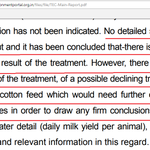
2) For health impacts on animals, how cotton yields in 19th century were much higher than what GM cotton and how 23/34 countries with cotton yield more than India do not grow GM cotton - attached


Today, India imports about $1 billion of cotton, and the textile industry is under stress.
The contrast with other countries is stark. India uses 36% of the world’s cotton land but produces only 24% of cotton.
Yield is just 454 kg per hectare. China, with far less land, produces much more. Even Pakistan’s yield is more than double India’s.
Before 2000, cotton farming in India was in deep trouble. Yields were very low, only about 190 kg per hectare.
Farmers regularly lost crops because a pest called the American bollworm destroyed cotton plants. Farming was risky and income was poor.
Everything changed in 2002 when the Vajpayee government allowed BT cotton. This was a genetically modified seed that used one gene from soil bacteria.
That gene killed only the bollworm. It did not harm humans or animals. Cotton plants survived, yields jumped, and farmers earned more.
But around 2010, politics stopped science. Activists claimed GM seeds were unsafe and pushed the government to block approvals.
Field trials were stopped, states got veto power, and new seed research came to a halt. Innovation in cotton completely froze.
Pests did not stop evolving. New insects like whitefly and leaf worm attacked crops. Indian scientists had better seeds ready, but they were not allowed to be used. Farmers were left without solutions.
From 2014 onwards, cotton yields fell, production dropped, exports collapsed, and India became Net importer.
If cotton had remained profitable, farmers in Punjab and Haryana would not have shifted to rice. Groundwater damage, stubble burning, and rice oversupply could have been reduced.
The core problem is clear. Anti-science thinking, activist politics, fear of technology, and slow bureaucracy hurt farmers.
Those claiming to protect farmers ended up blocking progress.

GMWatchIndia retweeted

India’s approval of gene-edited rice trials under relaxed GMO rules marks a push for self-reliance with climate-resilient seeds. Yet concerns over patents, costs, transparency, and public trust persist. @AmbikaSubash writes
theindiaforum.in/forum/gene-…

GMWatchIndia retweeted
The Rajasthan High Court issued a blanket ban on the manufacture, sale, or import of Genetically Modified (GM) foods until the Central Government frames safety regulations. The Court found it "astonishing" that despite the global health concerns, the Centre has failed for two decades to enact protocols under Section 22 of the Food Safety Act, 2006, constituting a violation of the Right to Health (Article 21). The FSSAI was ordered to frame these regulations within six months.
youtube.com/shorts/LCTn2LWwX…
@GMWatchIndia @GMWatch @pbhushan1 @ChouhanShivraj @PMOIndia
GMWatchIndia retweeted
India’s “gene-edited rice revolution” was launched with fanfare by the Central Minister for Agriculture — but ICAR’s own data, exposed by the Coalition for GM Free India, tell a very different story.
thenewsminute.com/news/india…
@ChouhanShivraj @PMOIndia @GMWatch @GMWatchIndia

GMWatchIndia retweeted
इस वर्ष मई में जारी जीनोम-एडिटेड धान की दो किस्मों पूसा डीएसटी-1 और डीआरआर धान 100 (कमला) को लेकर नया विवाद खड़ा हो गया है। कोएलिशन फॉर ए जीएम-फ्री इंडिया (Coalition for a GM-Free India) ने गुरुवार को एक प्रेस कॉन्फ्रेंस में कहा कि इन किस्मों की सफलता को लेकर जो दावे किए गए हैं, वे भारतीय कृषि अनुसंधान परिषद (ICAR) के अपने आंकड़ों से ही मेल नहीं खाते। संगठन का कहना है कि उसने अपने दावे के लिए आईसीएआर के ऑल इंडिया कोऑर्डिनेटेड रिसर्च प्रोजेक्ट ऑन राइस (AICRPR) की 2023 और 2024 की वार्षिक रिपोर्ट के आंकड़ों को आधार बनाया है।
@GMWatchIndia

@icarindia @AgriGoI claim on gene edited rice don't match up - ICAR's own data shows!
@ChouhanShivraj pls stop gene-edited crop release until strong biosafety regulations, independent oversight & thorough regulations are in place. Pls share all data in public. This is new-age GM

Full article here - downtoearth.org.in/agricultu…
Our demands here - eng.ruralvoice.in/national/i…

GMWatchIndia retweeted

India's two gene edited rice experiments and introduction is getting controversial. A coalition against GM-free @GMWatchIndia presented @icarindia data showing its study 'rigged' & 'hyped', in reponse @icarindia accused the coalition as 'anti-developmet' 'motivated' & 'baseless'.

GMWatchIndia retweeted

@icarindia 's “gene-edited rice” story is falling apart — exposed by the #GMFreeIndia @GMWatchIndia
Data missing. Yields exaggerated. Truth twisted.
This is not science, it’s spin.
downtoearth.org.in/agricultu…
For full PR see link in thread
GMWatchIndia retweeted
SOPA urges govt to block GM soybean meal imports from US
m.economictimes.com/news/eco…
@PMOIndia @ChouhanShivraj @GMWatch @GMWatchIndia

GMWatchIndia retweeted
Rajasthan High Court directed the Food Safety and Standards Authority of India (FSSAI) and the Union Government to formulate and notify regulations regarding GM foods within six months.
@fssaiindia @GMWatchIndia @GMWatch
newindianexpress.com/nation/…

GMWatchIndia retweeted
Why American corn is at the centre of a US-India trade deal deadlock
facebook.com/reel/1314775450…
@fayedsouza @GMWatch @GMWatchIndia @pbhushan1 @ChouhanShivraj @PMOIndia
Indeed!

Opening up for #GM crops under US pressure wil be suicidal for Indian agriculture. As I have repeatedly said, there is no GM crop that increases crop productivity. Strong lobbies backed by corporates/media have misled the nation. Be watchful.
m.economictimes.com/news/eco…
