

Andrés Zuleta retweeted

Jev Founder, Diogo Amogo, just released 12-page PDF on building a Jev Harness for coding agents
this is a 10-step blueprint on how to make your coding agents 200× faster and 400× cheaper:
step 1 → meet Jev: the LLM writes, the harness executes, Jev decides what each turn sees, where it routes and whether it runs
step 2 → ask the question that breaks every agent: how would you design one if LLMs had no KV cache?
step 3 → stop routing blind: Opus → Sonnet → Opus costs 6.19 vs 4.15 for pure Opus, because handing back reprocesses the whole context
step 4 → follow the tokens: reading and searching take 56.2% of tool turns and 46.5% of tokens. Writing code is under 10%
step 5 → score every chunk per query: hide, short summary, long summary or full. Compress after the question, not before
step 6 → disclose tools in tiers: one-line snippets for 100s of tools, schema on demand, docs for one-off queries. Batteries stop costing context
step 7 → load instructions by condition: touching *.tsx loads the style guide, billing/ loads its gotchas file, and compaction can't erase either
step 8 → route by trust, not just difficulty: secrets and infra stay on first-party frontier models, public docs go to the cheapest one
step 9 → share one retrieval pass: cross-model review, eval generation, ELI5 explainers and live progress pages all run read-only in the background
step 10 → gate every command: programmable allow / ask / deny policies that read a script before it runs, not just its name
Send this PDF and the article below to your Claude Code or Codex instance and start shipping 200× faster.


Readers added context they thought people might want to know
The post wrongly identifies "Diogo Amogo" as Jev founder; TypeSafe AI (Jev's developer) was founded by Diogo Almeida. The shared PDF is independently compiled and explicitly disclaims any affiliation with or endorsement by TypeSafe.
typesafe.ai/team
typesafe.ai/blog/introduci…
drive.google.com/file/d/17h982x…
pbs.twimg.com/media/HSv6c7rX…
Andrés Zuleta retweeted

最近Jev爆火,拿到 Jev API 还不知道怎么玩的,可以按这个清单抄。
1. jev-ultrafast
Browser Use 做的高速浏览器 Agent。Jev 每一步只判断「做什么、点哪个元素」,要打字才叫小模型。Google Flights 搜一次航班大约 7 秒。
github.com/browser-use/jev-u…
2. fast-jev-compaction
给 Claude Code 做上下文压缩。每次工具调用先让 Jev 判断还有没有用,没用的删掉,留下来的原文不重写。
github.com/tamaratran/fast-j…
3. json-render
Vercel Labs 的生成式 UI 框架。实验里 Jev 不逐 token 写 JSON,只负责选组件、属性和布局。
github.com/vercel-labs/json-…
4. typesafe-mcp
最适合刚拿到 API 的人。把 Jev 接进 Claude Code、Claude Desktop、Codex 和 Pi,随时做 Choice / Score / Noul。
github.com/itsmostafa/typesa…
5. jev-mcp
现成的 Agent 判断工具箱:事实核验、内容筛查、语义排序、分类和信息提取。
github.com/jkudish/jev-mcp
6. SemDecide
把 Jev 做成命令行。Shell 里直接分类、打分、过滤,适合接爬虫、CI 和数据流水线。
github.com/sharziki/semdecid…
7. jev-codex-router
先让 Jev 判断这一轮编程任务有多难,再决定模型档位、推理深度和速度模式。
github.com/0xNatoshi/jev-cod…
8. Winnow
给 Claude Code 做上下文垃圾回收。Read / Bash / Grep 吐一大堆时,Jev 先判断哪些真和当前任务有关。
github.com/GhalebDweikat/win…
9. jev-review
代码审查前先过一遍 Jev,把高风险改动挑出来,再交给更贵的大模型或人。带本地看板。
github.com/devagrawal09/jev-…
10. Blink
把 Jev 当代码库导航器。每走到一层目录,就判断哪些文件和当前问题最相关,再继续往下找。
github.com/ellipsis-dev/blin…
11. agent-desktop
桌面自动化。读系统无障碍树,判断下一步该点哪个按钮、菜单或输入框。
github.com/lahfir/agent-desk…
12. typesafe-mario
让 Jev 玩《超级马里奥》。不看截图,直接读模拟器 RAM 里的结构化状态,再决定跑、跳、躲。
github.com/fhshaik/typesafe-…
13. jev-drone
拿 Jev 控无人机。底层飞控继续负责稳定和安全,Jev 只做爬升、刹车、穿越障碍这类上层判断。
github.com/RomanSlack/jev-dr…
14. OneVOneJev
浏览器里的 1v1 FPS。每个决策 tick 都要判断走位、视角、瞄准、开火和跳跃。
github.com/emrickgarrett/One…
15. jev-trader
Monad 测试网上做高频做市。Jev 根据价差和成交方向判断下一步买还是卖,模型延迟大约 81ms。
github.com/jarrodwatts/jev-t…
16. Prism
不直接让 Jev 下单。它判断 toxic flow、市场压力、均值回归之类的状态,再交给原来的策略。
github.com/irfndi/prism-liqu…
17. neo4jev
把 Jev 塞进知识图谱。每走到一个节点,判断下一条最值得走的边,再一路找下去。
github.com/jexp/neo4jev
18. jev-curate
拿 Jev 筛训练数据。JSONL / Parquet 先做质量、相关性和风险判断,再决定哪些进后面的训练。
github.com/AkashPriyadarshii…
19. Canny
防 Coding Agent 嘴硬说自己做完了。看工具输出、代码 diff 和测试结果,再判断完成声明靠不靠谱。
github.com/qkal/Canny
20. killmyidea
输入一个创业点子,Jev 从多个维度打分,最后给你 KILL、FIX 或 SHIP。
github.com/monteduro/killmyi…

Andrés Zuleta retweeted

A 13-PAGE BREAKDOWN OF AGENT MEMORY THAT CUTS TOKEN COST BY 90%
your agent reads the same 12 files every morning
reaches the same conclusions
and charges you for it again
the model got 10x smarter in two years
it still forgets everything the second a session ends
five layers fix that:
1. working memory - what it sees right now
> the context window
> when it fills, the old context drops out
> most agents live here and never leave
2. episodic memory - what happened
> the full interaction log, timestamped
> the deploy that died tuesday at 3am over a typo stays remembered
> you explain it once
3. semantic memory - what is true
> facts, entities and relationships in a knowledge graph
> "this user prefers TypeScript" survives the session
4. procedural memory - how to do things
> three approaches tried, one worked
> that one becomes a reusable skill
> the next run starts there
5. forgetting - what to delete
> an agent that remembers everything collects contradictions
> you move cities, it keeps recommending the old restaurants
the numbers:
> Mem0 - 1,800 tokens per query instead of 26,000
> 91% lower latency
> Snowflake - one ontology layer, 20% more accuracy, 39% fewer tool calls
memory pays for itself on day one
the layer nobody builds is the forgetting engine
it decides whether the other four stay worth trusting
full 13-page breakdown below 👇


Andrés Zuleta retweeted

Google just dropped the best 1-hour course on Graph Engineering: from one agent to a full 24/7 system
00:00 - what graphs are
09:16 - build an agent
21:15 - graph engineering explained
41:03 - graph engineering in practice
52:21 - self-improving graphs
free, and the best thing on graph engineering I have come across
Prompts → Agents → Loops → Graphs
most people will watch the first nine minutes and go back to typing into a chat box
same model, same tokens, and the only thing that changes is the shape you run it in
watch it today, then read the full guide on agents and graphs below


Andrés Zuleta retweeted

Becoming a 10X engineer ain't what it used to be.
It's literally a SKILLS.md file.
Want help?

Andrés Zuleta retweeted

POV: you’re the only person at work who doesn’t know how to fine tune a model.


Andrés Zuleta retweeted

Chinese researchers published a paper with a devastating title: "The End of Software Engineering”
it argues software engineering is finished.
In traditional software, code is the carrier of pre-written human logic.
In agentic software, the AI agent is the software.
Code is no longer a permanent monument built by human hands. It is completely ephemeral, dynamically generated, executed, and discarded on the fly by an LLM-driven reasoning loop.
Think about how software delivery has evolved:
• Era 1: On-premise licensed software (you installed it locally)
• Era 2: SaaS (hosted in the cloud, managed by vendors)
• Era 3: Agent-as-a-Service (AaaS)
Each historical shift transferred complexity away from the user. But this latest shift transfers something entirely different.
It transfers decision-making complexity itself.
The paper argues that traditional engineering is hitting a hard complexity wall. Human brains can only hold so much state, manage so many dependencies, and debug so many lines at once.
LLM-based agents scale non-linearly.
They don't just write functions faster. They navigate architectural complexity by outsourcing reasoning to models that improve every single month.
Which means the role of the developer is permanently changing.
You are no longer a code author typing syntax line by line.
You are an intent architect.
Your job is no longer writing the implementation. It is specifying goals, designing multi-agent coordination loops, and auditing outcomes.

Andrés Zuleta retweeted

Visa sponsorship + Remote jobs + Freshly funded startups:
European Tech Visa Sponsorship
docs.google.com/spreadsheets…
US Tech Visa Sponsorship
docs.google.com/spreadsheets…
Japan Tech Visa Sponsorship
docs.google.com/spreadsheets…
150 Remote Companies Hiring
docs.google.com/spreadsheets…
100% Remote Hiring Companies
docs.google.com/spreadsheets…
400+ San Francisco Bay Area companies
docs.google.com/spreadsheets…
1500+ Recent Funding Startups
docs.google.com/spreadsheets…
Indian Startups Freshers DS/ML/AI Hiring 2026
docs.google.com/spreadsheets…
Indian Robotics Startups Database
docs.google.com/spreadsheets…
1300+ Hidden Companies Hiring List
docs.google.com/spreadsheets…
Bookmark it.
Repost it to help others.
Share with your friends.

Andrés Zuleta retweeted

Stanford just released the kind of LLM lecture Anthropic pays engineers $750,000+ a year to understand:
Not prompting
Not RAG
How to actually build language models from scratch
In this 104-minute lecture, they break down the full stack behind modern LLMs:
06:18 - how language models are built from raw data
21:42 - tokenization and model architecture
39:17 - why scaling laws predict model performance
57:36 - how compute, data, and parameters trade off
1:14:28 - what actually happens during post-training
1:34:11 - the engineering skills needed to build frontier models
This lecture is worth more than 100 LLM tutorials
Bookmark and watch it today
Then read the full guide to building language models from scratch below


Andrés Zuleta retweeted

This repo is a goldmine if you are preparing forn Systemd Design Interviews
github.com/liquidslr/system-…

Andrés Zuleta retweeted

I'm a Principal engineer & I passed system design rounds of Amazon, Atlassian, Walmart, Saleforce, and Deliveroo.
Trust me, learning system is not hard. Start from these fundamental concepts:
1) Load Balancing: lnkd.in/gH9rdjCx
2) CDN: lnkd.in/g83A7-rM
3) Caching: lnkd.in/gTjxhv2V
4) Cache Invalidation: lnkd.in/geC955AY
5) Rate Limiting: lnkd.in/gWqJzCNJ
6) API Gateway: lnkd.in/gBNKpecH
7) CAP Theorem: lnkd.in/g4yFYkEi
8) Sharding: lnkd.in/gFi23iNV
9) Replication: lnkd.in/gikkrmNp
10) Partitioning: lnkd.in/gQhJS8ii
11) Queues: lnkd.in/gPGiuxtu
12) Microservices: lnkd.in/gZfYV2Qu
13) Microservices Vs Monoliths: lnkd.in/gM-dKE3D
14) Fault Tolerance: lnkd.in/gdamMmtc
15) Database Scaling: lnkd.in/ghq4v_gQ
16) Service Discovery: lnkd.in/gjfbNVBe
17) Consistency models: lnkd.in/gGkMENA3
18) Eventual Consistency: lnkd.in/gdSn54SK
19) Distributed Transactions: lnkd.in/gTc8pSbH
20) Leader Election: lnkd.in/g-kwhzSb
21) Horizontal vs Vertical Scaling: lnkd.in/gW-Vi9Qt
22) Back of the Envelope Estimation: lnkd.in/gQ6vtM3U
23) Idempotency, Data Latency & Finale: xitter.cf/system_monarch/status/…
Let me know what you'd like me to cover, would love to help :)

Andrés Zuleta retweeted

ANDREJ KARPATHY POSTED AN IDEA THAT GOT CLOSE TO 20 MILLION VIEWS AND MOST PEOPLE ARE STILL SLEEPING ON IT WHILE WAITING FOR THE NEXT MODEL RELEASE.
Point Claude Code at a folder. Drop in any source. It reads, links, and files everything into a living wiki that compounds the more you feed it.
Install Obsidian. Paste the idea file. Tell Claude to build it. Three folders, one CLAUDE.md that runs the whole thing.
Five minutes to set up.
You never start from a blank chat again.
The model isn't the bottleneck.
The memory was.


Andrés Zuleta retweeted
A senior Google engineer just dropped a 19-page PDF on "Loop Engineering" for LLM and agentic systems.
Act → Observe → Learn → Repeat
• Act: the LLM proposes a code transformation (tile this loop, parallelize that one).
• Observe: a compiler runs it and reports back - is it valid? faster? slower? by how much?
• Learn: the LLM reads that feedback and adjusts its next move.
• Repeat until it stops finding improvements.
The agent gets smarter purely from grounded feedback inside its own context window.
This 19-page PDF totally changed the way I’m building agentic systems today.
Read it now, then explore the article below.


Andrés Zuleta retweeted
Andrew Ng:
"100% of my tasks are now done by AI agents - hype has exceeded my expectations. Loops is next step.
in 3-6 months, everyone will be using self-improving loops. No more prompting."
In a 30-minute talk, Andrew Ng explains how to build self-improving agentic systems from scratch.
Worth more than a $500 agentic course.

Andrés Zuleta retweeted

Todavía lo releo cada semana.
Es, sin exagerar, uno de los artículos más valiosos que he leído sobre cómo cambiar tu vida.




Andrés Zuleta retweeted

Someone just dropped a 9-layer production AI architecture and it's the most honest breakdown I've seen.
services/ - RAG pipeline, semantic cache, memory, query rewriter, router. Not one file. Five.
agents/ - document grader, decomposer, adaptive router. Self-correcting by design.
prompts/ - versioned, typed, registered. Never hardcoded.
security/ - input, content, output. Three guards not one.
evaluation/ - golden dataset, offline eval, online monitor. Most people skip this entire layer and ship blind.
observability/ - per-stage tracing, feedback linked to traces, cost per query.
.claude/ - agent context so your AI coding assistant knows the codebase before it touches a file.
The demo is one file. Production is this.
Check: academy[.]neosage[.]io

Andrés Zuleta retweeted

HarnessX: a harness that compiles itself.
every harness improvement so far has come from a human editing code by hand.
Anthropic strips planning steps out of Claude Code when a stronger model ships. Manus rebuilt its agent five times in six months, removing complexity each round.
the craft runs on human judgment about what to change and when. HarnessX is what happens when a system makes those edits itself.
the trick is to treat the harness as a first-class object, the way we already treat model weights.
once it's a typed, editable artifact, it can be optimized from its own execution traces.
the framing they use is an operational mirror. evolving a harness maps cleanly onto reinforcement learning.
the harness is the state. an edit is the action. the trace plus a score is the feedback. a new version is the update.
once you see it that way, the failure modes come for free. reward hacking, catastrophic forgetting, under-exploration.
the same problems that break model training show up when a system edits its own scaffolding.
so edits never ship blind. each round, a loop reads the traces, plans a change, writes the edit, then critiques it.
a gate keeps the new version only if it beats the current one on tasks it hasn't seen.
what makes this safe is the structure underneath. the harness is built from typed components the system can swap without breaking the rest.
that is what compiles really means here. every candidate harness is type-checked before it runs.
here is the result that matters. the weakest model improved the most. the strongest barely moved.
an evolved harness closes the gaps a weak model cannot fix on its own. the weights never changed. the environment around them got smarter.
this is the natural next phase of harness engineering. we moved from weights, to context, to hand-built harnesses.
the harness was the last piece we still tuned by hand.
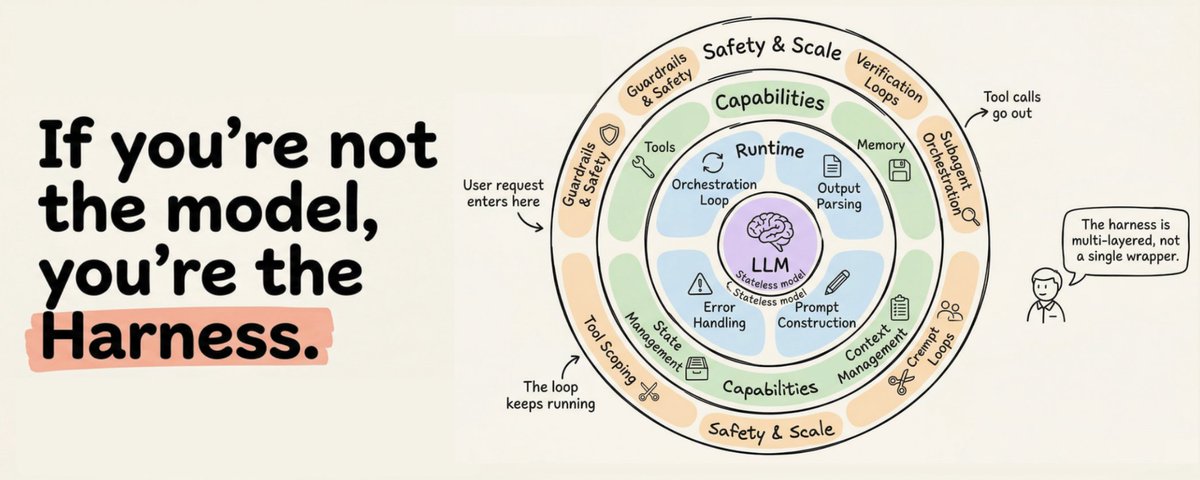
i wrote a deep dive on agent harness engineering a while back, covering the orchestration loop, tools, memory, context management, and everything that turns a stateless LLM into a capable agent. the article is below.
paper: HarnessX: A Composable, Adaptive, and Evolvable Agent Harness Foundry: arxiv.org/abs/2606.14249


Andrés Zuleta retweeted

Google CEO, Sundar Pichai:
"If you don't learn to how to orchestrate agents now, you'll spend 2027 catching up to people who started today"
In 30 minutes he explains why the best engineers stopped writing code and started running agents.
Watch the interview, then save the exact setup below 👇

