

Know exactly where your money goes. Budget • track • plan • grow Connect your bank accounts 👇 Take control of your money
🇿🇦 🇺🇸 🇪🇺 🇨🇦🇨🇭
Joined March 2023
- Tweets728
- Following2
- Followers675
- Likes550






A R50,000 salary doesn’t necessarily mean you can afford a R450,000 car.
The instalment is only part of the story.
Insurance. Fuel. Maintenance. Interest. All of it eats into what you actually have left every month.
We compared two South Africans earning the exact same salary, one buying new, one buying second-hand, and the difference is over R6,000 a month!
Before you sign for your next car, run the numbers.
Try our free Car Affordability Calculator 👉 finwiseapp.io/tools/can-i-af…
You can now ask your AI about your own money.
Connect @FinWiseApp to @claudeai, @ChatGPT, @cursor_ai, or any AI that supports custom connections, and ask in plain language:
"What did I spend last week?"
"How am I tracking against my budget this month?"
"Did my rent debit order go through?"
"Anything unusual in my spending this week?"
Read more here 👇
finwiseapp.io/blog/what-your…

If you have extra money, is it better to invest it or pay off your home loan first?
Read more here 👉 finwiseapp.io/blog/invest-or…

When will you hit your first R1 million?
It might be sooner than you think.
How much you already have invested, how much you add each month, and how long you give your money to grow can make a huge difference.
We built a free R1 Million Calculator to show you your date.
Try it free on FinWise → finwiseapp.io/tools/when-wil…
*Calculations are illustrative and based on assumed investment returns. Actual returns will vary.
Saving money in South Africa requires a few South African tricks.
Bank fees, groceries, petrol, insurance, electricity and phone contracts, small savings can add up to hundreds or even thousands of rand over time.
Check your bank fees
Use your grocery rewards
Compare expensive staples
Understand your electricity tariff
Use fuel rewards
Requote your insurance
Revisit old phone contracts
The goal isn’t to cut out everything you enjoy. It’s to stop unnecessarily overpaying for things you’re buying anyway.
What’s your best South African money-saving hack? Share it so we can all steal it.
🇿🇦 Interest rates just went UP. But what does that actually mean for your wallet?
The repo rate has increased from 7.00% to 7.25%, pushing the prime lending rate to 10.75%.
And that 0.25% can show up in very real ways:
- Higher home loan repayments
- More expensive variable-rate car finance
- Higher costs on some debt and credit
- Potentially better returns for savers
For example, on a R2 million, 20-year bond at prime, the increase works out to roughly R337 extra every month.
That might not sound enormous on its own, but add it to higher fuel, food, electricity and other living costs, and households feel it.
Link to full article: finwiseapp.io/blog/south-afr…
Link to interest rate hike impact calculator: finwiseapp.io/tools/interest…
“Renting is just paying someone else’s bond.”
But is buying actually always better?
It’s not as simple as comparing your rent to a bond repayment.
Buying comes with a deposit, transfer costs, interest, rates, insurance, maintenance and eventually selling costs.
But renting has an opportunity cost too, and property can appreciate while your bond gets paid down.
So we built a free South African Rent vs Buy Calculator that does the maths for you.
Enter the property you’re considering and see the break-even rent, the point where buying vs renting starts to make financial sense based on your assumptions.
🔗 Try it free at finwiseapp.io/tools/rent-or-…
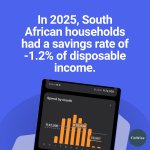
South African households have a negative savings rate.
In 2025, household saving as a percentage of disposable income was -1.2%.
In other words, collectively, households are consuming more than their disposable income rather than building net savings.
And it makes sense when you look at the bigger picture:
- Household debt remains above 60% of disposable income.
- 72% of South Africans surveyed say they experience money stress.
It's easy to tell people to “save 20% of your salary”. It's much harder when rent, groceries, transport, electricity and debt repayments are taking up most of it.
For many South Africans, the first goal doesn't need to be 20%.
It can be R100. Then R500. Then R1,000.
What percentage of your income are you realistically able to save each month?

Would you take R18,000 today if it could mean having R1 MILLION less at retirement?
South Africa’s Two-Pot system gives you access to part of your retirement savings when you need it, and for many people, that can be incredibly valuable.
But there’s a catch we don’t talk about enough: you’re not only losing the money you withdraw. You’re also losing the compound growth that money could have earned for decades.
That doesn’t mean you should never withdraw. Emergencies happen. Debt can be overwhelming. Sometimes accessing the money genuinely makes sense.
The important thing is understanding the long-term cost before you make the decision.
🇿🇦 Would you use your Two-Pot savings to pay off debt?
Thank you @PrieskaTjop!

Thank you @vault22_za for finally introducing fees on something that used to be free.
That inconvenience is the only reason I looked around and found @FinWiseApp.
Cleaner. No product pushing. Easy to switch. Actually built for tracking your money instead of selling you more of it.
100x better.
Earning R50k a month doesn’t automatically mean you can afford a R40k holiday
The real question isn’t just: “Do I have the money?”
Ask yourself:
Do I have an emergency fund?
Am I still saving for my future?
Can I pay for it without going into debt?
If not, that R40k might have another job to do first.
Would you spend R40k on one holiday if you earned R50k/month?

Your salary isn’t necessarily the problem. Your budget might be 👀
If your money seems to disappear halfway through the month, start with what you actually spend, not the perfect budget you wish you followed.
In our R30k example, cutting just R2,100 from takeaways, coffee, shopping and subscriptions, and moving it to savings on payday, adds up to R25,200 a year. 🤯
You don’t need to stop enjoying your money. You need to decide where it goes before it disappears.
Be honest: what’s your biggest monthly money leak?
Takeaways? Shopping? Uber? Subscriptions? Woolies?
How much does it REALLY cost to raise a family in Cape Town?
We worked out a rough monthly budget for a family of four and landed at around R53,000 take-home per month, including rent, groceries, school costs, medical aid, transport, bills and a little going towards savings.
Of course, every family looks different. School choice alone can completely change this number.
Cape Town parents: is R55k enough, too much, or nowhere near enough? 👇
What does your family spend each month?
FinWise retweeted

A major update to the @FinWiseApp app has been rolling out over the last few days. We've revamped the UI and fixed a bunch of bugs. Let us know if you have any feedback!

FinWise Widgets now available on iOS and Android
You can now add FinWise widgets on your Android or iPhone and track your budget, spend and net worth more closely.
Import your Vault22 data automatically into FinWise
We’ve added a Vault22 importer which lets you automatically transfer your entire Vault22 profile to FinWise.
When you sign up you’ll be given the option to import your data, otherwise, you can do so from the Accounts Page.

Your electricity bill is going up again. 🇿🇦
From April 2027, electricity prices are set to increase by an average of 8.83%.
At the same time, Eskom has just reported a R30.3 billion profit, more than double the R14 billion reported the year before.
So what could an 8.83% increase mean for your budget?
R1,000/month → ~R88 more
R2,000/month → ~R177 more
R3,000/month → ~R265 more
For someone spending R2,000 a month, that’s potentially more than R2,000 extra per year.
Important: 8.83% is an average increase. What you actually pay will depend on your tariff, municipality and electricity usage.
Gqeberha, it’s your turn 🇿🇦
Is R25,000/month actually a good salary in Gqeberha?
After tax, you’re taking home roughly R21.5k.
Then comes rent, groceries, medical costs, petrol, electricity, internet, your phone… and actually having a life.
And that’s before a car repayment, debt, kids or other big expenses.
Gqeberha may be more affordable than some of SA’s bigger metros, but does R25k actually go far enough?
Gqeberha people, we want to hear from you 👇
Is R25k a good salary? And what does a realistic monthly budget look like there?