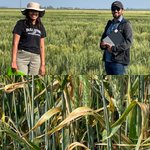
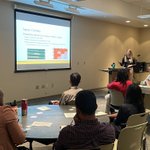
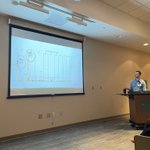
The fungal effector ToxB essentially hijacks the plant's innate immune system through recognition by a neofunctionalized Exo70-like protein. @Gurmnder_Singh @amandawheatgene @zhhliu2004 @acharya_krish87 @kadian11pooja @KLDRunning @PfaffTiana_7 @Shengmi06181681
Tan spot is a persistent challenge for U.S. wheat growers—but ARS scientists are helping to change that. Researchers at the ARS Cereal Crops Improvement Research Unit in Fargo, ND, and collaborators @NDSU have pinpointed a specific wheat gene that makes plants vulnerable to the costly fungal disease.
Their discovery shows that removing this gene by either traditional breeding or gene editing can boost a plant’s natural resistance.
For more details: nature.com/articles/s41467-0…
Fantastic work by @Gurmnder_Singh leading this work for his PhD dissertation. It was fascinating to discover a neofunctionalized Exo70-like protein exploited by a fungal pathogen to cause disease.
I’m happy to share that our work on the wheat Tsc2 gene is now published in Nature Communications! @FarisGenLab @USDA @NatureComms @NDSU @NDSUPlantPath @NDSUPlantSci
nature.com/articles/s41467-0…
Faris Lab retweeted
Open position: Wheat breeder position at Canyon/Bushland with Texas A&M AgriLife Research/TAMU @WheatInitiative @uswheatassoc graingenes.org/GG3/content/w…
Faris Lab retweeted
GrainGenes update: Triticum turgidum Durum Svevo 2.0 manuscript was accepted and all dataset and tools are released @luigicattivelli @WheatInitiative graingenes.org/GG3/content/a…
Faris Lab retweeted
thrilled to share our joint work on the amplification of virulence in tan spot & ToxB @GourlieRyan @McdonaldMeganc @hafez_mnm answering to 25+ yrs old Q on multicopy virulence gene | Molecular Plant-Microbe Interactions® apsjournals.apsnet.org/doi/a…
Faris Lab retweeted
Now online! An activated wheat CCG10-NLR immune receptor forms an octameric resistosome dlvr.it/TRfrkT
Faris Lab retweeted
The same western blot image used 23 times in 14 different papers by one Japanese team. The image has been labelled as representing a range of experiments and proteins. This is the most I have ever seen. Perhaps it is a record?
Faris Lab retweeted
Happy to share that our paper has been published 🎉in Theoretical and Applied Genetics.
This study examines the genetic basis of resistance to root-lesion nematodes in triticale and provides tools for cereal breeding programs.
📄 doi.org/10.1007/s00122-025-0…
Happy to provide tools for wheat breeders to efficiently remove the disease susceptibility gene Tsn1 from their materials. @KLDRunning did a fantastic job leading this project. rdcu.be/etVOd
Faris Lab retweeted
🌾Agnes Szabo-Hever @NDSU will reveal groundbreaking insights into how susceptibility genes interact with necrotrophic effectors in hard red spring wheat and durum wheat.
📅 Don’t miss the webinar on 17 July 2025 at 11 AM EDT!
🔗 Sign up today: tinyurl.com/yh8bc3au
Faris Lab retweeted
Zengcui Zhang et al. investigated the wheat–Parastagonospora nodorum pathosystem, a model for necrotrophic fungal interactions where SnTox3 induces disease via an inverse gene-for-gene mechanism. @FarisGenLab Learn more: doi.org/10.1094/MPMI-10-24-0…

ALT Flow cytometric analysis of mitotic metaphase chromosomes isolated from wheat Sumai 3 wild-type and mutant genotypes. A, The 4′,6-diamidino-2-phenylindole (DAPI) versus fluorescein isothiocyanate (FITC) dot plot was obtained after the analysis of DAPI-stained chromosomes labeled by fluorescence in situ hybridization in suspension (FISHIS) with FITC-conjugated probes for GAA microsatellites. B, 5B chromosomes were sorted from the sorting window shown as a red rectangle in A at purities of 79.4 to 87.5%. 5B chromosomes after FISH with probes for pSc119.2 (green), Afa family (red), and 45S rDNA (yellow); chromosomes were counterstained by DAPI (blue).
Faris Lab retweeted
🌐 The International Wheat Congress unites experts to share innovations & knowledge. The 2026 edition of the International Wheat Congress will be held from 25-29 of May 2026 in Bologna, Italy!
See: wheatinitiative.org/internat…
Congratulations Gazala @plantpath_PD! An award well deserved. #risingstar
Heartiest congratulations to Gazala Ameen @plantpath_PD for APS-NCD 2025 Early Career Award in the profession of Plant Pathology 🪴. Certainly a rising 🌟 in our research field.
Go Jacks!! @SDStateCAFES @SDState
Faris Lab retweeted
The International Symposium on Cereal Leaf blights #ISCLB2026 is happening May 2026 in Banff, Canada. Our official website is now live isclb.com/ Explore key info and stay tuned for more updates! @SaskWheat @AlbertaGrains @SeCan @WheatInitiative @AAFC_Canada
Faris Lab retweeted
Honored to present my work on wheat susceptibility to tan spot at the #IWGSC workshop @wheatgenome during #PAG32. A big thank you to IWGSC organizers for the opportunity and to everyone who attended. Looking forward to more great discussions!
Gurminder Singh @Gurmnder_Singh #IWGSC workshop #PAG32 presenting his work on the molecular mechanisms underlying wheat susceptibility to tan spot.
Congrats to @acharya_krish87 on leading this pioneering research to identify and map robust resistance QTLs for bacterial leaf streak in wheat. Impactful research needed for wheat improvement, especially in the Upper Great Plains.
Excited to share our new paper on QTL mapping for BLS resistance in hexaploid wheat! A huge thanks to my co-authors and everyone who contributed to this project @FarisGenLab
Check it out! link.springer.com/10.1007/s0…
Faris Lab retweeted
I like have a GS6/7 Biological Science Technician position available in my lab. Details and instructions can be found at
usajobs.gov/job/817344000
#wheat #rust #cropscience
Faris Lab retweeted
My USDA research unit has an opening for Research Leader Plant Pathologist/Geneticist/Molecular Biologist. It is posted at USAJOBS. Please forward. Thanks! usajobs.gov/job/815060500