





Pinned Tweet
🚨 *Vulnerability Alert:* Trust Wallet's Fomo3D Summer 🚨
🔗 Full Disclosure: secbit.io/blog/en/2024/01/19… 💸 Losses on ETH mainnet alone are staggering – and that's just the tip of the iceberg.
🧵 A thread on the findings and implications for users: 👇 (1/n)
p0n1 🦇🔊 retweeted

曾攻击 MEV 机器人 Jaredfromsubway.eth 使其损失超 750 万美元的黑客,时隔一个月再次有动静了🥷
10 小时前花费最后 244 万枚 DAI 买入 1277 $ETH,下一步应该打算通过龙卷风(Tornado)进行混币了,这也是该黑客链上的最后一笔待处理资金
钱包地址 arkm.com/explorer/entity/jar…
#Bitget 来了就是VIP!Crypto、美股、CFD,全球先机一站布局


应该是 Kimi Code 里的描述 vibe 反了:/permission 设置里说 YOLO 是 AI 自动审批低风险,Auto 是全批。实际应该是相反? moonshotai.github.io/kimi-co… @real_kai42

1
124
p0n1 🦇🔊 retweeted

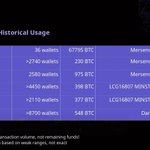
We just published the on-chain analysis of the second Ill Bloom wallet drain incidents (May - July 2026) across Bitcoin, Ethereum, Polygon, Rootstock and Tron wallets derived from weak recovery phrases.


p0n1 🦇🔊 retweeted
18天算“快”了,可以看一下我们之前沟通和披露的时间线 secbit.io/blog/en/2024/01/19… 关键到最后在各种证据面前为了公关不承认他们的用户大量被黑(因为都是老钱包并且过去一段时间,社交媒体上影响较弱,盗窃金额反而大于这次事件)这个团队内部指定有些说法的。 @cz_binance
A good TRUST wallet shouldn’t have been hacked three times in its short history. Sorry for the team and users. Stay safe. There must be something wrong.

🚨 Security Alert
It appears that the @TrustWallet browser extension may have been compromised via a supply-chain attack in the Dec 24 update.
Reports indicate that importing a seed phrase into the extension can result in immediate wallet draining.
⚠️ Do NOT use the Trust Wallet extension for now, and never import seed phrase until an official clarification and fix are released.
❗ As of now, there has been no official communication from the Trust Wallet team regarding this incident.
Exploiters are using multiple addresses and More than $2,000,000 appears to have been drained

3
281
p0n1 🦇🔊 retweeted

So here’s what’s happening :
In the Trust Wallet browser extension code 4482.js
a recent update added hidden code that silently sends wallet data outside
It pretends to be analytics, but it tracks wallet activity and triggers when a seed phrase is imported
The data was sent to metrics-trustwallet[.]com a domain registered days ago and now down

p0n1 🦇🔊 retweeted
🚨 Security Alert
It appears that the @TrustWallet browser extension may have been compromised via a supply-chain attack in the Dec 24 update.
Reports indicate that importing a seed phrase into the extension can result in immediate wallet draining.
⚠️ Do NOT use the Trust Wallet extension for now, and never import seed phrase until an official clarification and fix are released.
❗ As of now, there has been no official communication from the Trust Wallet team regarding this incident.
Exploiters are using multiple addresses and More than $2,000,000 appears to have been drained
p0n1 🦇🔊 retweeted

Here is an interesting ECDSA quirk. I've created the same signature that is valid for two different messages:
Message 1: "Ethereum the world computer"
Message 2: "Bitcoin the store of value"
Signer address: 0x126aABEc82aE54Bf03BC304DeD7d540E113F9963
Signature R, S: 0xec986ec3277febdaf14357431eba90f4218b65c8de80a77ebb6179a9bddc72f23517ac820af018fdf66ac767eff7e6cf7037266da787963b223b8a69145b5126
The only discrepancy is the V component: 0x1b for the first message and 0x1c for the second.

p0n1 🦇🔊 retweeted
Fixed in 2018, but many user wallets got hacked in 2023. @teawaterwire and I are one of them. The Lubian hack is not related with Trust Wallet. This is the FUD part. However, Trust Wallet team lied about many things in their statement.
Trust Wallet admitted their product had a vulnerability in 2018 but vehemently denies that it affected their users in the mass wallet theft incident of 2023. They claim to have notified all affected users back in 2018 to migrate their assets, which is clearly a lie fabricated for PR purposes.
We previously disclosed the vulnerability in Trust Wallet for iOS from 2018. Any security issue related to Binance easily turns into FUD, which in turn triggers a knee-jerk reaction from Trust Wallet. It's actually normal for any software to have security vulnerabilities; what matters most is how they are handled properly.
Here is our previous disclosure post about the Trust Wallet iOS vulnerability: xitter.cf/ErrNil/status/17482033…
And here is Trust Wallet's announcement after the issue gained traction: xitter.cf/TrustWallet/status/175…
After the last incident, I was quite disappointed with Trust Wallet's response and lost interest in following up on the case. However, whenever I see PR statements that I find obviously incorrect and illogical, I always feel uncomfortable and have to speak my mind. So I'm taking this opportunity to discuss some of these points, just to leave a record.
Trust Wallet mentioned that the number of affected users at the time was about 10,000 early adopters, and that they had notified each one and provided an asset migration plan. They claim no users suffered losses and all affected wallets have been deprecated.
In fact, this is highly counterintuitive. Trust Wallet was extremely popular in 2018, which led to its acquisition by Binance. In such a situation, notifying 10,000 users about a security issue with their wallets and getting them to migrate would have been a tricky affair. If they had really done it, it would have almost certainly made the news. My own first Trust Wallet address was also generated in 2018 and was drained in the July 2023 incident. I have no memory of ever receiving any notification. This user's situation is the same as mine: xitter.cf/teawaterwire/status/17…
Trust Wallet mentioned that since July 2018, all new wallets created by Trust Wallet users are no longer affected by this vulnerability.
This is also patently false. How can you guarantee that every single one of those 10,000 users updated their software to the latest version? If someone downloaded the problematic version at the time and never updated the app, then all addresses created with that version of the wallet would be permanently insecure and vulnerable to theft.
Trust Wallet mentioned that the comprehensive evidence suggests the 2023 attacks did not originate from a Trust Wallet vulnerability, but were more likely caused by a combination of multiple sources. They state they have full confidence that the 2018 vulnerability was not the root cause of this incident.
This is a very clever, but highly inaccurate, turn of phrase. In reality, while the 2018 Trust Wallet vulnerability was not the *sole* root cause of all the wallets drained in July 2023, it was a major contributor. The reasons are as follows: real Trust Wallet users were affected; the affected addresses could be reproduced using Trust Wallet's code from that time; and the activity timeline of the affected wallets highly correlates with Trust Wallet's code commit history. We discussed this in more detail in our original disclosure article, so I won't repeat it here.
Trust Wallet mentioned that in addition to fixing the vulnerability, the founder of Trust Wallet proactively contacted affected users to provide them with a secure migration path, ensuring no users remained at risk. They also state that the relevant affected addresses have all been confirmed to no longer hold any balance.
The part about confirming the relevant addresses no longer hold a balance is the most ridiculous part, because these addresses were cleaned out in July 2023.
I am also a heavy Trust Wallet user. The theft from my first Trust Wallet address in July 2023 prompted me and my colleague @outoflegend to conduct an in-depth investigation.
However, what truly made me lose my "Trust" in it was Trust Wallet's subsequent response and handling of this vulnerability. I can partly understand, as every wallet provider wants to have a perfect security record. I sincerely hope Trust Wallet can do better, provide more evidence, and dispel the community's doubts.
I have deliberately not deleted my first Trust Wallet address; I just added "Rekt" to its name.
@cz_binance @heyibinance I have great respect for you. Were you also deceived by your team, or were you in on it too?
I hope they/you can provide any valid evidence that they notified 10,000 users to migrate.
This quoted post is unavailable.
看到 Trust Wallet 中文在疯狂辟谣钱包安全问题。
xitter.cf/trustwalletzh/status/1… 搜了一下,原来很多帖子在讨论美国执法部门利用钱包漏洞掌握很多地址私钥,有些人提到了 Trust Wallet 可能受影响。据我了解,Lubian 矿池出问题用的钱包,应该不是 Trust Wallet,属于同类型漏洞,但不同变种。
用户无需恐慌。有问题的地址也早就被盗完了。尤其要小心从非官方渠道提供链接,提醒你迁移钱包的人。
我们之前披露过 Trust Wallet iOS 在 2018 年的漏洞。跟 Binance 相关的任何安全问题,总是很容易转变成 FUD,进而引发 Trust Wallet 的应激反应。其实任何软件有安全漏洞很正常,最重要的是如何妥善处理。
这是我们之前关于 Trust Wallet iOS 漏洞的披露贴 xitter.cf/ErrNil/status/17482033…
这是 Trust Wallet 在事情发酵之后的公告说明 xitter.cf/TrustWallet/status/175… 中文翻译 xitter.cf/trustwalletzh/status/1…
上次之后,我对 Trust Wallet 的回应比较失望,对这个 case 失去了继续追踪的兴趣。但是每每看到我觉得明显不正确不合逻辑的文字,我总是感觉到不舒服,不吐不快。所以趁这次顺便把其中的一些拿出来讨论,也算留下痕迹。
Trust Wallet 提到,“当时受影响的用户数量约为 1 万名早期用户,我们已逐一通知并提供资产迁移方案。没有任何用户受到损失,并且所有受影响的钱包已被弃用。”
事实上,这个是非常反直觉的。2018 年当时 Trust Wallet 非常热,导致后来被 Binance 收购。在这种情况下,如何通知 1 万名用户钱包存在安全问题,并完成迁移是一件棘手的事情。如果真的做了,几乎一定会上新闻。而我本人的 Trust Wallet 第一个地址也是 2018 年生成的,在 2023 年 7 月份的事件中被盗。我从来没有印象收到过任何通知。 这位用户跟我的情况一样 xitter.cf/teawaterwire/status/17…
Trust Wallet 提到,“自 2018 年 7 月以来,所有 Trust Wallet 用户新创建的钱包均不再受到此漏洞影响。”
这也是明显错误的。你如何保证 1 万名用户每个人的软件都更新到了最新?假设一个人下载了当时有问题的版本之后,没有更新软件,那么他那个版本钱包创建出来的所有地址永远都有安全问题,都会被盗。
Trust Wallet 提到,“综合证据表明,2023 年的攻击并非源自 Trust Wallet 的漏洞,更可能是由多种来源共同导致。我们有充分信心,2018 年的漏洞并非此次事件的根源。”
这个春秋笔法非常好,但是很不准确。实际上 Trust Wallet 2018 年的漏洞虽不是 2023年 7 月所有被盗钱包的唯一根源,但贡献很大。原因如下:有真实的 Trust Wallet 用户受影响;能用 Trust Wallet 当时的代码,复现出受影响地址;受影响钱包活跃时间和 Trust Wallet 代码提交历史高度吻合。我们原先披露的文章中有更多详细讨论,不再赘述。
Trust Wallet 提到,“除了修复漏洞外,Trust Wallet 创始人还主动联系受影响用户,为他们提供安全迁移路径,确保没有任何用户继续面临风险。目前,相关受影响地址均已被确认不再持有余额。”
关于相关地址确认不再持有余额,这点是最搞笑的,因为这些地址在 2023 年 7 月被洗劫一空了。
我也是一名重度 Trust Wallet 用户,我 Trust Wallet 的第一个地址在 2023 年 7 月被盗促使我和我的同事 @outoflegend 进行深入调查。
然而,真正让我对它失去 Trust 的,是 Trust Wallet 后来对这个漏洞的回应与处理。我部分可以理解,因为每个钱包供应商,都希望自己有完美的安全历史。我真心希望 Trust Wallet 能做的更好,拿出更多证据,打消社区的疑虑。
我特地没有删除我的第一个 Trust Wallet 地址,只是在它的名字后面加上了 Rekt。

我们注意到,社区近期出现了一些关于 2018 年早期钱包版本漏洞的讨论。
在此澄清:
-该问题源于早期版本中被行业广泛使用的第三方开源随机数库,已于 2018 年 7 月彻底修复。修复记录可在我们开源的Wallet Core library 可查。
-当时受影响的用户数量约为 1 万名早期用户,我们已逐一通知并提供资产迁移方案。没有任何用户受到损失,并且所有受影响的钱包已被弃用。
-自 2018 年 7 月以来,所有 Trust Wallet 用户新创建的钱包均不再受到此漏洞影响。
-目前的 Trust Wallet 使用经过审计的现代加密库与高强度随机数算法,钱包私钥生成安全、可验证。
-自 2019 年起,我们已完成多轮 独立安全审计,并上线了 公开漏洞悬赏计划(Bug Bounty Program)。团队持续投入安全测试与用户教育,确保用户资产安全可控。
我们也感谢社区持续关注钱包安全——这正是去中心化生态稳健发展的动力。
🔒 近期我们将推出 “钱包安全认知系列”,帮助更多用户了解:
「助记词与私钥的生成原理」
「随机数与安全性的关系」
「Trust Wallet 安全进化史」
一如既往,你的资产是安全的(#SAFU)。
透明与安全,是 Trust Wallet 的核心承诺。
链接其他人最近的一些讨论 from @bitfish and @_FORAB
xitter.cf/bitfish1/status/197883… xitter.cf/_FORAB/status/19787926…

被美国执法部门,拿到比特币私钥那个。 神鱼表示并非通过破解或黑入系统,而是荒唐的事实,这批比特币地址私钥生成,并不是随机的。
目前有 22 万个地址,可以被破解。
之前用 Trust Wallet 等钱包,生成过新比特币地址,存钱的,请紧急看下这个。
你的比特币钱包,可能随时能被盗。


721
链接一些之前的讨论 xitter.cf/ErrNil/status/17482033…

🚨 *Vulnerability Alert:* Trust Wallet's Fomo3D Summer 🚨
🔗 Full Disclosure: secbit.io/blog/en/2024/01/19… 💸 Losses on ETH mainnet alone are staggering – and that's just the tip of the iceberg.
🧵 A thread on the findings and implications for users: 👇 (1/n)
1
920
p0n1 🦇🔊 retweeted

milksad具体细节太多了,用Claude做了个PPT,阅读更方便~戳:claude.ai/public/artifacts/5…


2020年,12万枚比特币神秘转移,如今价值150亿美元。
最近谜底揭晓:美国执法部门拿到了私钥,
但并非通过破解或黑入系统,而是发现了一个荒唐的事实——这批私钥生成并不“随机”
技术细节→ milksad.info/posts/research-…
Nice update and in-depth write-up by Christian Reitter and the Milk Sad team. I'm just curious about the wallet or software solution LuBian was using at that time. milksad.info/posts/research-…

It appears that LuBian was using an algorithm to generate its private keys that was susceptible to brute-force attacks. This may have been the vulnerability exploited by the hackers.
LuBian preserved 11,886 BTC, currently worth $1.35B, which they still hold. The hacker also still holds the stolen BTC, with their last known movement being a wallet consolidation in July 2024.


244