

Software sales leader @autodesk. Currently focused on XR/AEC tech, gardening, biking + perfecting my macron recipe.
Portland, OR
Joined October 2013
- Tweets977
- Following649
- Followers403
- Likes7.2K









Emiley Oster retweeted

Portland is literally losing its future and city leaders seem incapable of understanding why.
The number of children under five has plunged more than ONE-THIRD since 2010. PPS enrollment is down 15% since 2018, and elementary enrollment has collapsed by a third since 2016.
Why are young families leaving or choosing not to come here?
Portland is no longer affordable. It ranks among the 27 most expensive metro areas in the country. Add failing public safety, deteriorating schools, homelessness, rising taxes, and an increasingly hostile business climate, and it's not exactly a compelling place to raise children or build a career.
Fewer children today mean fewer workers, taxpayers, entrepreneurs, and future employers tomorrow.
That means shrinking schools, weaker economic growth, and mounting pressure on an already strained tax base.
This isn't just an enrollment problem. It's a demographic and economic warning light flashing RED.
A city that cannot attract and retain young families cannot sustain its schools, workforce, economy, or public services.
Portland's leaders need to stop congratulating themselves on their policies and start confronting the consequences.
@PPSConnect
@MayorKWilson
@TinaKotek
@mitch4portland
@pnwpolicyangel
@TeacherTiff4PDX
oregonlive.com/business/2026…

Emiley Oster retweeted

For many Oregon public school students, Friday, Oct. 30, was another day off from school. While an occasional day off may not seem significant, a new analysis raises questions about how much time Oregon students spend learning in the classroom. bit.ly/4sCH9gr

Emiley Oster retweeted

“In this family, we can do hard things” is the energy we need to reverse all that overly Gentle Parenting that produced anxious, inept teens and young adults.


Emiley Oster retweeted

This piece on YouTube in schools may turn out to be the most influence on K-12 perspectives this year.
The stats in the piece come up all the time in conversation.
'Amy Warren’s "mom siren” went off when her seventh-grader in Wichita, Kan., seemed to know too much about Fortnite, a battling-and-shooting videogame he is barred from playing...
When Warren signed into his school Google account, she was aghast: Her son Ben had accessed more than 13,000 YouTube videos during school hours from December 2024 through February 2025, according to viewing data she provided the Journal.
His feed was rife with inappropriate content. Videos glorifying gun culture, asking about silencers on Nerf guns, “head shots” where children realistically portray being killed, a video with sexually explicit jokes about neighbors sleeping together.
YouTube during snack time, dismissal and indoor recess. YouTube to teach drawing to first-graders. YouTube to read a book to class. YouTube under the covers at night, watching hamster videos on school-issued Chromebooks. A survey touted by YouTube executives shows that 94% of teachers have used YouTube in their roles.
Granular data provided by parents highlight the scale: A second-grader in New York watched more than 700 videos in two months during school hours, including one featuring pole dancing. A tenth-grader in Oregon scrolled through more than 200 between 9 and 11:40 a.m. on March 6...
YouTube is a top-viewed website on school devices, sometimes accounting for half of student traffic, according to administrators and web-filtering companies...
When his middle-schooler began falling behind late last year, Massachusetts data scientist Jason Merkin sought her usage from her school district. They declined. He resorted to screenshotting her daily Chrome history and analyzing it with AI.
He discovered his daughter spent some 40% of her computer time on noneducational sites at school, including accessing more than 1,000 YouTube videos in about 50 days.
Watertown Public Schools said Merkin’s and others’ feedback—as well as a realization that YouTube’s filters “increasingly proved ineffective”—led to a districtwide block by January...
Stan Winborne, superintendent of Granville County Public Schools in North Carolina, blanched to find YouTube was a top-accessed site in an audit he commissioned. His district calculated that “distracted” screen time was costing students up to 31 instructional days per year.'

Emiley Oster retweeted

Oregon schools should rethink screen time for young kids. When kindergartners are asked to log in before they can read, write, hold a pencil, or build tactile skills, something is backwards.
Emiley Oster retweeted

I’ve always found people who bristle at “American exceptionalism” kind of… weird. Not because I lack self-awareness — I’ve spent my career cataloging every way this country fails to live up to its own rules. But that’s exactly why I love it so damn much. We built a system designed to be shamed by its own founding documents, and it still delivered one of the most spectacular, world-altering runs in human history. A genuine force for human flourishing.
I also found the argument against American exceptionalism to be historically illiterate. Here’s a sample of what we were first at:
• The first large-scale democratic republic in human history — not a city-state, not a monarchy with a parliament bolted on, but a bold continental experiment in self-rule, popular sovereignty, and ordered liberty.
• A written Constitution (1789) with separation of powers and checks & balances — still the oldest national constitution in force anywhere.
• The Bill of Rights (1791): the first time a nation wrote “the government cannot touch these” into supreme law and actually meant it. A dare the world copied — from later rights charters to the Universal Declaration of Human Rights.
• Public land-grant universities and mass higher education (Morrill Act), opening college to ordinary people no aristocracy would have let near the gates. (but don’t get me started about what happened after we started. Massively federally funding it.)
• Kitty Hawk, 1903 — first controlled powered flight.
• The Moon, 1969 — still the only ones who’ve been there.
• The world’s largest economy since ~1890, powering unprecedented prosperity through grit and genius.
• The assembly line, skyscraper, transistor, personal computer, ARPANET — the backbone of the modern world.
• Telephone, phonograph, GPS — connecting and powering daily life.
• Surgical anesthesia, polio vaccine — saving and transforming millions of lives.
• Jazz, blues, rock ‘n’ roll — brand new American art forms that conquered the globe.
• Hollywood’s dreams, blue jeans, bourbon, and a culture so open a kid like me could devour sushi, burritos, stuffed cabbage, and tabouli in the same week and rightfully think of it all as American.
That’s the part that fills me with genuine love and pride: not just the power or the wins, but the appetite for freedom, creativity, and reinvention. The audacity to say “We the People” and keep trying to live up to it.
What do you love most about this truly exceptional country? 🇺🇸

Emiley Oster retweeted

This reading plan doesn’t add up.
We’re talking about moving from 41% proficiency to 66%, but on a 12-year timeline. That’s an entire generation of students moving through the system while we wait to hit a target.
There’s also a disconnect between what the state is setting and what districts are actually expected to meet. The state sets one goal, but districts can set their own, and those are often lower.
At that point, it’s fair to ask what the target actually is.
If expectations aren’t aligned and timelines stretch this far out, it becomes difficult to see how real progress is going to be measured.
oregoncapitalchronicle.com/2…

Emiley Oster retweeted
A new statewide survey of Oregonians shows a clear and consistent message: many believe high costs, taxes, and regulations are making it harder for businesses to grow. bit.ly/4t0poqR
Emiley Oster retweeted

‘Open the school!’ Hundreds of parents are demanding Fairfax County to add more 5-day school weeks.
Right now, fewer than half of the school weeks have five days of instruction time in Fairfax County Public Schools.
wjla.com/news/local/hundreds…


Emiley Oster retweeted

No more pencils, no more books? Pushback is growing on screen time during school oregonlive.com/education/202…

Emiley Oster retweeted

I don’t think a lot of people understand how bad it has gotten in elementary school
Parents are fighting to keep their kids away from screens and junk videos only to have their public schools give away the game

Emiley Oster retweeted
Paging educators 🚩🚩🚩
This is the second time in 2 weeks that @JonHaidt has called to get Ed Tech out of classrooms by September:
"I hope that many elementary schools will remove devices by Sept., or create an analog path for parents who want that. Let's see if kids do better with books and paper"
Haidt drove the cell phone ban legislation. What are the odds his words carry in a similar fashion?
Are we doing enough to signal this shift to districts?
1/2

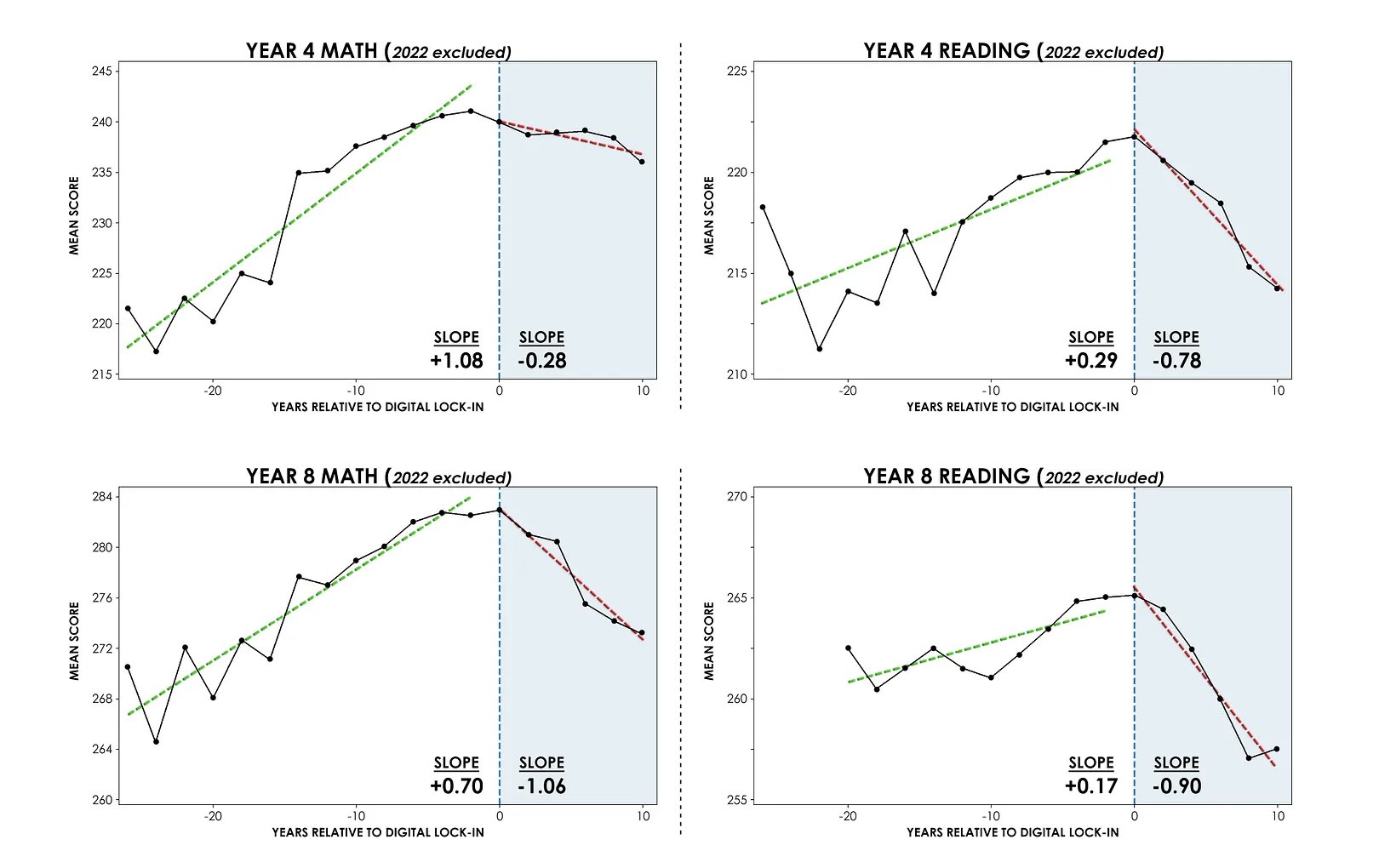
Still more evidence that EdTech harmed American education: Across states, the year that the state imposed mandates requiring computers/tablets, that's the year that test scores stopped rising and in most cases started falling.
From Jared Cooney Horvath
thedigitaldelusion.substack.…
Emiley Oster retweeted

Teach children their multiplication tables please

Well, a top math education professor from Stanford has persuaded many elementary school teachers that memorizing multiplication tables isn't essential.
Jo Boaler has repeatedly claimed that she had never memorized her times tables. “It has never held me back, even though I work with maths every day,” she said.

Emiley Oster retweeted
To make this a norm:
- Give teachers curriculum that expects fact fluency in early grades, and includes ample volumes of practice
- Introduce screeners to make sure we aren’t passing kids into upper grades without knowing times tables
- Cut the fluff from elementary math curricula

Emiley Oster retweeted

Good piece noting that one reason Oregon has among the worst educational test scores in America may be that it also has one of the shortest school years; by graduation, an Oregon kid has had the equivalent of a full year less than kids in other states. the74million.org/article/ami…


Emiley Oster retweeted

When I was a young product manager, I often struggled to get the engineers to build features customers wanted.
Eventually, I figured out the trick was to take them on customer visits. The bug or feature would get done almost immediately.
The lesson? Everyone in your company should be close to the customer.