

NFT & Meme addict
Joined September 2017
- Tweets5K
- Following3.2K
- Followers910
- Likes2.6K







You're in, but only with this invite: WIDE-LIVE-TASK
Limited spots. Don't share it publicly.
fastwork.com/join/WIDE-LIVE-…
1,096,361
1BTC = 1MBTC
.-- . / .-- .. .-.. .-.. / ... . -.-. ..- .-. . / .---- --..-- ----- ----. -.... --..-- ...-- -.... .---- / ... .- - --- ... .... .. / -... - -.-. .-.-. memebitcoin.org/register


EarthLambor🌊🎨🙏 retweeted

สมัครเกมส์ด้วย @AbstractChain Wallet แล้ว Link ไปที่ EVM เพราะ VIP จะกุญแจฟรีจากการ UPVOTE MOG ON ABS PORTAL ด้วยครับ
⚠️ ถ้าไม่เชื่อม EVM ไม่ได้ WL ทุกกรณี
ของฟรีต้องจัด


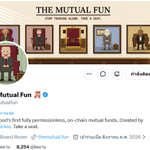
just sitting with this one for a bit @themutualfun
onchain mutual funds where the people holding the seats actually vote on what the fund holds each week. if it makes money, everyone in that fund gets a cut. five funds, random seat assignment, pretty simple idea.
2,000 soulbound TMF Passes. each one can mint 2 Seats. site is rolling out piece by piece.
bookmark it and leave it alone for now
themutual.fun no rush.
just a quieter way to not trade alone. 🪑

all my best friends are WLed for @standard_rsv
no one has vouched for me
@0xbeans, if u want a cool dude onboard, my dms are open

all my best friends are WLed for @standard_rsv
no one has vouched for me
@0xbeans, if u want a cool dude onboard, my dms are open
How to get rich with @standard_rsv
1. Understand the bank. Emissions follow real capital flow, not a fixed unlock.
2. Become a banker. 1,000 founding Charters. ~650 still unclaimed.
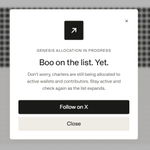
3. Get on the list. “Not on the list. Yet.” is currently my entire financial plan.
4. If demand cools: issuance slows, buybacks hit, burns hit.
5. If I get WL: I stop refreshing and start pretending this was the plan all along.
@0xbeans the whitepaper is solid. The missing step is the Charter.

i don't have any friends. so i'm waiting for @RareFriendsNFT rarefriends.com/whitelist?re…
The night before @standard_rsv isn’t interesting because of a mint window. It’s interesting because tomorrow, the protocol stops being a whitepaper and starts becoming a market.
Most launches ask one question: will people buy the token?Standard Reserve is built to ask a different one: is capital entering the system, or leaving it?
That distinction matters more than the artwork, more than the 1,000 Founding Charters, and more than whatever candle prints in the first five minutes. A charter here is not a profile picture. It is a license to operate a bank inside a closed monetary economy.
-One currency: $STANDARD.
-One market: the official ETH / $STANDARD pool.
-One signal: net ETH flow through that pool.
-One authority: immutable code.
No committee votes on whether to print. No DAO debates the rate. The pool reports whether ETH is coming in or going out, and policy is supposed to move with that signal.
If capital stays, issuance can expand and fees can stack harder reserves plus protocol liquidity. If capital leaves, issuance is supposed to contract and fees are supposed to rotate into buybacks and burns. That is the whole design in one loop. Everything else is plumbing.
-The charter is how you get a seat in that loop.
-The branch is how you take a share of issuance.
-Expansion is how you try to own more of the pie.
-Withdrawal is how you turn an internal credit into a token you can actually sell.
And none of those actions are free. Want another branch? You buy an expansion license in $STANDARD, and that $STANDARD is burned. Want the tokens in your wallet? You retire the branch that earned them, cashing out by shrinking your claim on future issuance. Stay idle too long and the system is designed to treat that as decay, not as a passive investment.
This is why the Genesis set is not just "1,000 free NFTs." It is the first cohort of bankers who will either keep the machine running or expose it immediately.
Today’s official details make the launch mechanics much clearer:
-Whitelist mint: Runs from 5:30 PM to 8:30 PM EST with a 0.15 ETH liquidity fee.
-Public Dutch auction: After the whitelist closes, remaining Genesis Charters go to a 30-minute auction starting at 1.25 ETH and descending toward a 0.15 ETH floor, ending at 9:00 PM EST.
-Proceeds: 100% of mint proceeds go to initial liquidity and protocol vaults. 0% goes to the team.
That is not decoration. It tells you what the mint is for: deepen the first pool and capitalize the vaults that the policy engine is supposed to use from day one.
After the mint, liquidity is seeded and $STANDARD trading opens. Because the launch has attention, trading starts with a temporary anti-sniping tax: 90% at the open, decaying exponentially over the first hour, with most of that decay happening in the first five minutes. Those fees feed the protocol before normal protocol fees take over. That matters for anyone planning to "be early"—the first prints are not a clean market, they are a defended open.
Day one also starts the real game for charter holders:
-Emissions for every active charter begin when trading opens.
-Branch auctions begin at the same time, with 100 branches auctioned and paid in $STANDARD through a descending Dutch auction.
-New charter auctions are not enabled yet.
So the first market is not "mint NFT, flip NFT." The first market is: who mints a license, who spends $STANDARD to open more branches, who holds issuance as an internal balance, and who retires a branch to sell into a pool that has just started measuring flow.
The useful questions tomorrow are therefore pretty specific:
1. Did the mint actually thicken liquidity, or did it just create a first-hour circus?
2. After the anti-snipe tax decays, does ETH keep entering the official pool?
3. Do charter holders burn $STANDARD to buy branches, or do they immediately look for the exit?
4. Does issuance start from a live set of banks, or from a set of idle licenses?
Price will be the loudest number. It will also be the least useful one. Net flow will tell you whether the central bank has anything to govern. Branch auctions will tell you whether bankers want more share enough to burn the currency. Exits will tell you whether the first cohort came to operate banks or to leave the second the tokens exist.
Standard Reserve is still an experiment. The paper can describe a reflexive policy, but only a live pool can prove whether contraction works when fees get thin. That is why September 14 is worth watching—not because a mint is happening, but because a monetary machine is being switched on, and the first outflow will say more than the first green candle. @standard_rsv

Close the day
Four sentences on @standard_rsv
Capital in: the system prints and stacks reserves.
Capital out: the system slows issuance and burns.
A charter is a banking license.
A branch is a claim on issuance.
Everything else is homework for Sept 14.
The market will test whether the code does what the paper says.

What to watch after Sept 14
Sept 14 is not the finish line.
It is the start of the machine.
After launch, price is the noisiest metric.
Better ones:
- is net flow green or red?
- is issuance expanding or contracting?
- are people burning STANDARD to buy branches?
- how fast are exits happening?
- is the reserve actually growing?
If the mechanism works, those numbers will say more than the narrative.@standard_rsv

Banks are not allowed to sleep
A detail most threads skip:
If a charter goes idle for 30 days, it can be reported.
There is a bounty.
There is a penalty.
Branches can be shut down and the charter can burn.T
his system does not want license holders who just sit on the NFT.
It wants bankers who keep the machine running.
That makes Genesis look even less like a PFP mint.
@standard_rsv

Hard reserves
If this system works, inflow fees are not just farmed away.
They are used to stack harder reserves, including tokenized gold.
The idea is simple:
a good market should not only print more currency.
It should also harden the balance sheet.
In a bad market, float should get scarcer
while the reserve side does not hollow out at the same time.
That is why they call it a reserve, not a farm.
@standard_rsv

The OHM difference
OHM broke on a fixed emissions schedule.
The market could reject the token and the protocol would still print.
@standard_rsv is trying to fix that.
It does not ask “is today an emission day?”
It asks “did net capital actually arrive?”
Heat up, then expand.
Cool down, then contract.
Still an experiment.
But the problem it chose is clearer than another rebase farm.

You mint tokens by retiring a branch
Bankers do not receive tradable STANDARD automatically.
The system credits an internal bala
nce first.
To get tokens you can actually sell,
you retire the branch that earned them.
Exit shrinks your claim on future issuance.
Stay and you keep earning, but the tokens are not in the float yet.
Leaving the system is supposed to cost something.
It is not a free claim-and-dump loop.
@standard_rsv

1/ Policy at @standard_rsv is not set by a committee.
It is set by the direction of capital.

4/ The hard part is contraction.
When people sell, fee flow also thins out.
The open question is whether the machine can still defend itself.