





Pinned Tweet
Taking a hiatus from updates here, but more - including open positions in the SCBIR lab @TheCrick - over there 👉 bsky.app/profile/eachanjohns…
Eachan Johnson retweeted

Now out in print: rdcu.be/dZO76
See Maria's thread below for a nice summary of what we got up to and let us know if you'd be interested in trying out any of our new tools for probing the function of PAD4/PADI4

We are very happy to share the result of a wonderful collaboration with @lwalport lab, on the development of a new suite of PAD4/PADI4 modulators
A cyclic peptide toolkit reveals mechanistic principles of peptidylarginine deiminase IV (PADI4) regulation biorxiv.org/content/10.1101/…

Eachan Johnson retweeted

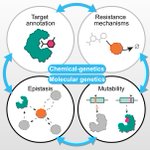
Check out this #OA review article, where Parkhill and @EachanJohnson explore potential routes to discover new antibacterial drugs, highlighting various classes of antibiotics, such as glycopeptides. #AMR #Microbiology #DrugDiscovery
doi.org/10.1042/BCJ20220062

ALT Biological approaches integrated with chemical understanding are essential for antibacterial drug discovery.
Eachan Johnson retweeted
I'm delighted to share our recent article developing an approach to identify cyclic peptide binders of challenging protein targets directly in cell lysates - led by @catherine_hurd with GSK's @Jake_T_Bush and Andy Powell @TheCrick @impch

mRNA Display in Cell Lysates Enables Identification of Cyclic Peptides Targeting the BRD3 Extraterminal Domain (Louise J. Walport and co-workers) @lwalport #openaccess onlinelibrary.wiley.com/doi/…

Eachan Johnson retweeted

New from our lab @TheCrick , led by @BetkaRoe. A fun side project that tried to understand what happens when a chaperonin encounters a translating ribosome.
biorxiv.org/content/10.1101/…

Eachan Johnson retweeted

...and if you find this work exciting, we have fully-funded PhD/post-doc positions available @TheCrick! International, collaborative environment, terrific Science and plenty of training & career support at every stage. Do get in touch, more details here
crick.ac.uk/careers-study/va…

Pumped to share our latest and first (!) work from @_Priya_R lab @TheCrick! Using the powers of #zebrafish, we uncover how multiscale mechanochemical coupling drives morphological and functional maturation of the developing heart 🫀
Stay tuned for the🧵
biorxiv.org/content/10.1101/…
Eachan Johnson retweeted
Check out this #OA review article, where Parkhill and @EachanJohnson explore potential routes to discover new antibacterial drugs, highlighting various classes of antibiotics, such as glycopeptides. #AMR #Microbiology #DrugDiscovery doi.org/10.1042/BCJ20220062

ALT Biological approaches integrated with chemical understanding are essential for antibacterial drug discovery.
Eachan Johnson retweeted
Beyond thrilled to present our first (!) work @TheCrick! A tour de force by @tobyandrews et al combining imaging, solid morphometrics, theory, perturbations to show how a developing heart grows and scales up its morphological complexity to keep beating...
biorxiv.org/content/10.1101/…
Pumped to share our latest and first (!) work from @_Priya_R lab @TheCrick! Using the powers of #zebrafish, we uncover how multiscale mechanochemical coupling drives morphological and functional maturation of the developing heart 🫀
Stay tuned for the🧵
biorxiv.org/content/10.1101/…
Eachan Johnson retweeted

Discovery of new antimicrobial has been neglected by UKRI for a while. Probably the panels still think almost non-existent Pharmaceutical research programmes will deliver new antibiotics. Very short sighted.
This Post is from an account that no longer exists. Learn more
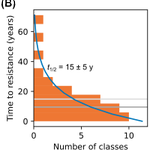
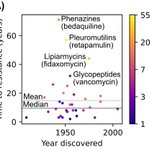
Our review on the past, present, and future of antibacterial drug discovery is out in @Biochem_Journal! It's the result of hard graft by Susie Parkhill, an excellent 3rd-year PhD. We aimed to be (hopefully) readable, informative, & a little provocative 🧵 doi.org/10.1042/BCJ20220062
Resistance mechanisms can act on chemical structure of drugs or compensate for their biological action. So we need more integrated approaches that understand both the biology and the chemistry of new drugs. We can't focus only on vulnerable targets 🧬 or only on safe chemistry 🧪

Using lots of illustrative examples, we advocate using molecular genetics in harmony with phenotypic drug discovery. Let us know what you think!
doi.org/10.1042/BCJ20220062
