

Neurosurgeon, neuroscientist, human and dog mom, social media account manager for my dog. @NeurosurgUCSF
San Francisco, CA
Joined October 2019
- Tweets827
- Following1.2K
- Followers6.7K
- Likes5K



Doris Wang retweeted

Dr. @DorisWangLab (@NeurosurgUCSF ) on focused ultrasound, incisionless treatment reshaping care for tremor and Parkinson's disease.
Register: sfneurological.member365.com…
#SFNS #ParkinsonsDisease #Neurosurgery

Doris Wang retweeted

Thrilled to share our latest work in @NatureNeuro, showing a reproducible brain signature to predict and prevent attention lapses in children before they happen. A work only made possible by @GMI_Canada mentorship and collaborators @SickKidsNews.
nature.com/articles/s41593-0…

Doris Wang retweeted

An automated #intracortical brain-computer interface, used at home with no researcher intervention, provides long-term and accurate restoration of #speech-based #communication and cursor-based computer usage in a person with severe dysarthria due to ALS. #BCI @NS_Card @SergeyStavisky @DrDavidBrandman
nature.com/articles/s41591-0…

Doris Wang retweeted

.@NeurosurgUCSF researchers developed a “smart” brain implant for patients with Parkinson’s that adjusts stimulation in real time, improving gait. "This is an important step toward a new generation of brain therapies," @DorisWangLab tells @nbcbayarea. ucsfh.org/4vcIwTD
Doris Wang retweeted
A randomized crossover study shows that gait-phase synchronized #adaptive deep brain stimulation is feasible, safe, and reduces falls compared to continuous #stimulation in #ParkinsonsDisease. #DBS #PD.
nature.com/articles/s41591-0…
Great work from @DorisWangLab, @UCSFneurosurg, @kennethlouiephd.

Doris Wang retweeted

New in @NatureMedicine, @DorisWangLab shows that distinct left- and right-leg swing biomarkers can drive DBS that changes on a sub-second timescale with each step. A major advance toward movement-driven, precision-timed neuromodulation for #Parkinsons. nature.com/articles/s41591-0…
Doris Wang retweeted

🚶🏽♂️🔄 Turns are one of the biggest challenges for people with Parkinson's disease. But what does brain activity actually do during a turn in the real world? 🧠🏠
📖 Check out our new preprint to find out!
medrxiv.org/content/10.64898…

Doris Wang retweeted

ICYMI…just realized this is available on YouTube: my presentation @CSRS_org a couple of years ago on research funding opportunities for #spine surgeons #neurosurgery #orthotwitter #mdphdlife #MedTwitter #Neuroscience youtu.be/h7yHmHlcJzg
Doris Wang retweeted

Looking forward to Dr. Wang’s lecture TONIGHT on FUS in Movement Disorders for the TEAM virtual lecture series…what a treat to have this amazing neurosurgeon/researcher present on the cusp of reaching this milestone. Learn more about TEAM here:
mailchi.mp/e94a6a9a7eb0/team…


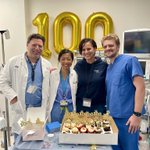
100 focused ultrasound procedures done!!! Thanks to the entire amazing team and our patients!
@NeurosurgUCSF @UCSFimaging @UCSFHospitals #hifu #fus #tremor

Doris Wang retweeted
Out today in @NatureMedicine, groundbreaking work by Philip Starr MD, PhD, Simon Little MD, PhD (@littleneuro) and colleagues shows that adaptive DBS provides better symptom control than standard DBS in a real-world setting: nature.com/articles/s41591-0…
Doris Wang retweeted

It was a tremendous honor to talk with Phil Starr @NeurosurgUCSF about ECoG recordings, iMRI DBS, the Open Mind Consortium and of course the new narrow band gamma physiomarker.
@DorisWangLab @scernera1 @CarinaOehrn @coradehemptinne
Tune in here 👇👇
stimulatingbrains.org/54-phi…

Doris Wang retweeted

🚨 New paper from the de Hemptinne lab! Big congrats to @CagleJackson @coradehemptinne and the whole team. Great summary here 👇

Ever wonder how circadian rhythms are tracked in the brain? These rhythms represent the physical, mental, and behavioral changes experienced over a 24 hour cycle. Thus, it isn't just 'light and dark' which affect these rhythms and guess what? You can measure them in the human GPi and STN if you happen to have a specific type of DBS in your brain. This study @CagleJackson and de Hemptinne in @NatureComms is pretty cool.
Key Points:
- This study examined GPi circadian rhythms in a large cohort of subjects with PD.
- They collected 130 recordings from 93 subjects.
- GPi activity was recorded in their home environment.
- There was a significant change in GPi activity between day and night in 82%.
- There was a reduction in GPi activity at night in over half of recordings. Interestingly, there was an increase in activity in about a quarter.
My view: It is really important that we recognize that circadian fluctuations are present and can be monitored from activity in the GPi (and also in the STN). There are important clues hidden in these brain tracings. Re-emergence of pathological neural activity is an important clue in understanding disruptions in the sleep cycle. This may help explain why when we re-dose sinemet at 2-3 AM it is helpful for folks to get back to sleep. Looking forward to more studies to further enlighten us on circadian patterns recorded from subcortical structures.
nature.com/articles/s41467-0… #parkinson #tremor @DBSThinkTank

Doris Wang retweeted
Congratulations to our three teams of @UCSF_Catalyst awardees! 🎉 The awards support their innovative research projects developing new technologies for patients with #glioma & #ParkinsonsDisease as well as minimally invasive surgical approaches.
@DorisWangLab @RithvikRamesh6

ALT Award graphic showing UCSF Neurosurgery's 2024 Catalyst Awardees. Top row: Jacob Young, MD and John de Groot, MD; Development of Hand-held Intraoperative Focused Ultrasound Device for Glioma Patients. Middle row: Hamid Fekri Azgomi, PhD, Rithvik Ramesh, and Doris Wang, MD, PhD; Development of Personalized Adaptive Deep Brain Stimulation for Enhancing Gait Functions in Patients with Parkinson’s Disease. Bottom row: Can Senol, MD and Luis Savastano, MD, PhD; A Minimally Invasive System for Brain Surgery.
Doris Wang retweeted

Amazing to see an outstanding neurosurgeon Dr Aaron Clark at @SFNeuro 🧠 Thank you for helping so many of our patients to overcome #pain and get back to better functioning! @ahsheadache @AANmember @WNGtweets @miles4migraine #Spine

Doris Wang retweeted
Speaker Spotlight at #SFNS2024!✨
Dr. Clark completed his #neurosurgery residency at @NeurosurgUCSF and pursued fellowship training in #MISSurgery at @SemmesMurphey.
Dr. Clark will present “Minimally Invasive Treatment of #Lumbar Stenosis.”
To register: sfneurological.org/cme/cme-e…

Doris Wang retweeted
Can you believe our talk series turns ONE already ? 🎂
It’s been a whirlwind, & we couldn’t have enjoyed this 🎢 more!
Thanks a million to all our amazing speakers, attendees, & partners for an incredible year of learning & 🧠-boosting inspiration!
Here's to many more! 🥂🎇

Doris Wang retweeted

Excited to share this paper using new neurotech and explainable AI to advance DBS for treatment resistant #depression (TRD). Team effort including @HelenMaybergMD, @sankar_alagapan and Patricio Riva-Posse. Summary thread!
go.nature.com/48lmlzC
@nature
PC: Mike Halerz

Doris Wang retweeted
Recharged & ready to roll 🏝️☀️ – our talk series is back from it summer siesta! Join us 🔜 to have your brains rebooted by mind-dazzling insights on adaptive DBS from the brilliant @scernera1 & @DorisWangLab!
📅 Aug 31st (12PM ET/6PM CET)
💻 Registration: talks.stimulatingbrains.org
Doris Wang retweeted

#NEUVisualAbstract A Systematic Review Comparing Focused Ultrasound Surgery With #Radiosurgery for Essential Tremor bit.ly/3YH6jLJ by @skondapavulur et al @AnnetteMolinar2 @DorisWangLab @CNS_Update @DKondziolkaCNS @ChenWuMD @adelawu #Thalamotomy #Essentialtremor

Doris Wang retweeted
UCSF neurosurgeon Dr. Doris Wang (@DorisWangLab) successfully used high-intensity focused ultrasound—an incision-free, minimally invasive procedure—to treat several older adults w/ hand tremors. Patients are thrilled w/ the results, she reports. ucsfh.org/3KOCe7B