

Welcome to Disruptive Concepts – your crystal ball into the future of technology. 🚀 In an age where innovation moves at lightning speed, it's easy to be left b
Menlo Park, CA
Joined September 2023
- Tweets8K
- Following5.3K
- Followers2.9K
- Likes189K





AI now leads 26% of its own R&D at Anthropic (up from ~1% in February). Not “assisting”—completing most of the task end-to-end while humans supervise.
The bottleneck is no longer model capability. It’s how fast humans can set the right tasks, review the work, and keep the loop safe. Labs that treat supervision as the product win the next decade.
bloomberg.com/news/articles/…

The next AI regulation fight won’t be about safety theater. It will be about who controls the marginal unit of compute.
Once inference costs drop another 10x, the economic advantage shifts from “who has the best model” to “who can run the most experiments against real users without asking permission.” Any framework that forces every new agent or fine-tune through a central gate effectively hands the next decade of progress to the three or four entities that already have the capital and the compliance teams. Open ecosystems win when iteration speed is the binding constraint. Closed ones win when permission is. Choose which game you want to play.
You don’t need a bigger AI team. You need people who can do three things:
1. Direct models with high taste (know what good looks like)
2. Build the systems that make output consistent (prompts, workflows, review loops)
3. Kill anything that doesn’t move the business metric
Most AI content fails because teams hire for prompting skill and ignore the other two. The leverage is in the person who can own the full loop, not the person who just knows how to use the latest tool.
Most companies are adding AI tools to their existing content process.
The ones moving faster are rebuilding the process around AI.
They treat models as junior team members: give them clear systems, tight feedback, and ownership of specific outputs. They measure speed-to-ship and quality retention, not “AI usage.”
If your AI content still needs the same number of people and the same amount of time, you’re not using the technology. You’re decorating the old way of working.
DisruptiveConcepts retweeted

A lot of questions this week on funding, so here's how a GPU typically gets funded at $IREN.
First, the customer signs a multi-year take-or-pay contract and agrees to a prepayment. On our recent 3-year contracts, prepayments have been 45% to 55% of the associated GPU capex.
Second, financing is committed, secured by the contracted GPUs. On the Microsoft contract we secured an A-rated facility at around 6%, which together with prepayments covers 96% of GPU capex. More recently, for a non-investment grade counterparty at Mackenzie, we secured financing at 9% fixed, which together with prepayments covers more than the full cost of the GPUs.
That's the GPU side. The data centers are a separate, long-term asset base, and we own the ones our GPUs run in. Construction has been funded from cash to date, with no debt against these multi-billion dollar assets. As they come online with contracted customers, they can support financing in their own right.
The processes behind the next facilities are continuing, and new paper will cost what the market charges. With GPU paybacks of around two years on our recent 3-year contracts, a wider spread barely moves the economics.
There's more customer demand than we can build for. As we noted at our recent earnings, 2026 is largely sold out, recent 3-year contracts are at more than double the prior year's pricing, and demand for anything we can bring online in 2027 covers it several times over, with prepayments a focus in every negotiation. Conversations on 2028 capacity are already underway.
Meanwhile announced capacity keeps slipping across the industry, which is the point: signing deals isn't the bottleneck in this market, bringing GPUs online is, and that's our focus.


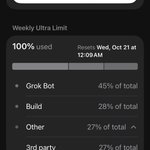
What 3rd Party? The top
up Tokens 🔥 super fast. 75$ in an hour. Unification isn’t going well. How do we separate back to cursor? #grokxit

DisruptiveConcepts retweeted

According to Waymo’s safety research, its vehicles had 92% fewer crashes involving pedestrian injuries than the human driver benchmark in comparable conditions.
Given that 36,000+ U.S. traffic fatalities happen every year, the safety case is the strongest argument for deployment.

Giving a robot a reliable sense of touch changes what it can safely handle on a factory floor. Strain and force sensors precise enough for delicate assembly or adaptive gripping turn humanoids and arms from demo pieces into everyday tools that reduce skilled-labor bottlenecks. $VPG
DisruptiveConcepts retweeted

Bullish on biotech

A weekly jab in the belly is generating more revenue than the entire AI industry.
Ozempic + Mounjaro: $71B in 2025.
OpenAI + Anthropic: $29B.
And they've barely started. ~2% of the 800 million eligible patients can currently access them.
h/t @DrSamuelBHume

DisruptiveConcepts retweeted

Poppi's founders just learned the most expensive lesson in M&A!
When they sold to PepsiCo, the deal was for $1.9B plus a $300M earnout (a future contingent payment based on the performance of the brand for some period after closing).
And PepsiCo just announced that it is valuing that $300M at a “paltry” $12M.
That stings!
I've negotiated a lot of earnouts in my career. Here's what most sellers don't understand until it's too late:
1. An earnout is a future bet on a business you no longer control.
After closing, the buyer sets budget, pricing, hiring, marketing, etc. Every lever behind whether or not you get your earnout belongs to someone else.
2. The incentives can flip the day you close if you’re not careful.
As a seller, you want to do everything to hit the targets. But as the buyer, you pay less if they're missed.
Ideally, the earnout is structured so that both parties win or lose together.
If performance tanks, the buyer earns less overall so it pays less to the seller.
If performance improves, the buyer earns more so it pays more to the seller.
Incentives are aligned.
What you absolutely cannot allow to happen is an earnout structured so that performance can improve allowing the buyer to earn more, but still pay less to the seller.
How on earth could that happen?
I'm so glad you asked...
3. The accounting decides the outcome.
How you define "revenue", "EBITDA" or any other measurement metric used to determine the earnout is what ultimately drives the payout.
So things like how corporate overhead gets allocated or what happens when the Seller’s product is folded into a larger brand with competing products becomes unbelievably important.
Again, remember the incentives.
With a poorly structured earnout, a company like PepsiCo could be incentivized to buy a brand like Poppi and purposely underinvest in the brand in order to eliminate a key competitor to its other products.
So PepsiCo could earn more by driving more revenue to products other than Poppi, while simultaneously reducing the earnout payable to Poppi because Poppi's direct performance declines.
PepsiCo wins -> Poppi loses.
Sellers have to be very careful about how the accounting for the earnout is defined and whether it causes misaligned incentives.
4. The reasons above are why earnouts are among the most litigated terms in M&A.
Sellers often sue buyers claiming the buyer sandbagged performance. And Buyers defend by saying “The contract gave us full discretion."
Courts will generally enforce whatever terms the parties agreed to in writing, so an argument that Buyer acted in “bad faith" rarely saves a seller who didn't negotiate adequate protections.
5. If you agree to an earnout, protect it at all costs!
> Tie it to metrics like revenue, which are subject to less manipulation than metrics like Adjusted EBITDA.
> Include strict operating covenants around things like required budget, sales support, and no diverting customers to other products or business lines.
> Push for audit rights and a dispute mechanism.
> Demand acceleration of the earnout if the buyer or product line is sold, merged, shut down, or deprioritized.
> Keep the measurement period short! The longer the period, the more opportunity it gives a Buyer to game the system.
To be transparent, I don’t have any background into what happened here. I have no idea if the earnout was poorly structured or if PepsiCo acted in a way to purposely reduce the earnout.
That's not the point of this post.
What I do know is that a $300M earnout that is written down to $12M is a tale as old as time and almost certainly to end up in litigation.
And even if not the case in this particular instance, in most cases where this happens, there's often things that could have been done in the transaction documents to avoid it.
My advice to every seller I represent who is considering agreeing to an earnout is simple:
Value the deal based on cash at close and treat the earnout as a bonus. If you get it, great. But don’t count on it!


Pepsi paid $2bn for Poppi and now says it won't pay the $300m earnout. Everyone's acting surprised.
What happens when a giant buys a challenger brand, with the receipts:
- Honest Tea, Odwalla, Zico: all bought by Coke, all discontinued. Zico's founder bought it back.
- Bai: Dr Pepper paid $1.7bn, wrote most of it down.
- Bodyarmor: Coke paid $5.6bn, took a $760m impairment three years later.
- Rockstar: Pepsi paid $3.85bn, has lost share every year since.
- Freshly: Nestlé paid $1.5bn, shut it within three years.
- Dollar Shave Club: Unilever paid $1bn, sold it for a fraction seven years later.
- Bonobos: Walmart paid $310m, sold for $75m.
- Mirror: Lululemon paid $500m, wrote it off and shut it.
- Ballast Point: Constellation paid $1bn, sold for pocket change four years on.
- Reebok: Adidas paid $3.8bn, sold for $2.5bn fifteen years later.
- Snapple: Quaker paid $1.7bn in 1994, sold for $300m in 1997. The original.
The pattern isn't bad luck. The brand was bought to protect the original and core portfolio, not to grow. Once it's off the market, the job is done.
If you ever sell to one of these: the cash on day one is the price. Everything else is a promise from someone who is incentivized is not to keep it.


DisruptiveConcepts retweeted

The same message we had shared a week ago seems to only have strengthened since as B200 and B300 GPU rental prices continue to rise sharply!
Also, dark mode is cool! So expect to see more of it going forward. 😄


Allegedly “the most important chart” for understanding the current state of the AI economy. The model layer seems to be going through a period of commodification as non-frontier models saturate everyday use while frontier models compete fiercely. Compute layer sees massive increase in total demand for compute regardless of the source or use case.

💯

Delta, Chase and Amazon are blocking AI agents.
The war on agents has begun, and here’s how it probably plays out:
Stage 1: Companies block agents because agents skip the ads and upsells.
Stage 2: Agents learn to act like humans, and it becomes an arms race.
Stage 3: The market splits. Companies that make money on sales let agents in, companies that make money on data charge for access, and the giants build their own agents.
Stage 4: A trusted middle layer for agent identity and payments becomes the standard way in.
Stage 5: Companies that welcome agents start winning customers from the ones that block them.
Stage 6: The agent blockers come back and let agents in on their own terms.
Stage 7: Everyone starts competing for agents with better prices, faster checkout and SEO built for agents.
Stage 8: The ads come back, and companies pay to be your agent’s first recommendation.
Stage 9: The agent war ends, and selling to agents becomes as normal as having a website.
DisruptiveConcepts retweeted

Rough day for the smart TV industry.
This took me 10 min from my phone with Grok @bot


DisruptiveConcepts retweeted

Google has another banger 🤯
It’s called PaperBanana.
It turns your methodology text into academic illustrations, helping you explain your research visually.
100% free.

