

Meteorologist. PhD in Radar Signatures of Severe Weather, UNL 2025. Father and husband. Member of the Church of Jesus Christ of Latter Day Saints.
Edmonton, Alberta
Joined March 2021
- Tweets142
- Following135
- Followers90
- Likes589






Pinned Tweet
Just finished some final edits from the Didsbury, Alberta EF4 on July 1, 2023. Quite the day!

Devon Healey retweeted

Introducing: Polygons.
Forecasters can now draw shapes around weather hazards, allowing them to target alerts.
Severe thunderstorm and tornado warnings… where they are needed most. 🌎
More: ow.ly/ntZF50ZzXVh
Devon Healey retweeted

French: While largest ZDR columns <40 km2 (by their measurement technique, not available operationally) rarely/briefly occur in nontornadic storms, they are single-scan/fleeting.
One tornadic storm can have more volume scans of such “immense” ZDR columns than all known nontornadic cases put together (7). Why such strong precursory association, physically?
Need to look at assoc. of SRW & large columns/updrafts. #sls32

Devon Healey retweeted

Mike French @StonyBrook_RAM exploring a possible relationship between ZDR column area and tornadogenesis and tornado intensity – at Monona, WI


Devon Healey retweeted
Kuster: HWT warning experiments/exercises show forecaster participants overwhelmingly preferred the more-frequent updates and better vertical coverage of PAR vs 88D. They adapted to the firehose of more/faster info. Gave more confidence in warning issuance (or not issuing!), and in being proactive as much as reactive.
Me to world: so why the hell is this not already operational? Phased-array tech has been around my whole lifetime and has been tested on real storms for many, many years.
#sls32

Devon Healey retweeted

In collaboration with SPC, a new track-based hail dataset is being developed with more than 175k hail events and proximity soundings since 2003. The dataset will store start/end points, MESH swath polygons, event length, width, duration, storm motion, and more. #AMSMadisonSummit

Devon Healey retweeted
An updated SARS in development finds the closest severe wx analogs to any sounding, using a database of nearly 500k events and full-skew-T and hodograph matching. It can help predict hazard type, intensity & path length. Research is in collaboration with SPC. #AMSMadisonSummit

Devon Healey retweeted
Matthew Jeglum, from a talk entitled, “Can a Tornado Warning Cause More Damage Than the Tornado Itself?”
One major point being: bad and/or unneeded warnings have not just a credibility cost, but economic too. #sls32

Devon Healey retweeted

Super excited to present my work on vertical supercell mesocyclone alignment this WEDNESDAY at the #AMSMadisonSummit!
If you’re attending and want to check it out, this will be part of Session 11A - Supercell Dynamics and Hazards II at 2:45 pm 🌪️
(Previous post said Tuesday)


Devon Healey retweeted
This was a well-developed, probably significant, supercellular tornado, based on my experience, and the surrounding ambient structure:: hard to beat! The Southern Hemispheric winter has yielded a few outstanding ones so far.

Dual pol signatures in supercells show promise folks! #abstorm


TORNADO ON THE GROUND! 🌪️
@WxMelinda21 @KMacTWN @MurphTWN @NicoleKarkic @nadinehp4 @RhythmTheMet @RachelSchoutsen @JordyCaprice @laurapowerwx @StormhunterTWN @LFB10
#ShareYourWeather #abstorm
July 18, 2026. 6:20pm mdt

There's a new version of this post
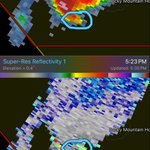
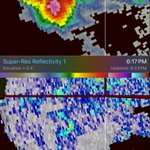
Still quite the ZDR column on this #abstorm. For those unfamiliar, larger ZDR columns in supercells may be more indicative of tornadic potential

The tornado warned #abstorm has what appears to be an impressive ZDR column with it…


Still impressive ZDR column with new area of convergent rotation… it’s definitely thinking about it #abstorm

What’s also interesting is that much of the core of the storm does not appear to be dominated by a large hail volume… worth watching… #abstorm


#abstorm @environmentca my farming family folks reported 8 inches (203mm) of rain at their location just north of Magrath at the conclusion of the bulk of the rain. Likely contaminated by some heavier convective precipitation as well - but worth including!
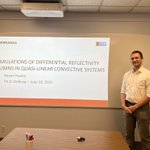
🚨 Pleased to share the second paper of my dissertation work has been published in Monthly Weather Review in EOR! We examined the connections between ZDR columns and mesovortices in simulated QLCSs! Full article to be available soon!
doi.org/10.1175/MWR-D-25-010…

Devon Healey retweeted

UNL is proposing to cut the Department of Earth and Atmospheric Sciences, which would eliminate the undergraduate and graduate meteorology programs. Please consider sharing the importance of our department with UNL through this link: apc.unl.edu/fall-2025-budget…


