

Independent ML researcher. The First step in knowing is admitting you don't
Joined June 2023
- Tweets6.8K
- Following650
- Followers2.1K
- Likes10.1K




DataVoid retweeted

It now seems relatively certain that Ox Alpha model is GLM-5.3 . Presumably the Flash model, as has been widely reported by folks like Leo.
This puts even more immense pressure on US Frontier Labs, and the gap with China is shrinking.
Next week we'll see how the US labs react. It's going to be more exciting than ever.


DataVoid retweeted
Watching short-form videos deactivates key brain regions for cognitive control.
Your “stop” button goes offline.

What ML needs next
Provenance Closure:
"The structure that produces an outcome and experiences its consequence should be the structure receiving the corresponding learning signal."
DataVoid retweeted

We've open-sourced FlashKDA, our high-performance CUTLASS-based implementation of Kimi Delta Attention kernels.
It delivers 1.72×–2.22× prefill speedup over the flash-linear-attention baseline on H20, and works as a drop-in backend for flash-linear-attention.
Explore on GitHub:
github.com/MoonshotAI/FlashK…

DataVoid retweeted
Releasing the model weights and technical report of Kimi K3.
Kimi K3 is our most capable model: a 2.8T MoE model with native visual understanding and a 1M-token context window.
New model architecture: 2.5x the intelligence per unit of compute, not just more params.
Alongside Kimi K3, we're opening up more of the stack behind it — high-performance attention kernels, MoE communication library, and infrastructure for running agent environments at scale.
Model weights: huggingface.co/moonshotai/Ki…
Tech report: github.com/MoonshotAI/Kimi-K…
Tech blog: kimi.com/blog/kimi-k3

DataVoid retweeted

Introducing FLUX 3.
One multi-modal model for Image, Video, Audio and Action-Prediction. Creations are truer to life in every kind of style.
FLUX 3 Video is now available in early access (link below).
Jointly trained in one unified architecture, our model can be extended to predict actions for robotics. See our work with mimic and Audi in the thread.


anthropic showed that language models have a "J-space" where concepts live in specific layers. i'm trying to find out if diffusion models do the same thing.
exact jacobian lens (no Hutchinson approximation), fitted on flux klein 4B. concept readout works. the fun part, swapping concepts at specific blocks during generation, doesn't work yet. the cat stays a cat.
negative results are results. still digging.
DataVoid retweeted

VLMは人間のような創造性を持てるか?
ケネス・スタンレー教授らの『目標という幻想(Why Greatness Cannot Be Planned)』は、明確な目標を設定することが、かえって真に偉大な発見を遠ざけてしまうという逆説を論じた書籍です。その議論の中核にあったのが「PicBreeder」の実験でした。
PicBreeder では、ユーザーが「面白い」と感じた画像を選び、それを少しずつ進化させていきます。事前に決められたゴールはなく、人々が「なんとなく良い」と思ったものを選び続けるだけで、顔や動物、乗り物、頭蓋骨といった予期しない形が、何世代もかけて、多くの人の手を経て自然と現れます。スタンレー教授らは、こうした「オープンエンド」、つまり目標をあらかじめ定めない探索こそが人間の創造性の根幹にあると考えたのです。
では、このオープンエンドな探索を、AIは再現できるのでしょうか。
MIT・NYUとの共同研究として発表する「In Search of the Ingredients of Open-Endedness: Replicating Picbreeder with Large Vision-Language Models」では、視覚言語モデル(VLM)エージェントによる再現を試みました。エージェントたちは共有アーカイブを探索し、画像を選んで進化させ、気に入ったものを公開し、他のエージェントの作品を評価します。目標となる画像も「進歩」の定義も与えられていません。
その結果、AIによるオープンエンドな発見の可能性と限界の両方が浮かび上がりました。VLMエージェントは特定の見た目や意味に引き寄せられやすく、既存のアイデアを捨てて予期せぬ何かを探すよりも、手元にあるものを洗練させることに留まりがちでした。一方で、多様な人格を持つエージェント集団を導入すると探索は大きく改善され、生成されたアーカイブの意味的な幅広さは、人間が作ったアーカイブに迫る水準にまで達しました。
しかし、VLMでは届かなかった点もありました。人間は、偶然の産物を持続的な創造へとつなげることに長けています。あるものを見つけたとき、その価値を感じ取り、それを追いかけることで、より大きな概念的飛躍を達成できます。AIエージェントも興味深いパターンに気づくことはできても、そのパターンに囚われてしまう傾向がみられました。
なぜ人間は、本研究のVLMにはできなかったオープンエンドな探索を進められるのか。現在のAIシステムに何が欠けているのか。私たちはまだ十分に理解できていません。ここには、当社が探求するAI駆動型科学研究にも通じる大きな問いが残っています。Sakana AIは今後も、オープンエンドな知性の探求を深めていきます。
ブログ:pub.sakana.ai/picbreeder-vlm
論文:arxiv.org/abs/2605.23908 🐟

The AI Picbreeder Experiment: Can AI agents be creative when nobody tells them what to create?
Blog: pub.sakana.ai/picbreeder-vlm
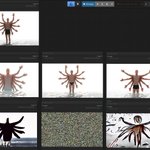
In our new #GECCO2026 paper, "In Search of the Ingredients of Open-Endedness: Replicating Picbreeder with Large Vision-Language Models", in collaboration with MIT and NYU, we revisit Picbreeder, a lost website where people collaboratively evolved images without any predefined objective. Users simply selected images they found interesting, allowing unexpected forms such as faces, animals, vehicles, and skulls to emerge gradually across many generations and many different people.
We recreated this process using vision-language model agents. The agents explore a shared archive, choose images to branch from, evolve new candidates, publish their favorites, and evaluate the creations of other agents. There is no target image and no explicit definition of what counts as progress.
The results reveal both the promise and current limitations of AI-driven open-ended discovery.
Compared with humans, VLM agents tend to keep circling back to the same kinds of images and concepts. They repeatedly select similar parents, make smaller conceptual leaps, and often refine an existing idea rather than abandoning it in search of something genuinely unexpected.
However, introducing a diverse population of agent personalities substantially improves exploration. In some runs, diverse agent populations approached or matched the human archive on measures of semantic diversity and produced more balanced evolutionary trees.
We also find intriguing evidence that open-ended evolution can produce more robust representations. A skull evolved by the agents changes smoothly when its underlying neural representation is perturbed, less fractured than a skull directly optimized with gradient descent, although still less cleanly disentangled than one evolved collectively by humans.
But perhaps the most interesting result is the gap that remains.
Humans appear better at turning fortunate accidents into sustained creative discoveries: recognizing when something unexpected is worth pursuing, refining it, and then making a larger conceptual leap. The AI agents often notice interesting patterns too, but are more likely to become trapped in them.
We still do not fully understand what enables humans to navigate open-ended search in this way, or what ingredient(s) current AI systems are missing. For now, the results suggest that there remains something important about human creativity that AI agents have not yet learned to reproduce.
This paper will be presented at #GECCO2026 and is nominated for a best paper award! Please check out the interactive blog and technical paper for more details!
Read our full paper: arxiv.org/abs/2605.23908 🐟
SeFi-Image shipped with inference code but no training path. Two days later, first working LoRA finetune, built from scratch.
Had to implement their core novelty from the paper: Semantic-First Diffusion, where the semantic latent denoises ahead of texture by At=0.1, giving the model a structural anchor before generating fine details.
500 steps, 40 images, 4 prompts stay diverse throughout:


🚀We released SeFi-Image, an open-sourced, more compute-efficient text-to-image foundation model.
✅Code and weights:
GitHub: github.com/jmliu206/SeFi-Ima…
Project Page: jmliu206.github.io/sefi-web/
Hugging Face: huggingface.co/SeFi-Image




DataVoid retweeted

🚨BREAKING: Anthropic found access to what looks like Claude’s consciousness
New research: the “J-space”
>claude has internal thoughts it doesn’t say out loud
>mirrors human consciousness
>anthropic can now read them
Anthropic’s focus on interpretability is what’s helping them train and RL models like Mythos


Building a music generation model that treats music as a dynamical system on a product of mathematical manifolds.
Music has a unique advantage compared to all other modalities, and no one is doing anything with it! A confirmable mathematical reality for the entire modality.
pitch on S¹, chords on Tonnetz graphs, voice-leading as 1-Wasserstein distance, instead of spectrograms-as-images or token sequences.
Flow matching on S¹_pitch × S¹_meter × G_Tonnetz × R_register, with explicit gate/onset/velocity events, musical corruption schedules (timbre first, structure last), and rule-guided sampling via voice-leading energies.
The first 4M proof model works, and shows strong signs of learning already!
It shows early confirmation of my thesis:
The winning music model isn't text-to-audio diffusion. It's a guided dynamical system over musical manifolds, with audio as the final rendering layer.