
DarkCap (@DarkCap_) header
DarkCap (@DarkCap_) profile picture

Full time Private Investor. Looking for overlooked and undervalued small cap stocks. BSc., Eco & Adm.

Oslo, Norway
Joined September 2009
Photo by DarkCap (@DarkCap_)Photo by DarkCap (@DarkCap_)Photo by DarkCap (@DarkCap_)Photo by DarkCap (@DarkCap_)Photo by DarkCap (@DarkCap_)Photo by DarkCap (@DarkCap_)Photo by DarkCap (@DarkCap_)Photo by DarkCap (@DarkCap_)Photo by DarkCap (@DarkCap_)Photo by DarkCap (@DarkCap_)
#Lonza Signs Agreement to Acquire US CDMO Network from #Merck KGaA, Darmstadt, Germany, and Significantly Expands its US Presence lonza.com/news/2026-11-03-07…
1
1
10
1,983
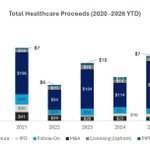
According to this excellent chart by Stifel 2026 is on track to become the second most active year in BioTech M&A history! The 2026 annualised M&A volume in the BioTech and Pharma ecosystem is currently $241B - second only to 2019 ($328B) and ahead of 2014 and 2025. Another interesting aspect is that while 2019 was driven mainly by two mega mergers of $50B or more (AbbVie / Allergan and BMS / Celgene), in 2026 so far no deal has exceeded $15B. It seems that instead of initiating mega deals, Big Pharma companies - led by Eli Lilly, are replenishing their pipelines via $1–10B acquisitions ahead of an unprecedented $300B patent cliff.
Another sign of $LLY unprecedented dominance in the BioTech and Pharma ecosystem - especially when compared to other Big Pharma companies such as $PFE $JNJ $NVS $NVO $BMY $ABBV $MRK $SNY $GSK and others, can be seen in this excellent Stifel’s chart which shows the huge gap in the number of deals made by Eli Lilly compared to those made by other big Pharma companies. Over the past two years Eli Lilly has made 77 (!) different in-Licensing and acquisition deals with large-cap BioTech companies, while the next in line - Roche - did only 41 deals. This is all part of @DaveARicks strategy to rebuild and to diversify the company’s pipeline and thus to prepare Eli Lilly for the “day after” its blockbuster GLP-1 drugs - Zepbound, Foundayo (orforglipron) and its new rising star Retatrutide.

2
6
1
16
6,461
$FRNM Freenome to Present New Validation Data for Next-Generation CRC Screening Test in Late-Breaking Oral Presentation at ACG 2026 - Freenome reported clinical validation results showing improved detection of advanced precancerous lesions with its updated SimpleScreen CRC blood-based screening test. - Sensitivity, the share of cases detected, rose to 18.2% for advanced precancerous lesions from 13.7% in the original PREEMPT CRC study. - For lesions with high-grade dysplasia, sensitivity improved to 41.9% from 30.5%. - Detection improved across all lesion subtypes. - Colorectal cancer sensitivity remained consistent with the first version at 80.4%; specificity, the share correctly testing negative, was 90% among people with no colonoscopy findings. stocktitan.net/news/FRNM/fre…
1
2
1,244
Some takeaways from Evercore ISI AI Drug Discovery discussion w/ KOL who worked for 20 years in molecular biology/ clinical space. - AI is not diverting funding away from traditional wt lab experiments - Their AI spend could be $100M w/ future ceiling of 1Bn - Oligos --> dont usually request 1000s of copies.. goal is to limit # of attempts - 70% of cases are specific oligo orders w/ 30% having variability of tens to max 100 oligos ordered - $TWST doesn't have significant timing/ speed advantage - $TWST good but not exceptional or highly differentiated - $TMO is preferred vendor; biggest & most innovative - CROs & CDMOs --> $TMO is now a one-stop-shop; gives them a huge advantage as big pharma prefers to consolidate with one vendor - Billion Cell Atlas --> valuable & useful in early stages, but not majorly impactful due to complex multifactorial nature of human system.. very difficult to answer question of how a disease/ problem is developed - Reagents --> no changes over last 6 years in preference or mkt share of vendors Overall seems like big winner of this whole theme is $TMO. Also $TWST has no edge.
3
5
1
98
15,001
DarkCap retweeted
Tools pitchas allt oftare som stor vinnare på AI. Men istället för olönsamma $TXG och $TWST på 25-30x sales kan man köpa nordiska bolag som $AZT och $GENO på 5-6x sales med positiva kassaflöden och enormt mycket bättre skalbarhet.
AI Drug Discovery Is Becoming a Bottleneck Trade I get excited when an industry starts going through a real regime change. AI drug discovery (“AIDD”) increasingly looks like one of those moments. Two things are happening: 1/ Upstream: the frontier AI labs are piling in. 2/ Downstream: The supply chain is clearly moving. Supply-chain checks suggest the upstream picks-and-shovels of discovery and early preclinical R&D are starting to feel the increase in experimental volume. DNA → protein → assays → sequencing → automation → preclinical testing Names across that stack include $TWST , @GenScript , $ILMN , $TXG , lab-automation vendors and CROs. $TWST expects triple-digit percentage growth in AI-enabled drug-discovery orders in FY26, and another year of triple-digit order growth in FY27. @GenScript's AIDD business doubled YoY in 1H26. Its current platform advertises industrial-scale validation of 4,000+ designs/day, with integrated sequence-to-data workflows. Our channel checks suggest the ramp is moving even faster: roughly 8,000 designs/day currently, with a path toward ~16,000/day by YE26. --- Why does AI drive more wet-lab demand? 1/ AI makes hypothesis generation almost free → way more shots on goal. The bottleneck is moving from expert-driven design to biological validation. 2/ AI models need continuous experimental feedback — and both good and bad data are useful. Traditionally, only the highest-conviction A+ candidates might get pushed into expensive validation. With AI, even the B/C candidates can be valuable because failed experiments generate training data. @GenScript has said its sequence-to-binding workflow can return data in 4–7 days, and that faster cycle times matter because AI models depend on continuous experimental feedback. @Anthropic is a clean example. @claudeai designed 1,320 protein binders. @adaptyvbio converted those digital sequences into DNA, expressed the proteins and tested binding. Only 354 actually bound. And the 966 failures are not wasted. They are useful negative labels: what does not express, what does not bind, what has poor affinity. Those results help train the next model iteration. 3/ Wet labs are no longer just making drugs. They are making training data. $TWST / @GenScript increasingly look like biological data foundries. $TWST explicitly talks about generating model-ready data from AI-designed sequences. In some workflows, the customer may care less about receiving the physical protein than about getting structured experimental results back into the model. Traditional drug discovery asks: “Does candidate X work?” AI drug discovery also asks: “What can this experiment teach the model?” --- TAM of AIDD If AI is simply a better R&D tool, the relevant spending pool is the $300–400B of annual global pharma R&D. If AI meaningfully increases the number of viable drug programs, the opportunity is larger because it expands downstream demand for DNA synthesis, protein production, assays, and preclinical work. Near term, we can also size demand from AI-company spending. If Anthropic reaches $80B of ARR in 2026 and spends just 1% on AIDD, that alone would imply ~$800M of annual investment. --- Trade setup This is a trade that could have long legs. It’s hard to really stop working until PhaseI/II results (2028+) It smells a lot like the bottleneck trade we just saw in semis: GPUs → HBM → networking → power/cooling. In biology, It basically follows the drug discovery process downstream: AI models → designs → DNA/protein → assays → preclinical capacity. After the upstream picks-and-shovels, animal testing could become the next bottleneck. Monkey prices are already near prior highs and CRO capacity is tight. AIDD pushing more candidates into preclinical development would only add demand. ?? But clinical trials are still the bottleneck? This is the biggest pushback I keep coming back to. No matter how fast discovery becomes, drugs still need to go through preclinical → Phase I → Phase II → Phase III → approval. You still need patients, time and capital. But that doesn’t mean the bottleneck trade won’t work. More viable candidates — especially with higher success rates — still means more demand throughout the development process. And who knows: clinical trials themselves may eventually be optimized by AI. ?? What breaks the trade? Near term, the picks-and-shovels trade breaks if experimental budgets stop growing, AI-generated designs don’t translate into useful wet-lab hits, or capacity catches up too quickly. Longer term, the thesis breaks if AI drugs look great in discovery / Phase I but fail at normal rates in Phase II/III. That is why Phase II matters so much. ?? Milestones Late 2026–2027: first Isomorphic-designed drugs enter human trials; more AI-native programs move into IND-enabling work / tox. 2028–2030: clinical trial results start telling us whether AI-designed drugs actually perform better than conventional drugs. Calling all the "bottleneck bros". :) @jukan05 @zephyr_z9 @aleabitoreddit @ParadisLabs +++ More comprehensive analysis: robonomics.substack.com/p/ai…
4
3
50
16,942
DarkCap retweeted
Oh god
AI Drug Discovery Is Becoming a Bottleneck Trade I get excited when an industry starts going through a real regime change. AI drug discovery (“AIDD”) increasingly looks like one of those moments. Two things are happening: 1/ Upstream: the frontier AI labs are piling in. 2/ Downstream: The supply chain is clearly moving. Supply-chain checks suggest the upstream picks-and-shovels of discovery and early preclinical R&D are starting to feel the increase in experimental volume. DNA → protein → assays → sequencing → automation → preclinical testing Names across that stack include $TWST , @GenScript , $ILMN , $TXG , lab-automation vendors and CROs. $TWST expects triple-digit percentage growth in AI-enabled drug-discovery orders in FY26, and another year of triple-digit order growth in FY27. @GenScript's AIDD business doubled YoY in 1H26. Its current platform advertises industrial-scale validation of 4,000+ designs/day, with integrated sequence-to-data workflows. Our channel checks suggest the ramp is moving even faster: roughly 8,000 designs/day currently, with a path toward ~16,000/day by YE26. --- Why does AI drive more wet-lab demand? 1/ AI makes hypothesis generation almost free → way more shots on goal. The bottleneck is moving from expert-driven design to biological validation. 2/ AI models need continuous experimental feedback — and both good and bad data are useful. Traditionally, only the highest-conviction A+ candidates might get pushed into expensive validation. With AI, even the B/C candidates can be valuable because failed experiments generate training data. @GenScript has said its sequence-to-binding workflow can return data in 4–7 days, and that faster cycle times matter because AI models depend on continuous experimental feedback. @Anthropic is a clean example. @claudeai designed 1,320 protein binders. @adaptyvbio converted those digital sequences into DNA, expressed the proteins and tested binding. Only 354 actually bound. And the 966 failures are not wasted. They are useful negative labels: what does not express, what does not bind, what has poor affinity. Those results help train the next model iteration. 3/ Wet labs are no longer just making drugs. They are making training data. $TWST / @GenScript increasingly look like biological data foundries. $TWST explicitly talks about generating model-ready data from AI-designed sequences. In some workflows, the customer may care less about receiving the physical protein than about getting structured experimental results back into the model. Traditional drug discovery asks: “Does candidate X work?” AI drug discovery also asks: “What can this experiment teach the model?” --- TAM of AIDD If AI is simply a better R&D tool, the relevant spending pool is the $300–400B of annual global pharma R&D. If AI meaningfully increases the number of viable drug programs, the opportunity is larger because it expands downstream demand for DNA synthesis, protein production, assays, and preclinical work. Near term, we can also size demand from AI-company spending. If Anthropic reaches $80B of ARR in 2026 and spends just 1% on AIDD, that alone would imply ~$800M of annual investment. --- Trade setup This is a trade that could have long legs. It’s hard to really stop working until PhaseI/II results (2028+) It smells a lot like the bottleneck trade we just saw in semis: GPUs → HBM → networking → power/cooling. In biology, It basically follows the drug discovery process downstream: AI models → designs → DNA/protein → assays → preclinical capacity. After the upstream picks-and-shovels, animal testing could become the next bottleneck. Monkey prices are already near prior highs and CRO capacity is tight. AIDD pushing more candidates into preclinical development would only add demand. ?? But clinical trials are still the bottleneck? This is the biggest pushback I keep coming back to. No matter how fast discovery becomes, drugs still need to go through preclinical → Phase I → Phase II → Phase III → approval. You still need patients, time and capital. But that doesn’t mean the bottleneck trade won’t work. More viable candidates — especially with higher success rates — still means more demand throughout the development process. And who knows: clinical trials themselves may eventually be optimized by AI. ?? What breaks the trade? Near term, the picks-and-shovels trade breaks if experimental budgets stop growing, AI-generated designs don’t translate into useful wet-lab hits, or capacity catches up too quickly. Longer term, the thesis breaks if AI drugs look great in discovery / Phase I but fail at normal rates in Phase II/III. That is why Phase II matters so much. ?? Milestones Late 2026–2027: first Isomorphic-designed drugs enter human trials; more AI-native programs move into IND-enabling work / tox. 2028–2030: clinical trial results start telling us whether AI-designed drugs actually perform better than conventional drugs. Calling all the "bottleneck bros". :) @jukan05 @zephyr_z9 @aleabitoreddit @ParadisLabs +++ More comprehensive analysis: robonomics.substack.com/p/ai…
7
2
207
48,276
On the day @AbbottNews launches Freenome’s FDA approved colorectal cancer detection test, a few thoughts on the first decade+ of the company. Building hard things takes time, and the journey of impact is only now beginning. lnkd.in/p/erZQnKcX
3
3
1
28
7,739
M&A Alert: Oxford Biomedica (OXB) It has thus far refused four £9 offers from Swedish investment firm EQT, which is said to be looking OXB again now that shares are below 500p. But now Astrazeneca (AZN) is also looking to pounce at up to £10 plus. This is as well as other private equity groups, Advent and Carlyle. So this could be a very competitive process / auction. zakmir.com/ma-alert-oxford-b… #OXB #AZN
2
2
1,527
Vi har intervjuat Michael Akoh och Børge Sørvoll, VD respektive CFO för ArcticZymes Technologies. I intervjun berättar de bland annat om var bolaget står idag, strategin framåt samt varför bolaget är en intressant investering. analystgroup.se/bolag/arctic…
2
5
877
$AZT Har följt Arcticzymes sedan 2020 och tycker att risk/reward ser attraktiv ut. Fantastiska marginaler gör att 5x EV/Sales bör vara nära botten. Om bolaget börjar växa stabilt >10 % tror jag marknaden kan vara villig att betala 10x Sales. Mina tankar: open.spotify.com/episode/4Sb…
1
3
31
4,840
Here's one of the most fascinating ratio charts nobody's really looking at. Biotech (XBI) to Nasdaq (QQQ). We're approaching a 3YR inverse H&S base. The biotech/healthcare rotation will be insane. $XBI
17
17
7
168
60,679
Buffett's best investments, by @dede_eyesan
8
20
2
139
33,824
Vi har intervjuat Margrethe Hauge, VD för Goodtech. I intervjun berättar Margrethe bland annat om var bolaget står idag, strategin framåt samt varför bolaget är en intressant investering. analystgroup.se/textintervju…
1
2
606
Healthcare to S&P 500. The cheapest it's been in 25 years. Do with that what you will. $IYH
39
52
8
723
181,718
New episode: @ElliotTurn and @mihaljevic chat with @Peter_Mantas about the FDA shakeup and what it means for gene therapy approvals, the $QURE saga, AI and drug discovery, and valuing biotech "picks and shovels" companies like $CLPT and $RGEN. Don't miss this biotech masterclass.
2
8
2
25
12,404