
All opinions expressed are not necessarily my own - please hold my employer responsible instead. Retweet = endorsement (but see above)
London, England
Joined August 2022
- Tweets8.4K
- Following637
- Followers192
- Likes32.3K







Dao ดาว retweeted

The Britain I was born into was a stunning success story.
Gleaming new infrastructure, net energy exporter, efficient and growing private sector, public sector cut down to size, on the road to a sparkling budget surplus.
We really had turned things around from the horror show of the 1970s. It was a remarkable success story. A second coming.
New Labour coasted on that for a decade. And ran down the investment.
The last new motorways, nuclear power stations, runways, reservoirs - they’re all from the Long 90s.
And all we’ve done since then is squander that inheritance, instead of build on it.


All part of the plan to gradually make it harder and harder for people with assets to leave

I've just brought a big tranche of 25y index linked gilts. If rates rise, it will be due to higher inflation, so seems like a win win. But we'll see
Dao ดาว retweeted

Good to see Harry and Meghan achieve 6 full tax years of non-UK residency to manage the “temporary non-resident” rules for capital gains tax 😬
They have clearly had some good tax advice and the timing of their move back to the UK is immaculate 👌
bbc.co.uk/news/articles/c62e…


Dao ดาว retweeted

Holy cr*p, this guy is beyond dumb. He’s also very nervy because he knows he’s out of his depth.
Dao ดาว retweeted

This body cam footage is extremely shocking.
You can hear Henry Nowak’s pleas about being unable to breathe.
And you can hear how the police dismissed them and failed to take action to try to save his life.
This is not just about knife crime. This is about police failure, poor police training and anti- white racism.
Who is going to be held accountable for this scandal?
Dao ดาว retweeted

This statement from Henry Nowak's father is heartbreaking.
The Hampshire police treated Henry like a criminal instead of a victim.
Henry said he could not breathe 9 TIMES and told them 4 TIMES that he had been stabbed.
Release the bodycam footage. This is scandalous!
Dao ดาว retweeted

I naively assumed that police officers, when confronted with someone who denies doing a stabbing, might be sceptical rather than just accept it as true. Particularly when there’s a dying person also there who is saying “I’ve been stabbed”.
This quoted post is unavailable.
Dao ดาว retweeted

Right now, British electricity pricing is bonkers. Prices are disconnected the from the underlying reality in several very important ways.
1. The costs of keeping the grid going, like transmission and balancing, are spread over every unit of electricity sold. This means the price of an extra unit of electricity is vastly higher than the social cost of providing that unit. The cost of having a grid connection at all is, conversely, much lower than it actually costs society to provide you one.
Economically, this amounts to a crippling price cap on grid connections, which is part of why we can't expand infrastructure to plug people in: they don't pay for it. It also amounts to an enormous tax, over 2/3 of the price of electricity, on using an extra unit of it.
Which is presumably why electricity use has cratered since 2003, when we started driving up the cost of our grid like this.
Note how perverse the incentive is here. We are heading into a situation where electricity is extremely expensive because the ratio of grid costs to the amount of electricity put through that grid. Our high prices incentivise everyone to have a connection, but then to use it as little as possible, the EXACT opposite of what we need. We charge the most tax on people use their connection most intensively (i.e., efficiently) and the least on those who use it the least intensively!
2. We impose carbon taxes on electricity produced through gas that we don't impose on gas used directly. This is part of why electricity is so expensive, and means people electrify less than we would like, which leads to less decarbonisation overall. A child, with a basic understanding of supply and demand, would see how perverse this is.
3. We charge the same price for electricity nationwide, and pay the same amount, in a single market, even though electricity is worth more and less at different places. This is part of why people are building solar farms in Scotland, where it is not only less sunny, but which is on the other side of massive grid congestion that we are paying BILLIONS of pounds to relieve. Yet we keep paying people to make the problem worse.
4. We keep buying Contracts for Difference off electricity generators. CfDs say 'we will pay you X for every unit of electricity you produce, whenever you produce it'. (Recent iterations have cut off these payments when prices go negative, but they will still pay them £90 per megawatt hour when the megawatts they are producing are worth 1p each!)
Renewables Obligations Certificates were a lot more honest. They just paid producers a top up on what they got on the open market: a straightforward subsidy. CfDs are a totally hidden subsidy. The amount of subsidy is set by the market trajectory after today. So, for example, every time we sign a new wind CfD we increase the subsidy for past tranches.
The really messed up thing is that CfD recipients do not cover for when they don't provide any power. If the CfD was set on quantity as well, so generators had to pay back money when they didn't produce, to cover the cost of running the grid to accommodate them, and for the gas needed to keep the lights on, then we would get a good sense of how much we were actually paying. Buying a CfD would be buying new electricity at its going rate. Instead, practically all the important pricing functions are hidden.
The result of all these broken pricing systems is poor coordination. Everyone is working exactly as the price system tells them to: plug in but only use your grid connection when the grid is having trouble, use less electricity, don't electrify, add generation far away from where it is consumed, and produce the most electricity possible whenever and wherever you like, not when or where it's rare and expensive. The ultimate result is expensive electricity, industrial decline, and economic stagnation.
Dao ดาว retweeted

Left and right are becoming less important in terms of understanding politics. More important now is the dichotomy between those who believe in enlightenment values and those who reject them.
Dao ดาว retweeted

Thwarted in their attempts to kill people when they’re nearly dead, the political class have settled for killing people when they’re nearly born.
Dao ดาว retweeted

"perhaps the most effective of all pension reforms we could see would be for parliamentarians to be switched into DC pensions like the vast majority of the rest of us." bloomberg.com/news/newslette…

Because FIs would be able buy gilts and swap them to overnight, and end up with a net rate higher than base rate. Demand for swaps from that arbitrage opportunity would ensure their price rose to close that gap
Dao ดาว retweeted

Seeing a plethora of low IQ “Israel FORCED the US into war” takes. Xi thanks you for helping to unwittingly launder CCP propaganda btw.
The US strikes come down to Iran and China having engineered a mathematically unwinnable war of attrition for any purely defensive strategy. In other words, they can replace missiles faster than the US can replace the interceptors needed to stop them.
Secretary of State Marco Rubio stated this week that Iran is now producing over 100 ballistic missiles per month, while the US can manufacture only 6–7 relevant ballistic-missile interceptors per month (the high-end systems actually capable of reliably knocking down Iran’s advanced threats).
Even the broader Patriot PAC-3 MSE line is only at ~45 per month today and THAAD/SM-3 production is even tighter at under 10 per month before emergency surges. Surely you can see how this is a giant problem.
And what is China doing? China is deliberately supercharging this imbalance. Beijing has been caught shipping dual-use propellant ingredients, planetary mixers, and components that let Iran rebuild its munitions factories at breakneck speed.
Reuters released a report on Feb 24 revealing that Iran was days from sealing a deal with China for CM-302 supersonic anti-ship missiles capable of evading defenses, sinking US carriers / destroyers from a distance of 290 km, which turns the Strait of Hormuz into a lethal kill zone. If this doesn't strike you as a red line that should galvanize action now rather than later, then you are unable to handle the reality of geopolitical survival.
Why is China doing this? Because a cheap, endless Iranian missile barrage that forces the US to expend $4-million interceptors against $20K Shaheds (or $200K ballistic missiles) is Beijing’s perfect trap - keep America’s navy, aircraft and industrial base tied down in the Middle East burning through stockpiles. Basically, keep America busy and out of the West Pacific.
The imminent arrival of a Chinese-backed “gamechanger” would have rendered America’s naval supremacy obsolete and provide an anti-access shield over the Gulf, Iranian nuclear sites, and every proxy from Hezbollah to the Houthis. This is why the Gulf States are also aligned with US action.
The US needed to restore deterrence against a regime racing toward nukes, and send an unmistakable message that the United States will never cede the Gulf to a Sino-Iranian nightmare.
I highly recommend listening to the latest episode of @triggerpod and @havivrettiggur. These guys provide the best analysis of the situation.
Dao ดาว retweeted
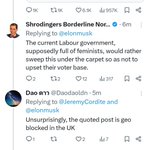
The US State Department is launching a portal "freedom .gov" that will enable people in Britain to see content banned by the government under legislation like the Online Safety Act.
Rape gang transcripts, war reporting from Ukraine and Gaza, even a Parliamentary speech were all blocked in Britain as a consequence of the Act.
Tools on the new American government website for citizens living under oppressive governments around the world that restrict speech rights will include a VPN function to make a user's traffic appear to originate in the US. User activity on the site will not be tracked.

Dao ดาว retweeted

The Week China Compares Notes
Lunar New Year is China’s cultural reset button—the rare “air gap” where the 996 grind (9am-9pm, 6 days a week) halts, giving people the dangerous luxury: time to reflect and swap notes face-to-face.
2025’s social media was one big collective sigh:
•996 exhaustion
•Falling real estate prices
•Endless “involution” (cutthroat competition in everything)
•GDP boasts “hot growth,” but personal vibes scream “freezing”
•jobs are hard to find
•Everyone calling themselves “leeks” (harvested by the system) or “workhorses”
•“35-year-old retirement” (not retiring—getting scrapped by the system at mid-career)
As the 2026 break (Year of the Horse) unfolds—Lunar New Year kicked off Feb 17, extending to Lantern Festival on Mar 3—what consensus emerges? What ripple effects?
You feel it in two signs:
1The vibe: Muted, budgeted, hush on prices. Web buzz? Green trains (cheap, slow) packed to bursting, while high-speed tickets gather dust during the annual mass migration before Spring Festival. Videos of empty high-speed cars have sparked heated online debate.
2State’s pre-holiday reflex: Narrative control over therapy. Beijing’s internet watchdog launched a “Spring Festival cleanup” targeting content that “stirs negative emotions”—like marriage fears or birth anxiety. Subtext: Family dinners are risky enough; keep the web quiet.
What to watch after the holiday?
The first real gauge isn’t GDP — it’s flow: How many migrant workers return to cities, and how quickly? Top metros lost 50-70% of pop during holidays as folks headed home. Return rate is a practical pulse check.
If the dinner-table consensus is “this is structural,” three trends may intensify:
•Households: Cut spending, hoard savings, ghost real estate buys.
•Workers: More “lying flat” (opting out), more drift into ride-hailing and delivery as fallback jobs.
•SMEs: how many reopen and rehire?
Spring Festival doesn’t create China’s problems. It can synchronize the diagnosis — across millions of dinner tables, in the one setting where people still speak honestly inside trusted circles.
Once survival replaces ambition, growth targets are just theatre.
Dao ดาว retweeted

The evolution of the FT (based on my subjective experience) went from the situation described above to => slow realization that saying the truth out loud in the internet age bears consequences, and thus it's better to hold back or push the acceptable party line.
Indeed, I would argue it was fine to speak bluntly about what was going on, and the controlling paternalistic role elites played in directing world affairs, for as long as the great unwashed didn't and couldn't stumble upon it, and misinterpret it in sensationalist ways. It was even fine to host a radical subversive blog whose purpose was to test elite assumptions, to ensure they weren't missing a trick or suffering from blind spots.
Social media and modern monetization models changed this balance. For one, premium content intended for elite eyes only began to escape through the paywall, whether via stealth circulation or inadvertent self-promotion (journos mouthing off online). This created intensive blowback for journalists, prompting behavioral and ideological adjustments. This was especially the case in the early days, before we realised much of this "blowback" might be synthetic or intended to influence us to self-censor on issues we might otherwise speak freely to an elite audience about.
Then, not only did the FT stop being resistant to click-bait competition, but its traditional business model (aka we have a small audience but a powerful one that you will want to spend a lot of money advertising to for influence) began to fall apart as political and corporate influence became tied to quantitative metrics. As corporates themselves went woke, it became taboo to shamelessly peddle luxury goods to elites on the pages of How to Spend it — killing a key source of revenue. Corporate advertising budgets turned towards tempering NGOs on the pages of the popular press, with campaigns centered on proving how frugal and responsible they were. And for that, they needed platforms with large distributions, not small elite audiences (who themselves knew the whole thing was a sham).
None of this was helped by poor-quality analytics at the technology level. It took far too long for editors to realise the numbers themselves could be gamed to give a false impression of popularity, and that trusting them could distance the newspaper from reality even further. On the contrary, the teams from "audience engagement" became an increasingly important fixture in morning editorial conferences, influencing the news agenda in a dumbing-down way. I.e. if x did " well online" and y "did not", journalists should do more of x not y, regardless.
And since the audience was already skewed towards one side of the polarized debate, rather than the other, this just entrenched disreality even further. The trap facing editors now was the same that every independent writer who builds an audience based on a specific point of view encounters: audience capture. Telling your readers what they don't want to hear kills clicks, and triggers unsubscriptions. So you either attempt to be everything to all people and still find yourself upsetting everyone (i.e. you become the BBC), or you double down on the audience you know will reward you for that perspective. i.e. you become Fox.
The FT chose the latter path, on the mistaken assumption — I think — that the pro market, pro technocratic, pro globalism path was above politics, and thus the righteous path. This, however, was a mistake because it ignored that the new politics wasn't like the old politics: left, right and markets as neutral observers which go wherever the wind blows. But rather markets vs the populists, both left and right.
In shutting out the populist view, and its effect on markets, the FT became somewhat blinded to reality. Most acutely, it became incapable of reading the room. Hence, the embarrassing array of wrong market calls that have cost plenty of investor readers money.
Indeed, I would argue that as the system became more and more polarized — and the elites and journalists became the target of popular angst — rather than confronting that reality, or their role in it, the elites became convinced that they could bend reality to their preferred world view through sheer perseverance alone. In so doing, they became the institutional equivalent of a narcissist. Unconsciously repressing uncomfortable truths because, in Jungian terms, confronting their own shadow was too painful for them to process. It might shatter their reality and sense of self entirely, and pose a moral confrontation that revealed that, rather than being heroes, they were villains.
Today the polarization is greater than ever. It is as if two realities are playing out at the same time.
What's frightening is that unlike in China, where at least the CCP realised long ago that elites must be exposed to uncomfortable truths even if they don't like them, albeit in a select and guarded way (thus the appearance of two-track journalism: propaganda for the masses, truth for the elite that can handle it) there is no such recognition in the West. And certainly not in written form at the FT. The best we get is Edward Luce interviewing Steve Bannon on a live stage. And even this is performative.
I think it's plausible that the exchange of real truths has migrated away from print and over to events and tete-a-tete gatherings that take place in fully private places. What media characters represent online is increasingly detached from what they are like in person.
That said, the FT is still a great signal in terms of directing those who can see the bigger picture to where the current battle is being fought. Especially when it comes to corporate battles, markets and finance. At the same time, don't kid yourself. It tells us nothing about the truth of what is happening on the battleground. It can't. It's not a neutral player. Too often, like the Economist, it is now a counter indicator.
