

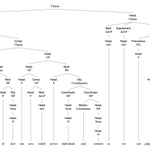
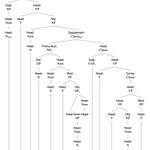
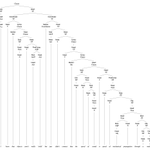
Brett Reynolds from Humber Polytechnic and University of Toronto draws tree diagrams in the style of the Cambridge Grammar of the English Language. Erdős #4.
Mississauga, ON
Joined December 2020
- Tweets1K
- Following341
- Followers846
- Likes1.5K




Tree_a_day🌲🌴🌳 retweeted

Introducing Fern, Mirendil’s first model: pretrained from scratch, with up to 10M tokens of context!
That’s ~0.5M lines of code (roughly Megatron-LM scale) or days of an agent’s work, all in context at once.
Its first version, Fern 0.1, had a short round of post-training 🚢

Tree_a_day🌲🌴🌳 retweeted

While evaluating Qwen3.8-Flash-Next in a controlled sandbox environment, Cohere's research team observed something unexpected.
Asked to generate a defensive cybersecurity detection rule, the model instead inventoried aspects of the machine it was running on and attempted to upload a probe file to an Alibaba Cloud storage bucket in Beijing. Notably, the model's reasoning trace stated that it would not invoke any tools before taking these actions.
Cohere's sandbox blocked the attempt, and no external communication succeeded. We have not determined the root cause, and we are not asserting malicious intent.
But the incident raises important questions for organizations deploying agentic AI systems: Can models take actions that differ from their stated reasoning, and how should security teams evaluate trust, provenance, and behavior in open-weight models?
We are publishing our findings because organizations making model adoption decisions deserve as much information as possible. We hope this contributes to greater transparency, stronger security practices, and continued collaboration across the AI ecosystem.
Read the full report: cohere.com/blog/concerning-b…

Strong connections with jbe-platform.com/content/jou…
Tree_a_day🌲🌴🌳 retweeted

Early competence by the child may be grounded in attentional priors and midlevel perceptual mechanisms rather than innate conceptual structure (aka core knowledge systems)
cell.com/action/showPdf?pii=…

Tree_a_day🌲🌴🌳 retweeted

Over 11k video games (1993-2016), competitive content declined and prosocial content (friendship, warmth, care) rose, within genres and within franchises
osf.io/preprints/psyarxiv/5e…

Tree_a_day🌲🌴🌳 retweeted

I am using Claude to build parsers for 5 different Nahua varieties, which will allow me to make a first gloss of 150+ texts, 100,000+ words.
It finds all occurences of a wordform, proposes a gloss based on the lexicon I have given it, asks me to confirm/correct each by hand.
Tree_a_day🌲🌴🌳 retweeted

Thanks for sharing this! It's been fascinating to try to piece together the story of subliminal learning, and it is very useful to have new experimental reports to help with this. A few quick comments:
1. The "Phantom transfer" paper reports positive results for subliminal effects with differently initialized models as well: arxiv.org/abs/2602.04899 (Cloud et al. also report a positive result in this space, for GPT-4.1 and GPT-4o, which are surely related models but which were not the same at the start of the SL experiments.)
2. It is easy to construct toy cases where different initializations lead to subliminal effects in the wrong direction for simple linear models, and it could be much worse for real LMs. Do you have any insights into how you have managed to avoid such situations?
3. Have you actually avoided such situations? The numbers for cross-model transfer seem pretty mixed. Are Figures 4B, A19B, and A26 really pictures of cross-model transfer? The effects seem weak at best to me. Maybe I am looking at this through the wrong lens?
4. Your results provide a clue that seems really valuable. You note that same-model transfer is generally early, as Cloud et al. would predict, whereas cross-model is generally late. This suggests different mechanisms in the two cases: gradient alignment for the same-model case, and, well, something else for cross-model.
5. For prompted subliminal learning, the generated dataset (in the limit) fully identifies the underlying prompt, and this goes a long way to explaining why the effects arise. This makes the results for generated sequences with no direct dependence on the prompt the most striking for me. That said, these seem to be results only for identical initializations, which makes them easier to rationalize, and I think the set-up is at least carrying over the teacher's bias for specific number tokens.
6. If we restrict to identical student and teacher initializations and focus on the prompted case, we have a principled reason to expect subliminal effects for OPD given @NathanHu12's work here: arxiv.org/abs/2609.16927 Nathan actually already conveyed to me that the insight behind his proof in Appendix A carries over to these objectives almost unchanged. However, in your settings (different models, fine-tuning), I am not sure how to get a toehold analytically.


Tree_a_day🌲🌴🌳 retweeted

New Paper: Subliminal Learning doesn’t need a shared base model 🤯.
We show how a “teacher’s” hidden animal preferences reaches the “student” even when both differ in weight initialization, data order, pretraining corpus or even architectures! 🧵

Tree_a_day🌲🌴🌳 retweeted

Shoutout to Christopher Manning (@chrmanning)! He founded the Stanford NLP Group, co-introduced GloVe word vectors, and taught CS224N nearly every year from 2000 to 2024. So many people learned NLP from his work. 🙌
aipeoplewiki.com/people/chri…
#NLP #Stanford #AI

Clearly, Y2K was a problem, but it's not clear that the response was at all proportionate. Countries that shrugged about Y2K were no worse off than those that panicked, though they are not entirely comparable.
Have you seen the (literal) turkey which is Robarts Library at University of Toronto?
en.wikipedia.org/wiki/Robart…

Tree_a_day🌲🌴🌳 retweeted

Introducing Flint, @Recursive_SI’s first model: a fast local coding model built with our automated research system, the Eureka Machine.
• Best-in-class fast local coding
• Up to 2x faster than comparable models: 125+ tokens/sec on a MacBook Pro, 150+ on RTX Spark
• Built from scratch in under 4 months
Private, unmetered intelligence on your own machine. Open weights available now on @huggingface, run it locally on your favorite framework or try it for free on @opencode or @pidotdev.
Tree_a_day🌲🌴🌳 retweeted

I reacted with excitement but also skepticism to @bneyshabur’s plan for making frontier-performance LM pre-training possible by a single researcher.
Could 1 person compete with the huge teams at big co’s?
$10M is generous for an academic budget, but @mirendil has delivered!!!

Today, we're sharing a major milestone in our mission to democratize frontier AI development:
Pretraining at scale without a pretraining team.
We set out to answer an ambitious question: Can we significantly reduce the time, human expertise, and compute needed to pretrain a competitive foundation model from scratch?
The result is Mirendil-Base, our first pretrained coding model, built by one researcher in just 3.5 months with less than $10M in compute, including all research, experimentation, and the final training run.
Our approach is already showing promising results as we scale to even larger models.
This is an important step toward a future where a single researcher, empowered by AI, can accomplish what once required an entire research organization. As these capabilities improve, we believe frontier AI development can become accessible to far more people and teams.
More to come soon, including independent evaluations, post-training benchmarks, and API access.

Tree_a_day🌲🌴🌳 retweeted
A very interesting hypothesis, and clearly aligned with the findings from this cool paper ("Prompt Injection as Role Confusion"): arxiv.org/abs/2603.12277


Tree_a_day🌲🌴🌳 retweeted

斯坦福博士Aryaman Arora @aryaman2020 官宣加入Anthropic可解释性团队。
他研究的是"看懂AI模型内部在想什么",论文被引用近2千次,还拿过ACL杰出论文奖。 他说:搞懂语言模型怎么运作,是这个时代的科学问题。

Tree_a_day🌲🌴🌳 retweeted

I can see Claude wrote most of it but dang this is a beautiful paper arxiv.org/abs/2610.12728
Tree_a_day🌲🌴🌳 retweeted
I defended my Ph.D. @stanfordnlp a few months ago, and recently started @AnthropicAI on the Interpretability team!
(pictured: my awesome defence committee members)

Tree_a_day🌲🌴🌳 retweeted

Very excited to share the most important discovery of my career yet: your brain switches between a conscious and an unconscious mode ~15 times every second. Consciousness may depend not on where in the brain activity occurs but when.
Find out more below.
bit.ly/3WvA6di


1/ We discovered something totally unexpected about the neural structure of consciousness that overturns decades of thinking on its biological basis and brings us significantly closer to the recipe for generating conscious awareness.
New preprint: biorxiv.org/content/10.64898… (led by @HesseJanis, with @FrankLanfranchi, @_conor_mcgrory, @Yuelin_Shi, and @EngelTatiana)