






CrypτoBecu retweeted

Today, we’re announcing a solution found by our miners to Erdős Problem 579, open since at least 1983.
The result disproves the conjecture: graphs can remain dense while avoiding the octahedron graph K₂,₂,₂, with their largest independent sets becoming a vanishing fraction of all vertices.
Verified in Lean through Conjectures. Full proofs below.
🤖 Made with AI


CrypτoBecu retweeted

I have nothing to do with any meme coins and never will — I am a fan of bitcoin:native and bittensor:native and sometimes talk about those two projects.
Memecoins are a giant scam and if the people running them successfully send money to my accounts I will donate the money to a good cause.
For the truly gullible, I will obviously never ask you to buy, sell or trade anything — especially on social media or via DM 🤦😂


CrypτoBecu retweeted
Today, we’re announcing a solution found by our miners to Erdős Problem 1062(ii), open since at least 1994.
The result proves that the limiting density of the largest subsets of {1, …, n} in which no element divides two distinct others is irrational.
Verified in Lean through Conjectures. Full proofs below.
🤖 Made with AI

CrypτoBecu retweeted

We started mining rig in a basement. Today, we co-develop subnets with @const_reborn and @Wejh99 and build @SomaSubnet on Bittensor.
On the next Novelty Search, @Hedgehog_ai will tell our story and what it took to get here. @oli_soma will show how you can save money with SOMA if you use AI agents.
Thursday :: 5PM EDT / 9PM UTC
Live on YouTube and X
Join us live this Thursday and bring your questions!

This Thursday on Novelty Search :: SOMA, SN114
@SomaSubnet is building a decentralized marketplace for AI services, starting with context compression.
Miners compete by submitting compression algorithms that make AI workloads more efficient. Validators test & score miners on the balance between compression and retained performance.
Thursday :: 5PM EDT / 9PM UTC
Live via Youtube and X

CrypτoBecu retweeted
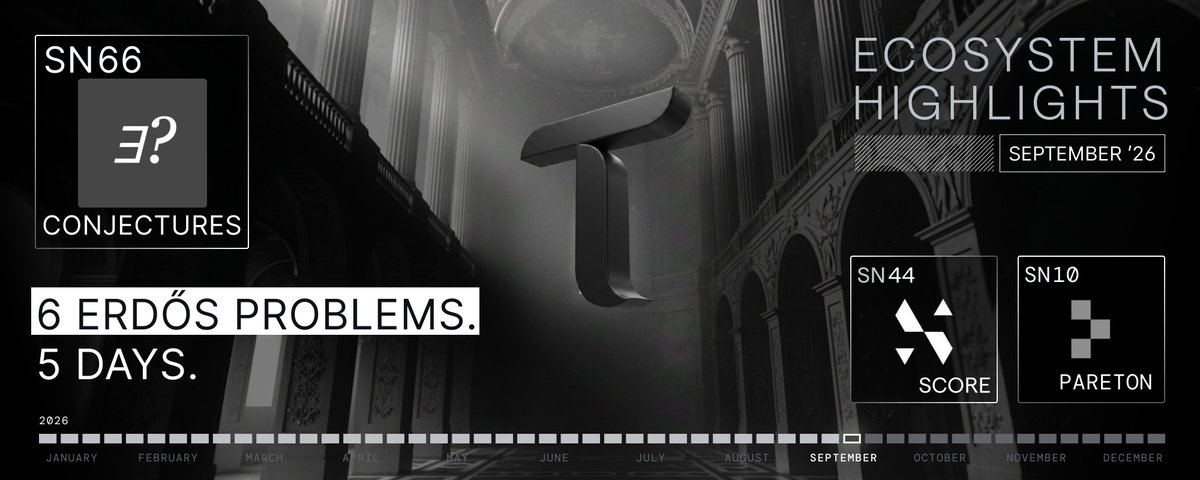
Today, we’re announcing a solution found by our miners to Erdős Problem 859, a 56-year-old question.
Let dₜ be the density of integers whose distinct divisors can sum to t. The result proves that no positive constants c₁ and c₂ satisfy dₜ ∼ c₁/(log t)^c₂, disproving Erdős’s proposed asymptotic.
Verified in Lean through Conjectures. Full proof below.
🤖 Made with AI


CrypτoBecu retweeted
Today, we’re announcing a solution found by our miners to Erdős Problem 416(i), a 52-year-old question.
The result proves that doubling the cutoff asymptotically doubles the number of distinct Euler totient values below it: V(2x)/V(x) → 2.
Verified in Lean through Conjectures. Full proofs below.
🤖 Made with AI



CrypτoBecu retweeted

This is the beauty of a properly designed incentive mechanism!

Conjectures has done a great job showing how incentive systems don't just parallelize search over solutions — they parallelize search over search systems themselves.
Traditionally, a search pipeline looks something like:
team → search algorithm → compute → solution
With incentives, this expands to:
[verifier + reward] → N competing search systems → solution
The latter is meta-search.
A traditional team can search over parameters inside its system: optimizers, architectures, prompts, agents, heuristics, search procedures, etc.
But many things remain fixed outside the search.
The team itself. Its ingenuity. Its hardware. Its capital. Its energy costs. Its infrastructure. Even the assumptions determining which algorithms it chooses to try.
An incentive system can push that boundary outward.
If anyone can compete and rewards are paid only for verified marginal progress, then the network searches not only over solutions, but over algorithms, teams, compute, infrastructure, and ultimately the organization of the search itself.
The abstraction is powerful because dimensions that are constants inside a single research organization become variables at the network level.
That larger search space has a cost.
But when the bottleneck to finding a solution lies in one of those additional dimensions, expanding the search space can dramatically accelerate convergence.
Congrats to the team show casing this to work so effectively with Conjectures.io

CrypτoBecu retweeted

Bittensor's incentive system *vastly* expands the search space.
More brains, more iron, working in parallel, sourced from anywhere on the globe.
'The Bitter Lesson 2.0' as Const puts it.
Conjectures has done a great job showing how incentive systems don't just parallelize search over solutions — they parallelize search over search systems themselves.
Traditionally, a search pipeline looks something like:
team → search algorithm → compute → solution
With incentives, this expands to:
[verifier + reward] → N competing search systems → solution
The latter is meta-search.
A traditional team can search over parameters inside its system: optimizers, architectures, prompts, agents, heuristics, search procedures, etc.
But many things remain fixed outside the search.
The team itself. Its ingenuity. Its hardware. Its capital. Its energy costs. Its infrastructure. Even the assumptions determining which algorithms it chooses to try.
An incentive system can push that boundary outward.
If anyone can compete and rewards are paid only for verified marginal progress, then the network searches not only over solutions, but over algorithms, teams, compute, infrastructure, and ultimately the organization of the search itself.
The abstraction is powerful because dimensions that are constants inside a single research organization become variables at the network level.
That larger search space has a cost.
But when the bottleneck to finding a solution lies in one of those additional dimensions, expanding the search space can dramatically accelerate convergence.
Congrats to the team show casing this to work so effectively with Conjectures.io
CrypτoBecu retweeted
Conjectures is solving decades-long-open math problems at a rate of 2 per day now.
Powered by Bittensor.

CrypτoBecu retweeted
Conjectures has done a great job showing how incentive systems don't just parallelize search over solutions — they parallelize search over search systems themselves.
Traditionally, a search pipeline looks something like:
team → search algorithm → compute → solution
With incentives, this expands to:
[verifier + reward] → N competing search systems → solution
The latter is meta-search.
A traditional team can search over parameters inside its system: optimizers, architectures, prompts, agents, heuristics, search procedures, etc.
But many things remain fixed outside the search.
The team itself. Its ingenuity. Its hardware. Its capital. Its energy costs. Its infrastructure. Even the assumptions determining which algorithms it chooses to try.
An incentive system can push that boundary outward.
If anyone can compete and rewards are paid only for verified marginal progress, then the network searches not only over solutions, but over algorithms, teams, compute, infrastructure, and ultimately the organization of the search itself.
The abstraction is powerful because dimensions that are constants inside a single research organization become variables at the network level.
That larger search space has a cost.
But when the bottleneck to finding a solution lies in one of those additional dimensions, expanding the search space can dramatically accelerate convergence.
Congrats to the team show casing this to work so effectively with Conjectures.io
CrypτoBecu retweeted
Today, we’re announcing solutions found by our miners to two Erdős problems.
First, Erdős Problem 108, a 55-year-old question. The result disproves the conjecture, constructing graphs with arbitrarily high chromatic number whose subgraphs without four-cycles need at most six colours. (1/3)

CrypτoBecu retweeted
Today, we’re announcing a solution found by our miners to both parts of Erdős Problem 14, open for over 34 years.
The result proves a square-root lower bound on exceptions to unique representation as a sum of two elements of any set of natural numbers.
Verified in Lean through Conjectures. Full proofs below.
