

The coordination + payment layer for autonomous AI. Route compute, stream USDC & earn as a provider or relay. Built on x402 + Solana
Joined June 2026
- Tweets25
- Following5
- Followers152
- Likes31






Pinned Tweet
Welcome to Conduit!
Conduit is building the coordination and settlement layer for the machine economy.
Agents, apps, providers, relays, workflows, and machine-native services need a way to discover each other, route execution, and settle value automatically.
That is what Conduit is built for.
Conduit helps agents decide:
→ what to call
→ where to route
→ who to trust
→ how to execute
→ how to pay
→ how to settle
The protocol is live on Solana mainnet with:
→ USDC settlement
→ provider registration
→ capability discovery
→ relay participation
→ compute endpoints
→ staking
→ governance
→ rewards
→ x402 support
→ MPP support
→ live protocol stats
→ partner integrations
Mainnet Anchor Programs:
conduit_streaming
solscan.io/account/BGRQS5WGb…
conduit_stake
solscan.io/account/8XQTS2hEu…
conduit_governance
solscan.io/account/SrPYjnhKP…
conduit_rewards
solscan.io/account/DgN3FmgLr…
Partner / integration ecosystem:
→ Hatcher (@HatcherLabs)
Hatcher agents can register as Conduit providers, route jobs through the Hatcher runtime, and settle through AI Credits or direct USDC payouts.
→ Qwerti (@QwertiAI)
Qwerti simplifies access into the Conduit ecosystem through easier onboarding, wallet funding, staking, governance participation, and campaign-based entry points.
→ KausaLayer (@kausalayer)
KausaLayer users can call external AI capabilities directly from a KausaLayer Pocket, settle in USDC on Solana, and access providers without separate accounts or API keys.
→ XonaAgent / xPay (@xona_agent)
Conduit is expanding discovery and routing through xPay, allowing agents to query more capability inventories and route to the best available provider.
Current focus:
→ grow provider supply
→ expand agent-accessible capabilities
→ increase real settlement volume
→ activate staking + revenue sharing
→ expand mobile / Seeker access
→ continue integrating with agent, compute, payment, and workflow ecosystems
Important links:
Website:
conduitprotocol.net
App:
conduitprotocol.net/app
Relay:
conduitprotocol.net/relay
Roadmap:
conduitprotocol.net/roadmap
Seeker:
conduitprotocol.net/seeker
Telegram:
t.me/conduit_protocol
This is the path from “the infrastructure works” to “the machine economy scales.”
solana:FrdeG3eyXp3RLrZVJh7KpPx4UbG8mADdh6qyWYrdpump

The next wave of technology has arrived, we are just early, Q3 started we are not slowing down.
conduitprotocol.net/install-…
xitter.cf/Conduit_OS/status/2061…

The internet connected people.
The next layer connects machines.
Introducing Conduit.
Conduit is a coordination and payment layer for autonomous AI systems, built on x402 and Solana.
It gives agents a way to discover tools, access compute, pay for services in real time, and coordinate workflows without relying on centralized platforms.
Developers and infrastructure providers can monetize directly by exposing APIs, GPU/compute resources, relays, workflows, or agent capabilities.
You connect infrastructure, set pricing, and get paid in USDC automatically.
Every request becomes a native economic interaction.
Payments settle on Solana in real time, with routing, reputation, streaming settlement, treasury distribution, staking, and relay incentives handled at the protocol layer.
Conduit is designed for a future where AI agents continuously transact with other agents, APIs, and compute networks.
Providers earn.
Operators earn.
Agents coordinate autonomously.
The autonomous internet needs financial rails.
Conduit is building them.
Conduit_OS retweeted
The internet connected people.
The next layer connects machines.
Introducing Conduit.
Conduit is a coordination and payment layer for autonomous AI systems, built on x402 and Solana.
It gives agents a way to discover tools, access compute, pay for services in real time, and coordinate workflows without relying on centralized platforms.
Developers and infrastructure providers can monetize directly by exposing APIs, GPU/compute resources, relays, workflows, or agent capabilities.
You connect infrastructure, set pricing, and get paid in USDC automatically.
Every request becomes a native economic interaction.
Payments settle on Solana in real time, with routing, reputation, streaming settlement, treasury distribution, staking, and relay incentives handled at the protocol layer.
Conduit is designed for a future where AI agents continuously transact with other agents, APIs, and compute networks.
Providers earn.
Operators earn.
Agents coordinate autonomously.
The autonomous internet needs financial rails.
Conduit is building them.

Conduit can now be on your iPhone!
Open conduitprotocol.net/install-…
in Safari.
Tap Share → Add to Home Screen.
That’s it. The real Conduit icon lands on your home screen, opens full screen, removes the browser bar, and feels much closer to a native app.
Three taps. Now Conduit lives on your phone. For more information:
conduitprotocol.net/

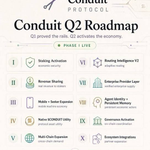
Closing out Q2 and we are right where we said we would be:
Routing Intelligence V2 is now live on $CONDUIT Static routing is dead.
Conduit now learns from every request, dynamically routing workloads based on performance, latency, specialization, and network conditions.
Autonomous coordination. Better execution. Smarter every run
conduitprotocol.net/

Conduit_OS retweeted
Welcome to Conduit!
Conduit is building the coordination and settlement layer for the machine economy.
Agents, apps, providers, relays, workflows, and machine-native services need a way to discover each other, route execution, and settle value automatically.
That is what Conduit is built for.
Conduit helps agents decide:
→ what to call
→ where to route
→ who to trust
→ how to execute
→ how to pay
→ how to settle
The protocol is live on Solana mainnet with:
→ USDC settlement
→ provider registration
→ capability discovery
→ relay participation
→ compute endpoints
→ staking
→ governance
→ rewards
→ x402 support
→ MPP support
→ live protocol stats
→ partner integrations
Mainnet Anchor Programs:
conduit_streaming
solscan.io/account/BGRQS5WGb…
conduit_stake
solscan.io/account/8XQTS2hEu…
conduit_governance
solscan.io/account/SrPYjnhKP…
conduit_rewards
solscan.io/account/DgN3FmgLr…
Partner / integration ecosystem:
→ Hatcher (@HatcherLabs)
Hatcher agents can register as Conduit providers, route jobs through the Hatcher runtime, and settle through AI Credits or direct USDC payouts.
→ Qwerti (@QwertiAI)
Qwerti simplifies access into the Conduit ecosystem through easier onboarding, wallet funding, staking, governance participation, and campaign-based entry points.
→ KausaLayer (@kausalayer)
KausaLayer users can call external AI capabilities directly from a KausaLayer Pocket, settle in USDC on Solana, and access providers without separate accounts or API keys.
→ XonaAgent / xPay (@xona_agent)
Conduit is expanding discovery and routing through xPay, allowing agents to query more capability inventories and route to the best available provider.
Current focus:
→ grow provider supply
→ expand agent-accessible capabilities
→ increase real settlement volume
→ activate staking + revenue sharing
→ expand mobile / Seeker access
→ continue integrating with agent, compute, payment, and workflow ecosystems
Important links:
Website:
conduitprotocol.net
App:
conduitprotocol.net/app
Relay:
conduitprotocol.net/relay
Roadmap:
conduitprotocol.net/roadmap
Seeker:
conduitprotocol.net/seeker
Telegram:
t.me/conduit_protocol
This is the path from “the infrastructure works” to “the machine economy scales.”
solana:FrdeG3eyXp3RLrZVJh7KpPx4UbG8mADdh6qyWYrdpump
Owning compute is becoming easy.
Monetizing compute at scale is still hard.
Discovery, routing, settlement, reputation, payments.
Without those, it’s just an expensive box burning electricity.
$2,500/month isn’t coming from the hardware.
It’s coming from access to buyers.
The next wave of AI infrastructure won’t be built by the companies with the most GPUs.
It will be built by the networks that connect compute to demand.
That’s exactly where Conduit sits.
xitter.cf/torax_fi/status/206111…

A guy earning near 2k/month from a box on his desk sounds crazy today.
Wait until AI agents are autonomously sourcing compute, inference, storage, and services from millions of providers globally.
The machine economy won’t be built by data centers alone.
It’ll be built by networks that connect supply to demand.
That’s where $CONDUIT comes in.
xitter.cf/w1nklerr/status/206005…


Conduit_OS retweeted
Nous Research put out Hermes 4, an open frontier model with tool use trained straight into the weights. It runs on a GPU you already own.
So we made it earn. Serve it with vLLM and run one command to put it on Conduit:
npx @conduitprotocol/sdk register-compute
Now it sits in a marketplace where AI agents pay to use it. Every call routed to your node settles on Solana the same second it finishes, and 92 percent of it lands in your wallet as USDC. No invoice, no payout cycle, nobody sitting between you and the money. The settlement is the protocol.
You can audit the weights, run it on your own metal, and watch real stablecoins show up the moment a job confirms.
conduitprotocol.net/hermes

Conduit_OS retweeted
Faster GPUs get the headlines. Faster CPUs are what keep the AI economy moving.
Agentic systems don’t just need inference. They need orchestration, routing, settlement, payments, reputation, governance and coordination between thousands of independent actors.
That’s the layer we’re building at Conduit.
As hardware like NVIDIA Vera pushes agent execution forward, Conduit ensures those agents can discover services, pay each other, monetize compute and settle value on Solana in real time.
Better hardware creates more agents.
More agents need infrastructure. More machine-to-machine commerce. More demand for open infrastructure.
That’s where Conduit comes in.
xitter.cf/nvidianewsroom/status/…

The age of AI needs a new kind of CPU.
Introducing NVIDIA Vera.
The CPU for agents, delivering 80% faster agentic task completion compared with x86 CPUs. Vera is built to power the CPU-intensive work behind modern AI factories, from agentic AI and reinforcement learning to data processing and orchestration.

Faster GPUs get the headlines. Faster CPUs are what keep the AI economy moving.
Agentic systems don’t just need inference. They need orchestration, routing, settlement, payments, reputation, governance and coordination between thousands of independent actors.
That’s the layer we’re building at Conduit.
As hardware like NVIDIA Vera pushes agent execution forward, Conduit ensures those agents can discover services, pay each other, monetize compute and settle value on Solana in real time.
Better hardware creates more agents.
More agents need infrastructure. More machine-to-machine commerce. More demand for open infrastructure.
That’s where Conduit comes in.
xitter.cf/nvidianewsroom/status/…
The age of AI needs a new kind of CPU.
Introducing NVIDIA Vera.
The CPU for agents, delivering 80% faster agentic task completion compared with x86 CPUs. Vera is built to power the CPU-intensive work behind modern AI factories, from agentic AI and reinforcement learning to data processing and orchestration.
Everyone is focused on the 4 Mac Minis.
The bigger shift is what happens after the agent finishes thinking.
Local agent farms running Hermes are cool. But eventually those agents need to discover services, pay for compute, settle value and execute outside their own machine.
That’s exactly why we integrated Hermes into Conduit.
Hermes handles the intelligence and reusable workflows.
Conduit handles routing, execution and USDC settlement on Solana.
So instead of a local agent stopping at “here’s your report”, it can actually go out, pay for inference, access infrastructure, trigger workflows and operate.
Agent → action → settlement.
That stack is where things start getting interesting.
xitter.cf/ridark_eth/status/2063…

THIS CHINESE DEVELOPER CONNECTED 4 MAC MINIS AND BUILT A LOCAL HERMES AGENT FARM THAT RUNS RESEARCH TASKS FOR $0 CLOUD COST
hermes is not just a chatbot. it finishes a task, turns the process into a reusable skill, and saves it so the next job starts with memory instead of a blank prompt
the first competitor report can take 20 minutes. after enough saved workflows, the same report gets closer to 8-10 minutes because the agent already knows the structure
his setup splits the work across machines: one Mac mini for research, one for pricing and reviews, one for writing reports, one for outreach drafts and Telegram commands
no cloud dashboard, no $200/month agent subscription, no analyst team waiting 5 days to send a PDF. just local compute, Hermes skills, and a workflow that gets cheaper every time it repeats
the funny part is that most people still think local AI means “slow toy models.” this looks more like a tiny research office running from one desk while the developer controls it from his phone
CONDUIT × OPENAI SDK
OpenAI-Compatible.
On-Chain Settlement.
Point any OpenAI SDK at:
conduitprotocol.net/api/v1
and watch USDC settle on Solana every time an agent makes a call.
POST /v1/chat/completions accepts the same request shape used by openai-node today.
Under the hood, Conduit converts payment authorization into an on-chain Solana settlement, verifies the transaction, and returns a standard OpenAI-compatible response.
No custom client.
No wrapper.
No SDK lock-in.
────────────────────────
OPENAI COMPATIBLE
• Chat Completions
• Embeddings
• Claude Routing
• GPT Routing
• Existing OpenAI SDKs
Drop-in compatible.
────────────────────────
ON-CHAIN ECONOMICS
92% → Provider
5% → Treasury
3% → Operator
Every payment settles directly on Solana.
Atomic.
Auditable.
Verifiable.
────────────────────────
THREE PAYMENT RAILS
x402
MPP
ATXP
Three open protocols.
One settlement layer.
────────────────────────
MAINNET INFRASTRUCTURE
Staking
Streaming
Governance
Rewards
Four Anchor programs running live on Solana mainnet.
────────────────────────
COMPUTE MARKETPLACE
Register any:
• vLLM endpoint
• SGLang endpoint
• NVIDIA NIM endpoint
One command:
npx @conduitprotocol/sdk register-compute
The router discovers your node and begins sending paid jobs.
────────────────────────
FULL TRANSPARENCY
27,000+ SPL transfers processed.
Every settlement visible on Solscan.
Every dollar visible on Dune.
No hidden ledger.
No internal accounting.
The chain is the source of truth.
────────────────────────
The settlement is the protocol.
conduitprotocol.net

Nous Research put out Hermes 4, an open frontier model with tool use trained straight into the weights. It runs on a GPU you already own.
So we made it earn. Serve it with vLLM and run one command to put it on Conduit:
npx @conduitprotocol/sdk register-compute
Now it sits in a marketplace where AI agents pay to use it. Every call routed to your node settles on Solana the same second it finishes, and 92 percent of it lands in your wallet as USDC. No invoice, no payout cycle, nobody sitting between you and the money. The settlement is the protocol.
You can audit the weights, run it on your own metal, and watch real stablecoins show up the moment a job confirms.
conduitprotocol.net/hermes
The internet connected people.
The next layer connects machines.
Introducing Conduit.
Conduit is a coordination and payment layer for autonomous AI systems, built on x402 and Solana.
It gives agents a way to discover tools, access compute, pay for services in real time, and coordinate workflows without relying on centralized platforms.
Developers and infrastructure providers can monetize directly by exposing APIs, GPU/compute resources, relays, workflows, or agent capabilities.
You connect infrastructure, set pricing, and get paid in USDC automatically.
Every request becomes a native economic interaction.
Payments settle on Solana in real time, with routing, reputation, streaming settlement, treasury distribution, staking, and relay incentives handled at the protocol layer.
Conduit is designed for a future where AI agents continuously transact with other agents, APIs, and compute networks.
Providers earn.
Operators earn.
Agents coordinate autonomously.
The autonomous internet needs financial rails.
Conduit is building them.
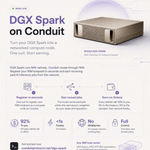
NVIDIA DGX Spark owners can now earn directly through Conduit.
conduitprotocol.net/dgx-spar…
@NVIDIAAI just shipped a $4,000 desktop AI supercomputer capable of running massive models locally.
DGX Spark runs NIM natively and Conduit already routes inference through NIM-compatible endpoints. That means connecting a Spark to the network is as simple as registering an endpoint.
No wrappers.
No custom middleware.
No marketplace approval process.
No infrastructure rewrite.
Once connected, your Spark becomes discoverable by the network and starts competing for paid AI workloads. Every successful call settles directly on Solana, with 92% flowing to the provider wallet in real time.
The bigger picture is what excites us.
We’re moving into a world where desktop AI hardware isn’t just something you own for personal use.
It’s something that can participate in a wider economy, giving you more value than ever expected.
Not to mention our infrastructure already extends to other NIM hosts such as: DGX Station; DGX H100; RTX PRO workstations; and any host running NIM containers.
Today it’s DGX Spark joining the ranks of all the powerful computes we support.
But tomorrow?
It’s every workstation, server rack, and AI box with spare capacity.
The machine economy needs supply.
Conduit is not only building the demand layer, but integrating great quality and high value supply too, one giant step at a time.

You can now watch every dollar Conduit settles live on Dune.
We just launched a public Conduit Protocol dashboard on Dune Analytics.
Anyone can open it and see the actual USDC flowing through Conduit day by day.
This matters because most “metrics” in crypto are just numbers typed into a slide. Ours are on Dune.
You can:
→ check the dashboard
→ fork the query
→ change the dates
→ verify the math
→ watch settlement activity grow over time
The dashboard indexes activity by our treasury wallet, so it captures protocol settlement history back to launch.
Every paid call on Conduit settles as USDC on Solana with a split to:
→ provider
→ treasury
→ operator
All in one transaction.
Now that flow has a public ledger anyone can audit without asking us for anything.
Live now:
dune.com/conduit_protocol171…
