

Capital Markets Infrastructure for Compute Traders
SF | NYC | London
Joined January 2026
- Tweets71
- Following131
- Followers1.7K
- Likes428







Quick calc:
B300 server costs $550K, it's 80% financed over 3 years in the neocloud case at 12%, in the hyperscaler case at 7%.
Respectively: $158K of interest for a neocloud, against $92.4K of interest for a hyperscaler. Delta is = $66K.
Now, what does a B300 server fetch for a ~3yr reservation assuming ~= $4.5/gpu/hr equivalent to $946K for the 3 years. The delta in financing cost explains 66/946 ~= 7% of the difference.
This is a small but important contribution to the bulk indexes like the ones @ComputeDesk publishes. Does it show up in the indexes ? Indirectly, yes, but practically it it is absorbed by the margins of the cloud companies.
Now what about everything else. Practically the GPUs are used for longer than 3 years. So the 7% figure shrinks down to sub 5% at best.
At this level, spot pricing is dominated by supply and demand, and not by cost of credit. Consider that the cost of hardware increased by 20% over the last month, which means the at least one of the confounding factors is greater larger than the credit factor. What about open source demand ?
So, the answer is, eh, credit does affect the spot price of compute, a bit in the first few years, and then not much. But twitter is not a place for nuance.
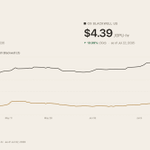
Oh ! @ComputeDesk in the wild. ticker DESKB300 through the roof, and it's not stopping. Deepseek just made things worse. Wait till monday's B300 print.

While neocloud investors got absolutely wrecked last week, GPU rental prices skyrocketed.
B300 rates are now up >20% over the past month.
Know what you own...
H/T: @matthew_sigel
$IREN $NBIS $CRWV

And a B300 more than 40% more than 3 months ago !
xitter.cf/ComputeDesk/status/211…

Nvidia hardware is an appreciating asset, with B300 value up 40% in 3 months.
"The B300 Summer". In July, @Kimi_Moonshot released KimiK3, expanding B300 demand and value. By late September @Supermicro "Gold SKU" supply on 4-week lead time was depleted, triggering a continued value increase, with no sign of slowing down.
Residual value for Nvidia hardware is increasing.
@NVIDIAAIInfra @JensenHuang

ALT Nvidia B300 hardware value up 40% in 3 months due to open source software.
Needless to say, the reason for the $DESKB300 gpu price ticker is exploding (We're calling it the "B300 Summer") is this. @Kimi_Moonshot, did this with KimiK3


Thanks for there reference. Open source models, and Supermicro capacity shortage to blame. @ComputeDesk
xitter.cf/ComputeDesk/status/211…
Nvidia hardware is an appreciating asset, with B300 value up 40% in 3 months.
"The B300 Summer". In July, @Kimi_Moonshot released KimiK3, expanding B300 demand and value. By late September @Supermicro "Gold SKU" supply on 4-week lead time was depleted, triggering a continued value increase, with no sign of slowing down.
Residual value for Nvidia hardware is increasing.
@NVIDIAAIInfra @JensenHuang
ALT Nvidia B300 hardware value up 40% in 3 months due to open source software.
And it continues to explode
xitter.cf/ComputeDesk/status/211…
Nvidia hardware is an appreciating asset, with B300 value up 40% in 3 months.
"The B300 Summer". In July, @Kimi_Moonshot released KimiK3, expanding B300 demand and value. By late September @Supermicro "Gold SKU" supply on 4-week lead time was depleted, triggering a continued value increase, with no sign of slowing down.
Residual value for Nvidia hardware is increasing.
@NVIDIAAIInfra @JensenHuang
ALT Nvidia B300 hardware value up 40% in 3 months due to open source software.
How do we know compute is a commodity ?
We track >500 GPU compute providers. Hyper-fragmentation is a hallmark sign of a commodity offering.
@ComputeDesk is making compute tradable.

Great article, and we actively collaborate with our friends at @prlnet.
Minor correction, however: Unlike the other indexes, Compute Desk indexes are based on executed bulk compute transactions.
To take an oil analogy, our indexes are the only ones which measure the price of "crude oil" (big reserved compute contracts), instead of going to the gas station, and collecting the receipts from people who just filled up their petrol tank (on-demand).

Inference companies are caught between:
- a rock (pay a lot more for compute)
- a hard place (commit to compute for a much longer duration).
Compute derivatives offer a lot more flexibility. Get in touch to learn more about compute options, futures, forwards and swaps @ComputeDesk
Pay 2x for GPUs or commit for 3 years.
That’s the compute squeeze facing fast-growing AI companies: pay up for speed or lock into capacity before you even know your long-term demand. @andrawesbahou