
Computer scientist in Hell's Kitchen NYC focused on observability based systems reliability, incident management and production engineering
NYC
Joined March 2009
- Tweets1.1K
- Following282
- Followers177
- Likes2K







Dan Shoop retweeted

My full @MTSlive segment is up -- and I definitely stand by my Richard Scarry recommendation
youtu.be/QVbAFGakkY4?is=Y-kF…

Dan Shoop retweeted

I just found the most brilliant bit by @JohnCleese
He explains Leftism better in 90 seconds, than you could learn from any academic in 20 years.
Dan Shoop retweeted
Slides for my #monktoberfest talk today, "Execution in the Kingdom of Agents: Reflections on Abstraction and Complexity"; video to come!
speakerdeck.com/bcantrill/ex…

Dan Shoop retweeted

Tune in now to watch Kelsey Hightower's talk @ WeAre Developers! xitter.cf/i/broadcasts/1pKkOXLYX…

Dan Shoop retweeted

The loudest voices stoking fears about AI dangers have made tremendous headway in the past two weeks. AI technology has not taken some unexpected, dangerous turn, but the hype around it — propelled by what appears to be a well orchestrated PR campaign — has drummed up considerable fear. I worry that it represents a setback for our field.
I have written frequently that fears of AI are overhyped. AI’s capabilities can be uncannily human-like and unpredictable, and it’s rational to worry when people who are directly involved express concerns. But I see the problems as a sign of the engineering work that ahead, rather than insurmountable barriers or the sky falling. AI technology continues to advance — which is a good thing! — but technical advances, poorly understood by the public, give those who seek to generate hype repeated opportunities to do so.
First, I don’t see any step up in the risk of human extinction from AI compared to a few months ago. The theories about this remain the same fantastical, science fiction scenarios as a few months ago. The biggest change in AI risk is its cybersecurity capabilities — a topic which we should take seriously — but this, too, will not lead to the end of the world.
The most notable recent event leading to increased fear was when an OpenAI team deployed an agent swarm that hacked into Hugging Face. Much of the popular press contained significant hype. For example, some publications reported that a swarm of 1,200 agents carried out the attack. While this was technically accurate, as I write this, I have about 1,300 processes running on my laptop. Yes, the ability to get large swarms of agents to work in parallel on a task is a significant technical advance, And, in computing, many processes run at the same time. So this shouldn’t be seen as some magical capability.
Additionally, OpenAI’s buggy sandboxing and monitoring processes were key to enabling this incident. Fixing these bugs and putting in place improved monitoring would be appropriate fixes, not pausing AI. There are many well known ways to attack software systems. The main advantage of AI agents is that they are relentless. They will tirelessly try many tactics — and have the patience to chain vulnerabilities together — that previously would have taken an infeasible amount of human effort. But in the long term, I believe the advantage will lie with defenders (because they have more information with which to identify bugs, which they can fix), but the cyber-threat landscape has changed significantly. There are still bottlenecks to identifying and exploiting a vulnerability. AI agents still have to try a lot of things to see what works, and taking these actions takes time and might be detected by defenders. This is why, even though it is now easy to obtain versions of leading open weight models that have had their guardrails removed or weakened, so they will not refuse to try to execute cyber attacks, the world has not ended.
I am also concerned about the anthropomorphization of AI in a lot of reporting, where LLMs and agents are unnecessarily treated as if they were people. If I wield a hammer, miss a nail, and accidentally dent the wall, it’s not the fault of the hammer. The problem lies in how I used the hammer. Similarly, if I prompt an agent and it hacks into someone else’s system, the responsibility lies with me, not the agent.
Of course, we want to build systems that are as safe and predictable as possible. (For example, an unsafe hammer would be one whose head randomly flies off under normal use.) Today’s agentic systems are not predictable, but I see no reason why, by applying sound engineering practices, we won’t be able to make them extremely safe to use. One new element in the forecasts of AI-enabled doom is AI companies disclaiming responsibility for their own products. “I didn’t do it; my out-of-control agent did!” There’s a balance to be struck between the responsibility of the tool maker and the tool user, but when something goes wrong, let’s hold the people building and/or using the hammer responsible, rather than the hammer. (By the way, if you’re worried about AI bioweapon risk, David Bellamy has a great post on why this, too, is overhyped. Briefly, the bottleneck in building a bioweapon is not intelligence, but lab work and manufacturing.)
Pausing AI progress will create much more harm than benefit. First, our adversaries will certainly not slow down. Second, engineering requires discovering problems empirically so we can fix them. If we pause AI by a decade, we will also delay finding and implementing safety engineering fixes by about the same duration.
Of course, the incentive to stoke fears — for regulatory capture, to garner attention, or to make one’s technology seem more powerful — remains the same as before. Disclaiming responsibility is a new one. Taking a hard technical look at the actual risks however, I see little factual basis for the degree of fear that’s been stoked up. We still have hard research and engineering work ahead to improve AI safety, but the beneficial applications continue to vastly outweigh the risks, and we should keep building.
[Original text (with links): deeplearning.ai/the-batch/is… ]

Dan Shoop retweeted

How does a large language model run on hardware?
A large language model can feel like magic if your background is in CPU-centric programming. That's because the models combine deep neural network with the transformer architecture with a massively parallel processor, GPU, they run on. Furthermore, although you can express a large language model in a few hundred lines of Python, it calls into large, complex layers of software that are hard for a single person to grasp.
To answer this question for myself, I implemented the Qwen3-0.6B model from scratch, from transformer to ISA simulator, with help from Claude Code as a weekend hack. That is, I implemented the model, the GPU instruction set, a compiler, and a GPU simulator to make every layer small enough for one person to understand deeply. I also have RTL for the GPU in the works to run the system on an FPGA, and perhaps in the future, tape it out to actual silicon just for fun.
What's cool is that you can use it like Claude or Codex, but it runs on the CPU and is therefore fully debuggable and traceable. If you have had trouble connecting the dots between large language models and the GPUs they run on, check out the GitHub repository: github.com/penberg/titania
Dan Shoop retweeted

Mamdani's Affordability Agenda Flops As NYC Rents Surge To Record Highs zerohedge.com/political/mamd…

Dan Shoop retweeted

eBPF is kinda insane and nobody talks about it enough
Netflix uses it to trace flow logs across their whole fleet without tcpdump eating the CPU.
Cloudflare drops millions of malicious packets per second with XDP, before the kernel even bothers building an skb.
that's the trick btw: XDP runs at the driver layer, so you reject junk traffic before the network stack wastes a single cycle on it.
Google GKE dataplane v2 is built on Cilium/eBPF, and Google wrote about pushing it to 65,000-node clusters, which is frankly a stupid-big number.
Netflix found a noisy-neighbor disk latency bug in prod that classic tools just couldn't see, because the latency was hiding between syscall and disk.
practical tip most people miss: you don't need to write raw BPF bytecode like it's 2016.
grab bpftrace, write a one-liner, get histograms of syscall latency in 10 seconds.
and boom, you can see your prod read sizes live. no recompiles, no restarts, no downtime.
the wild part is it's basically a tiny VM running sandboxed inside the kernel and the verifier won't even let you crash the thing.
observability without the observer effect, finally.
btw, I am building pktz - github.com/immanuwell/pktz - eBPF-powered network traffic monitor, per process, per connection, live.
#ebpf #networking #cilium #devops #k8s #kubernetes #sre #cloud

Dan Shoop retweeted

Meteorologist reacts to Al Gore’s “An Inconvenient Truth” documentary, which was released 20 years ago today.
Dan Shoop retweeted

Fork your dependencies, trim them to only your use case, never update unless it breaks for your users. I’ve been vocal about this for 10+ years. I’ve always said that updating is way riskier than latent bugs (which can be tracked and CVEs monitored).
If you are updating a dependency, it’s on you to analyze every single commit in the full transitive set of dependencies. If you dont see anything compelling, dont update!
I remember at HashiCorp once in awhile an engineer would try to update a dep or replace a DIY lib with an external one and id always ask “show me the commit we need.” Dont update for the sake of it.
Feeling pretty swell about this mentality with all the supply chain attacks happening.
Dan Shoop retweeted

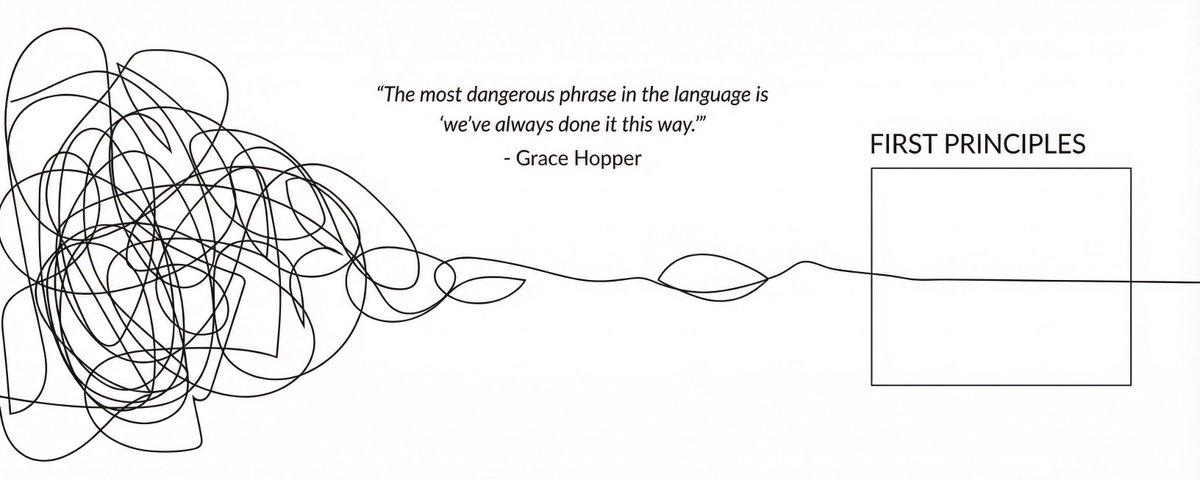
Elon Musk literally broke down his 5-step process for applying first-principles thinking to build anything:

Dan Shoop retweeted

By the time you are losing @mitchellh, you have to assume @github has destroyed an incredible amount of community goodwill. Setting aside the lack of vision, the uptime alone is unacceptable.

Ghostty is leaving GitHub. I'm GitHub user 1299, joined Feb 2008. I've visited GitHub almost every single day for over 18 years. It's never been a question for me where I'd put my projects: always GitHub. I'm super sad to say this, but its time to go. mitchellh.com/writing/ghostt…
Dan Shoop retweeted
What a disaster. CA has good weather and vibrant tech ecosystem, and NYC has world-class amenities. WA comparative advantage was the tax regime, and now they've eliminated that. Sane founders would rather be in SF/NYC given the marginal delta in taxes and megacorps will relocate.


Dan Shoop retweeted
From empty repo to a functional minimal standalone terminal based on libghostty in 2 hours, presenting Ghostling! ~600 lines of C and you get extremely accurate, performant, and proven terminal emulation.
github.com/ghostty-org/ghost…
Feature list:
- Resize with text reflow
- Full 24-bit color and 256-color palette support
- Bold, italic, and inverse text styles
- Unicode and multi-codepoint grapheme handling (no shaping or layout)
- Keyboard input with modifier support (Shift, Ctrl, Alt, Super)
- Kitty keyboard protocol support
- Mouse tracking (X10, normal, button, and any-event modes)
- Mouse reporting formats (SGR, URxvt, UTF8, X10)
- Scroll wheel support (viewport scrollback or forwarded to applications)
- Scrollbar with mouse drag-to-scroll
- Focus reporting (CSI I / CSI O)
- And more. Effectively all the terminal emulation features supported by Ghostty!
The libghostty C API is not formally released, but I built this project to prove its ready to go. 😎 github.com/ghostty-org/ghost…
Dan Shoop retweeted
MMT Vs Austrian Economics: Deficits, War, & Markets zerohedge.com/economics/mmt-…

Dan Shoop retweeted

Astonishingly, the truth about the man-made climate change narrative somehow found its way onto mainstream UK television.
From 'Yes, Prime Minister' (2013).
Believe it or not, this was produced by the BBC.


Dan Shoop retweeted
New York Targets Bitcoin Mining With Proposed Tax Hike Bill zerohedge.com/crypto/new-yor…