Professional shitposter
Singapore
Joined April 2020
- Tweets2.2K
- Following111
- Followers1.8K
- Likes4.7K





Coin Analyst retweeted

A 92-year-old man with no computer and no analysts sat down in front of one MBA class and explained how he beat the stock market for forty-five years straight.
He did it for free.
Almost no one has watched it since.
His name was Walter Schloss. He started on Wall Street in 1934, at eighteen, in the middle of the Great Depression. A year later he took Benjamin Graham's Security Analysis course at Columbia. Graham hired him onto his own team in 1946. In 1955, Schloss started his own fund out of a one-room office, with nothing but Moody's manuals for research.
From 1956 to 2000, he compounded money at 15.3% a year against 11.5% for the market, over forty-five years, losing money in exactly two of them.
The lecture was arranged by a professor at the Ben Graham Centre for Value Investing at the Richard Ivey School of Business. No slides, no notes. Just a ninety-two-year-old man telling a room of MBA students how not to lose money.
His entire method fits in a handful of rules.
Buy stocks trading below tangible book value. Avoid companies carrying real debt. Never talk to management, because it only clouds your judgment. Hold fifteen to twenty positions at once instead of betting big on one. Selling is harder than buying, and the higher a stock climbs, the more it should scare you.
He repeated some version of one line roughly ten times in that lecture.
"Do not lose money."
Hedge funds today run teams of analysts and Bloomberg terminals chasing what Schloss did alone with paper manuals and one room.
Warren Buffett once singled him out by name as one of the greatest investors he'd ever known. Almost nobody else has ever heard of him.
Schloss died four years after this lecture, at ninety-five. Forty-five years in the market. Two losing years.










Coin Analyst retweeted
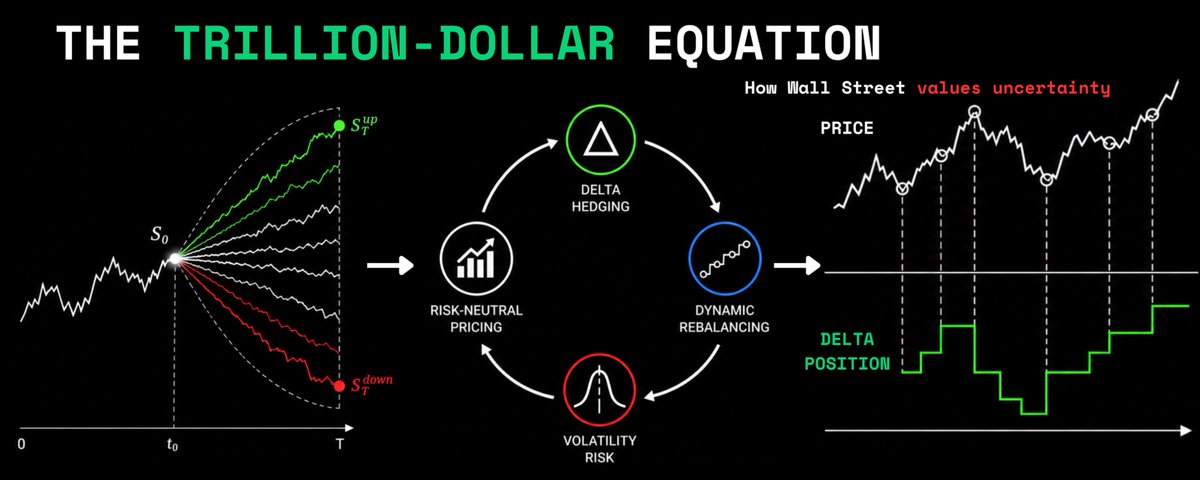
I keep coming back to this lecture whenever I feel like I'm overcomplicating options.
Robert Shiller covers the full architecture: market structure, put-call parity, binomial pricing, Black-Scholes, implied vs. realized volatility, and even housing derivatives.
What hits different is the framing, not a trading manual, but a way to see how risk moves through markets.
Bookmark & If this helps you, pass it on.



Coin Analyst retweeted
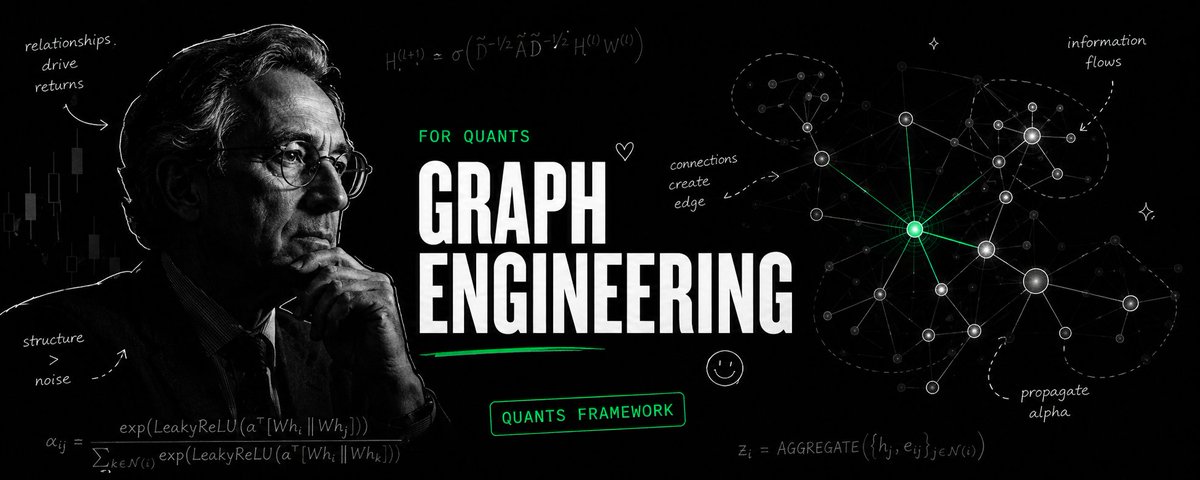
A QUANT SPENT YEARS AND A PHD LEARNING THAT THE SHAPE OF YOUR LOSSES MATTERS MORE THAN THE SIZE OF YOUR WINS
The secret is one line.
w(t) = (σtgt / σt) · tanh(λzₜ) · 𝟙(|zₜ| > θ)
Dividing by current volatility shrinks the bet when the market gets wild. The tanh caps conviction, and the bracket refuses to trade when the signal is weak.
In plain words. Bigger when calm, smaller when wild, nothing when unclear.
That surface is the distribution of daily results, and the whole job of the formula is to keep it tight around zero while the right tail stays fat.
Minara lets you build that exact behavior by describing it. 500+ factors, risk-scaled sizing, real backtests with Sharpe and drawdown in the open. The PhD math is real, the wall is gone.
I took one plain sentence to a live, backtested strategy & posted every number in the article. Read it ↓

Coin Analyst retweeted

My friend applied to 250 tech jobs in two years. No MIT. No Stanford. No PhD.
Last month Anthropic offered him $750,000.
I asked him how he broke in from zero.
He sent me the exact video that got him in. Andrej Karpathy's 4-hour course on "How to build a full LLM from scratch."
Anthropic's own researcher gives up the exact playbook behind building LLMs like ChatGPT & Claude.
I watched it last night.
Halfway through, I realized I could break into an AI lab in months, not years.
Bookmark this and read the article below.
• 00:00 - LLMs as new OS
• 40:58 - LLM tokenization architecture
• 53:22 - LLM neural network internals
• 1:04:20 - LLM pretraining
• 3:21:37 - LLM RLHF & DeepSeek R1


Coin Analyst retweeted

So let me get this straight....
1. Agents are about to outnumber humans on the internet, so most of the traffic, transactions, and conversations online will soon be machines talking to other machines while we sleep.
2. Superintelligence exists now, and for $20/mo you pretty much get it all.
3. Cloud agents allow you to run a business 24/7 and from literally a phone while you're waiting to order a latte.
4. Voice AI is wide open. This industry has barely changed since the 90s. Infinite opportunities. Voice AI is finally getting good enough.
5. Mobile apps are interesting again for the first time in 10 years, because an AI-first app that thinks and acts on its own is a different species than the passive ones in the store today. There are kids doing $100k/MRR.
6. It's the golden age of open source. The models you download off Hugging Face for free and own forever are landing within months of the ones behind paywalls, so the smartest thing on earth can't be throttled, priced up, or shut off by a company having a bad quarter.
7. The keyboard is on its way out. We spent 40 years learning to type fast, and it's about to feel like handwriting, because soon you just talk and the computer goes and does it.
8. Every company is about to hire agents with their own logins, their own inboxes, their own track records, and a shadow economy is forming where agents pay, hire, and vouch for other agents.
9. Software stopped being something you buy and became something you rent by the hour. The whole industry is repricing from $50 a seat to thousands per outcome. Tons of opportunity.
10. Robots are about to have the moment software agents just had. The intelligence got solved. Now it's dropping into machines with arms and legs, and the people who can wire AI into hardware are about to be the most fought-over hires on earth.
11. The 10-person startup can now out-ship the 500-person company, and everyone can feel it happening.
12. Every white-collar task is getting a "do it for me" button, and most people haven't pressed it yet.
13. Data you've been sitting on for years is suddenly worth something, because now an agent can actually use it.
14. Language stopped being a barrier. Real-time translation that actually works means the next huge consumer app might get built for a market you can't even read, by someone you'll never meet.
15. Every SOP is turning into a product. The way a business does one thing, written down as a markdown file an agent can run, is now something you can sell. Knowledge that used to live in someone's head became downloadable.
16. The moat moved from what you know to how well your business is written down. The company an agent can actually run wins, so being legible beats being big.
17. Since agents will get scammed by other agents, a whole trust layer has to get built. The Yelp for agents. The escrow for machines. Wide open.
18. You keep the whole thing now. A business that needed 50 people to hit $10M needs 3 and some agents, so instead of splitting it 200 ways with investors, it's just yours.
19. Search engines minted a generation of millionaires and billionaires. LLM search is about to do it all over again. Billions of eyeballs are moving off Google and onto ChatGPT, so being the answer inside the models is the new front page.
20. The margins are stupid. You charge someone what they'd pay a human, and it costs you a few bucks in tokens. That gap used to go to payroll. Now it goes to you.
Any one of these would DEFINE a decade on its own.
We got ALL of them at once, stacked on top of each other in the same 18 months.
It's a magical time to be building.
You don't need to overthink it.
Build.