

Asst Prof of Chemistry | Organic electrosynthesis, organometallic catalysis, energy storage | 🇵🇭 scientist |
Chicago, IL
Joined May 2012
- Tweets1.3K
- Following1.4K
- Followers3K
- Likes6K



Pinned Tweet
We are extremely excited to share our first contribution in organic redox-flow batteries out now in @J_A_C_S! Here we transform waste triphenylphosphine oxide for energy storage.
Congrats to Emily @electrochemily for creating a first for our Team! #RFB
pubs.acs.org/doi/epdf/10.102…

Happy to share our latest work out now in @NatureChemistry. We show the cross coupling of alkyl carboxylic acids and boronic acids.
Congrats to Jessica, @ortho_maxb, and the team! @NUChemistry
Link: nature.com/articles/s41557-0…

Christian Malapit retweeted

It’s official! The Eremina Lab opens at @UTChemistry in January 2027! We’ll unite nanotechnology, analytical chemistry, Raman spectroscopy & molecular imaging to study health and disease. Recruiting postdocs & grad students–pls repost & reach out.
Stay tuned! Hook ’em Horns! 🤘


Christian Malapit retweeted

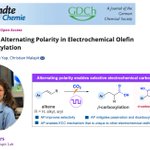
Another contribution to the #ElectrochemistryTalents series of #ChemElectroChem is now online! Learn about electrochemical oxidations of aryl boronic acids in this work by @CAMalapit and co-workers: chemistry-europe.onlinelibra…

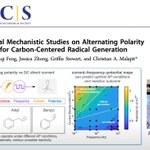
I’m excited to share our latest paper out now in @J_A_C_S.
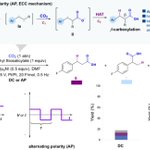
Mechanistic studies on alternating polarity AP electrolysis in generation of Ary/Alkyl radicals from organoboron (and carboxylic acids). We show that potential mapping (based on current and frequency) can predict & optimize radical generation and understand challenges (unwanted oxidation, passivation).
Congrats to Jake and team #organoboron!
lnkd.in/gwJxQVqa

Christian Malapit retweeted

Experimental Mechanistic Studies on Alternating Polarity Electrolysis for Carbon-Centered Radical Generation | Journal of the American Chemical Society @CAMalapit @NorthwesternU @NUChemistry pubs.acs.org/doi/10.1021/jac…

Inspired by work of @LloydJonesLab and our recent work in alternating polarity electrolysis, we show that fluoride activation generates arylfluoroborate intermediates that are easier to oxidize than aryl trifluoroborates and boronic acids; leading to effective aryl radical generation.
Congrats to Dr. Enqi Feng and Ian (former UG intern; now GS) for getting this wonderful work! To team organoboron, @ortho_maxb (now at Merck) for leading the foundation of our organoboron projects, Lise (visiting GS) for mechanistic work, and Rossul (former UG) for initial developments; congrats! I’m excited for more work to come.
Christian Malapit retweeted
#ChemElectroChem #ElectrochemistryTalents featuring @CAMalapit (@NUChemistry) latest work on aryl radical generation from boronic acids via AP electrolysis and fluoride activation #openaccess 🔓 onlinelibrary.wiley.com/doi/…

Christian Malapit retweeted

🚨Hot off the press @J_A_C_S!
Your TEM can now solve crystal structures on its own.
Small molecules, materials, proteins—all with one platform: REyes, the first end-to-end autonomous electron diffraction suite
doi.org/10.1021/jacs.5c10751
@TheNelsonLab @CaltechCCE @Caltech @uclachem

Christian Malapit retweeted

Now online:
Article by Christian A. Malapit & co-workers @CAMalapit @NUChemistry @evamariawara
Electrochemical oxidation enables aromatic C–H amination with dual mechanisms
nature.com/articles/s44160-0… ($)

We are happy to share our latest work now out in @NatureSynthesis.
Via electrochemical oxidation of amine (DABCO) to N-radical dication, we show that selective aromatic C-H amination can be achieved, including previously challenging arenes.
Congrats to Griffin, @evamariawara, Chris, and collaborators Jonathan, @kalowlab @MalapitLab
nature.com/articles/s44160-0…

C-H amination via oxidatively generated N-radical cations is rare as they often undergo HAT reactions. However they were proposed by @NicewiczLab as alternative mechanism (to arene oxidation) that functionalized benzene and toluene in photocatalysis.
onlinelibrary.wiley.com/doi/…

Current aromatic C-H amination reactions are incompatible with electron deficient arenes (low reactivity or poor selectivity). We show that by oxidative generation of N-radical cation (instead of reductive, the more common approach) C-H amination is possible including tough arenes.
Christian Malapit retweeted

Thank you to Phil S. Baran (@BaranLabReads) from @scrippsresearch for delivering the 2025 Bender Lectures! His lectures on radical cross-coupling inspired collaboration and gave students and faculty an exceptional chance to connect with world-class science. #OrganicChemistry


Amazing two days of hosting Phil Baran @BaranLabReads for the Bender Distinguished Lectures @NUChemistry
⚡️Thanks for the inspiring talks and stories!


We are thrilled to celebrate Dr./Prof. Eva Alvarez @evamariawara as she begins her role as Assistant Professor at U of Virginia @ChemistryUVA this week! Thank you for the leadership and mentorship you brought to @MalapitLab and @NUChemistry!
We will miss you! 💜🧡


