

We study how circadian time is processed in the brain. We do biology, some electronics, a bit of mathematics, and just a tint of philosophy.
Taipei City, Taiwan
Joined February 2017
- Tweets111
- Following139
- Followers98
- Likes125
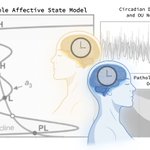



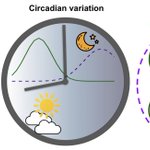


More implications of the washboard potential of affection: doi.org/10.31234/osf.io/874f…
Veronica's model pictures mood on a washboard (빨래판) potential and proposes how the brain’s clock may stabilize mood. The circadian clock rhythmically tilts it and sustains daily “ups and blues” while helping keep mood from sliding into deep depression.
doi.org/10.1063/5.0327423

With a single parameter set, most aftereffects of photic entrainment can be explained by an attractive-repulsive coupling motif in the SCN. Work by Vuong @VuongTruong9.
biorxiv.org/content/10.64898…


The Chronotype Paradox: intrinsic circadian periods are slightly left-skewed, yet human chronotypes are heavily right-skewed. We show stochasticity in sleep pressure accumulation is sufficient to flip the skew. biorxiv.org/content/10.64898…

Circadian swings in the mood potential protect against falling into mood extremes such as mania and depression, and this helps explain why bipolar disorder and circadian dysfunction subtly interact. Work by Veronica Will (now at UCSD).
biorxiv.org/content/10.64898…

We know use of affective words show circadian fluctuations. Now Vuong and Mariana show circadian structure in embedding space, too: morning peak in local semantic exploration, later peak in global diversity as posts accumulate. arxiv.org/abs/2601.15091

Non-seasonal infradian (longer-than-24h) rhythm exists in mice in age & sex dependent manner. By Pishan Chang and Hugh Piggins, and our lab’s Vuong. physoc.onlinelibrary.wiley.c…

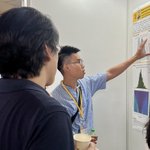
Ben Nguyen explaining his mathematical model of chronotype at the Taiwan Sleep Society Meeting (October 2025).

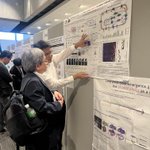
Vuong presenting his work on the origins of the heart's circadian rhythm at the Japanese Chronobiology Society 2025 @jsc2025_kyoto meeting in Kyoto. (ヴオンの初めての時間生物学会での発表) #JSC2025

New v2 on bioRxiv, with minor revisions with larger n. Conclusions unchanged: the choroid plexus is the earliest brain circadian clock in mouse; onset is SNIC-like; tiny Δ0.5 °C cycles entrain during early development. biorxiv.org/content/10.1101/…
The earliest circadian clock in the brain is not the SCN. It is the choroid plexus, ticking by ~E12 with intriguing SNIC-like dynamics. Work by Helene Vitet and Vuong Truong @VuongTruong9
biorxiv.org/content/10.1101/…

Circadian biologists from Korea, Japan, and Taiwan got together at #KSBNS2025 — Jihwan Myung, Eun Young Kim, Kazuhiro Yagita, and ShihKuo Chen!

When circadian periods are skewed, the relationship between period variance and coupling strength becomes 2D, creating a geometry of synchronization and macroscopic period. Circadian rhythms across aging can be viewed as movement along this geometry.
link.springer.com/article/10…

Braintime Lab’s Vuong and Sun Lab’s Mariana took a joyful moment to celebrate their upcoming marriage💍 with a one-of-a-kind photo shoot!
#BraintimeLab #SunLab #LoveInTheLab #CircadianRhythms #BuryingBeetles #ScienceAndStory


Our super-postdoc Hélène is back from GRS/GRC after her wonderful talk and poster presentation! We still need to absorb what she learned there—but we are so proud of her. #GRC2025 #HeleneVitet

The slow ovarian clock (~28 days) is regulated by the brain’s circadian clock (~1 day). Mood stabilizers (e.g. lithium) that affect circadian rhythms may also influence the reproductive cycle. chronobiologyinmedicine.org/…
The Braintime Lab is looking for a postdoc to join an exploratory project on circadian development and neuroscience. Rodent experiments + chance to learn computational modeling. Competitive salary & benefits. Find out more at braintime.tmu.edu.tw
Our amazing master's student Veronica has officially graduated! Huge congratulations from all of us at Braintime Lab!

Braintime Lab retweeted

Excited to announce Centaur -- the first foundation model of human cognition. Centaur can predict and simulate human behavior in any experiment expressible in natural language. You can readily download the model from @huggingface and test it yourself: huggingface.co/marcelbinz/Ll…
