

Tracking capital flows, market regimes, billion-dollar investors, and the systems behind outsized returns.
Joined July 2026
- Tweets156
- Following46
- Followers217
- Likes397
this is getting f*cking dangerous, a swarm of up to 300 AI agents can now take apart an app and explain how a feature works, without the original source code
REA is the open-source tool behind it. it decompiles a program and hands the evidence to your coding agent. Kimi K3 brings the huge context and the parallel hands
u start small: ask a calculator why 200 + 10% gives 220, and REA recovers that one rule so u can rebuild it
each part gets its own job:
→ REA decompiles the target and tags every piece of evidence with an ID
→ Kimi Code reads that evidence and turns it into an answer
→ /swarm sends independent questions to parallel agents
→ Kimi's Agent Swarm takes the wide work: up to 300 sub-agents and 4,000+ tool calls on one task
and this is where it gets interesting
an agent can sound confident while half the answer is a guess. so every answer has to separate what REA actually saw in the code from what the agent is only assuming
then u rebuild the one rule in ur own code and run both versions through the same cases. anything that differs goes back to the swarm as a new question
if u wanna try it, give Kimi Code this:
"Use REA to inspect [your target].
1. Question: [one behavior, e.g. why does X produce Y?]
2. Return the evidence with its IDs, and mark what was observed versus inferred
3. Rebuild that one rule in my own code and test it against the original on normal, boundary and branch cases"
start with software u wrote, an open-source app or a tool u're licensed to examine. cracked copies and bypassing licenses are off the table
the full 8-lesson course is in the article below ↓


1
6
316
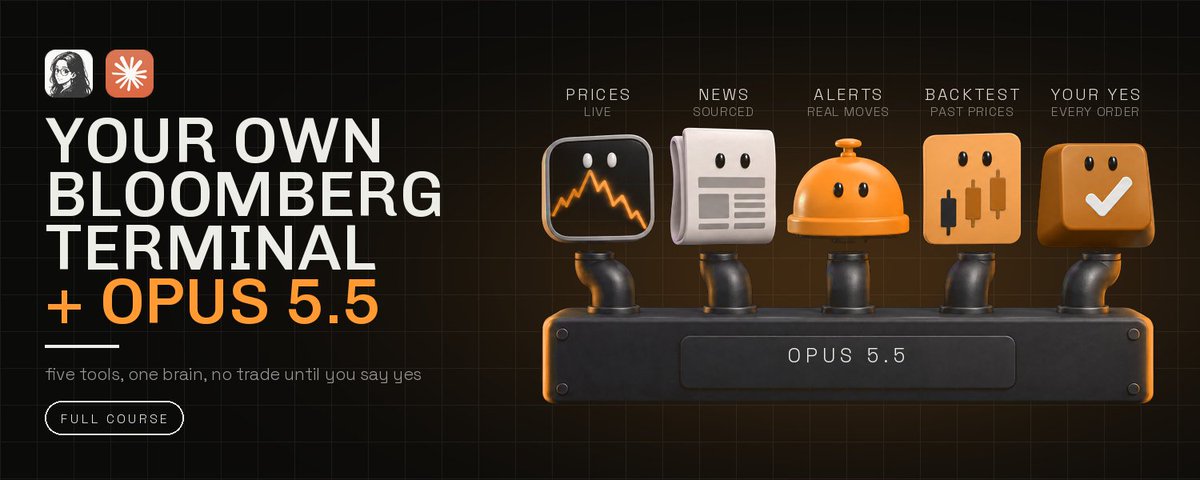
you don't need a Bloomberg seat anymore. you need one rules file.
i just built my own market terminal with Opus 5.5 and Claude Code, and the chat box will never answer "why did it move" the same way again
traders pay ~$30K a year for a price, the news behind it and an alert on one screen. mine runs on a $20 Claude plan and a free public price feed
here is how to build it with your AI agent from scratch:
→ open Claude Code on Opus 5.5, create one folder, and let it ask you what you hold and what counts as a real move
→ give it a free feed: public crypto prices and candles plus 30 days of daily stock data, read only, no account, no keys
→ write the rules file it reads before every run: every number with its source and time, anything older than 15 minutes refreshed, anything unsourced marked missing
→ measure noise properly: usual daily move as the 30-day median, volume against its median, levels at the nearest 30-day high or low
→ ask like an analyst: what moved, real move or noise, what would change the view, and what it could not verify
→ backtest any idea on 24 months of hourly candles with fees set a little high, and make Claude try to prove the backtest is fake before you trust it
→ put it on a weekday morning routine that stays quiet until something real moves, and proposes one action that waits for your yes
if you want the full build with every prompt, you will find it in the article below:

4
8
495
QuantGPT is the most powerful MCP for traders right now
this one genuinely changed how i build trading systems...
QuantGPT gives Claude, ChatGPT or any AI the same 3 layers a hedge fund runs on: data, compute and trading, through one connection, starting free
i wrote a research paper on turning any AI model into a research-grade trading system with hedge fund infrastructure
here is how you do it:
1. the data warehouse feeds your AI decades of US prices, delisted companies from 1998 and fundamentals stamped by filing date, so survivorship and look-ahead bias stop faking your results
2. the MCP connection plugs Claude, ChatGPT, Gemini or Cursor into one endpoint in about 10 minutes
3. the cloud backtest engine runs your AI's rules on stored history, so it can't hallucinate a Sharpe ratio it never calculated. 175 strategies in the library, 63 run in one click
4. the findings system splits every study at an out-of-sample year and returns one fixed verdict: data validated, trade-off or no edge
5. the futuretest engine replays your holdings through every past tariff shock, oil shock and war onset, and the journal rechecks old research as new data arrives
6. the runner hosts your own code 24/7 and sends orders to your own Alpaca account, while the AI itself can't place a single trade
the whole setup, step by step with every prompt, is in the article below ↓


if you want to build an AI trading system from scratch, start with this article
you will end up with real market data, real backtests and a bot that trades for you 24/7

1
10
268
a guy talked to his computer for 5 minutes, went to sleep, and woke up to a 142-second music video made by Opus 5.5. 2.1M views.
Claude worked for 12 hours. every frame you see was redrawn in code.
the "one prompt" was actually a 9,500-character director's brief:
- a one-line logline every shot gets checked against
- references to copy the grammar of, never the content
- a beat sheet with a new payoff every 3 to 5 seconds
- gates: plan → stills → animatic → full pass → render
- a critique loop where Opus scores its own frames until everything is 8+
Tony Dinh paid $1,000+ for a launch video like this a year ago. with the same setup he made one in under 30 minutes.
the prompt is 10% of the video. the other 90% is the harness.
explore it today, then read the full 12-step motion studio course in the article below ↓


1
6
343
this is free f*cking gold for anyone still treating AI video as one giant prompt
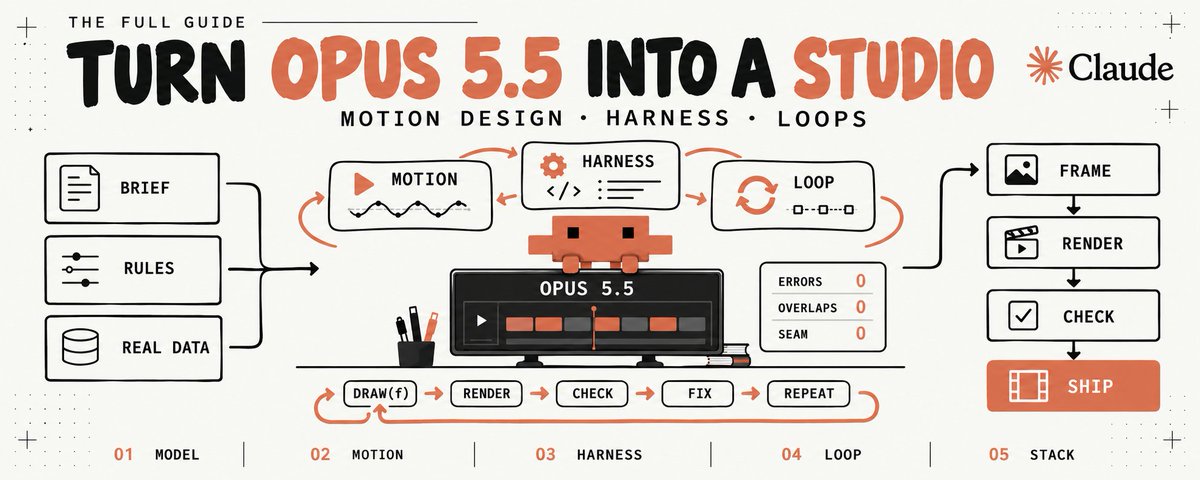
Opus 5.5 can’t make a single mp4. it writes the program that draws one frame, and that’s how the timeline filled up with launch films in a week
a frame is a function of its number: no clocks, no timers, no random numbers, so frame 431 looks the same on every render
brief → rules file → draw(f) → render → smoke test → seam check → look, one loop
two guides steer it before it acts, three sensors check it after, and every failure becomes a new rule
the goal is one sentence a machine can check: six counters read zero, frame 0 matches frame 720, stop after 5 rounds
it only pays off now because cache reads dropped 60% to $0.20 per million, and a loop re-reads the same context all day
give this to your next Claude build before you blame the model for another mid render

8
378
this is free f*cking gold for anyone still rewriting prompts every time their AI animation comes out mid
the first render from Opus 5.5 is always the same: a centered title on a gradient, everything fading in. the fix was never a better prompt
a model, a harness and a loop, one studio
brief → code → render → smoke test → seam check → fix the worst failure → repeat
6 error counters have to read zero and frame 0 has to match frame 720 pixel for pixel before anything ships
every bad render becomes a new rule in the file the model reads on every run, not just a one-off fix
Opus 5.5 is the first model where this pays off: 40% cheaper to run than Opus 5, cache reads 60% cheaper, and it grades its own frames
when the same problem shows up twice, don’t fix the output. fix the harness
give this to your next Claude setup before you write another prompt
11
612
this is free f*cking gold for anyone still re-explaining the same job to their AI every single week
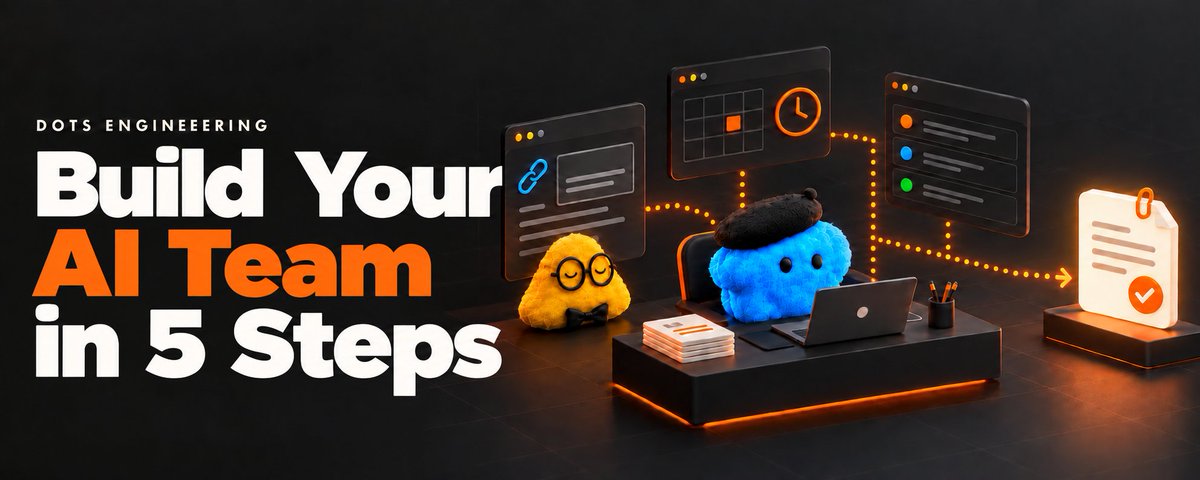
3 old requests to teach it, 1 held back to test it, 2 background agents, 1 review gate. that’s the whole OpenAI Dots setup
your Dot breaks the job into tasks, hands them to agents with their own sources, merges the findings and stops at you
queue → Dot → documentation agent + issue-history agent → one brief → your review
every correction you make goes into a playbook, so the next run starts smarter instead of from zero
Boris Cherny runs Claude Code the same way: every time Claude gets something wrong, the fix goes into one shared file the whole team updates
on a schedule it takes up to 3 requests, oldest first, drafts everything and sends nothing
give this to your next agent setup before you explain the same task one more time

7
294
this is free f*cking gold for anyone still dumping every task into one Grok Bot and wondering why it gets worse
1 bot doing 6 jobs is a mess. 6 bots doing 1 job each is a team. Grok Bot's own procurement bot saved over $100K in its first week
SpaceXAI's own PM runs 9 seats, 9 memories, 9 lanes, with a Chief of Staff as the only generalist
goal, tools, style, approval, schedule, 5 signals that tell you when a job deserves its own bot
description → 1 real task → correct it → save as skill → test on a 2nd input → only then a routine
every official starter prompt ends with a stop: do not send, do not contact, do not change budgets
the bot that drafts and the bot that sends are never the same bot
all your bots share one computer and its logins, so separate bots are an org boundary, not a security one
give this to your next Grok Bot setup before you hand one bot your whole week

1
6
372
send this to Claude and he'll make you f*cking rich
this prompt turns Opus 5.5 into a full quant desk
scan → 5 hypotheses → code → a separate risk officer attacks it → hard gates → small size live → nightly review
6 of every 7 ideas die before they touch a dollar. the one that survives trades 24/7 on Minara with a hard drawdown stop
every idea has to name who loses on the other side of the trade. no loser, no edge, no trade
nothing goes live without 100+ trades, Sharpe above 1, profit factor above 1.3, and a backtest that survives double fees
every night it checks live fills against the backtest and writes one new rule per losing pattern. the desk gets sharper while you sleep
the full 80-line prompt is below. paste it into your trading agent tonight

opus 5.5 is the most dangerous AI model for trading right now
it gives you 1M token context and always-on reasoning
that can discover new profitable trading strategies for you 24/7
if you set it up correctly, you gain superpowers

8
268
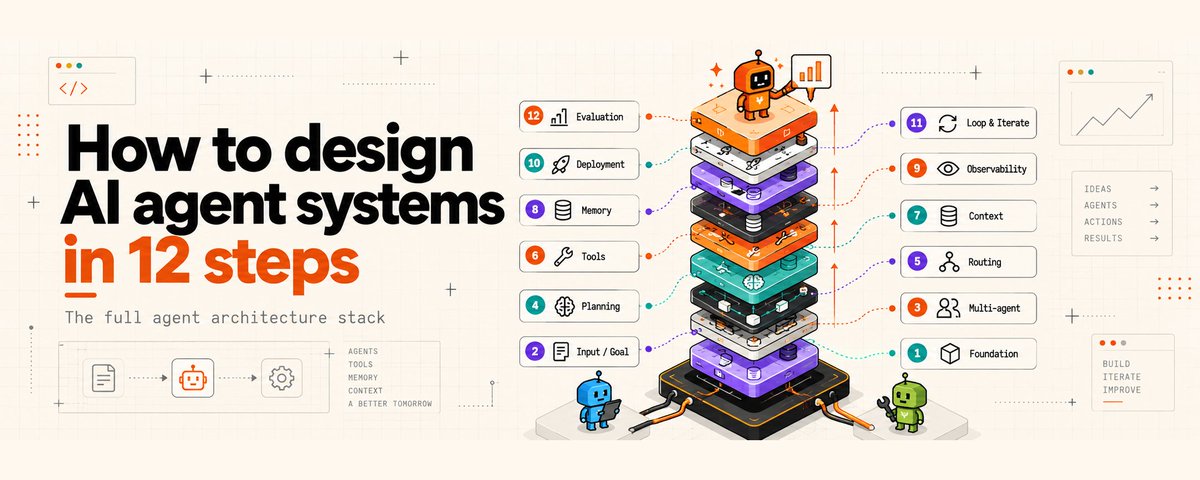
this is pure f*cking gold for anyone running multi-agent crews
every agent crew hits the same wall: dozens of small forks, "which file?", "which tool?", "retry or stop?", all sent to the LLM as prose
each one takes 1–2 seconds and half of them come back unparseable
this run moves every fork to Jev instead
42 forks, all typed, 371 ms each, and the answers are numbers your code can act on
when Jev isn't sure, like "which tool?" at 0.48, it hands the fork back to the LLM instead of guessing
one crew run, zero regressions
bookmark it for future reference
2
6
554
Blue Delta retweeted

holy sh*t, Sam Altman just launched Dots
this is an 8-step blueprint on how to set up your dot so it does the work while you're gone:
step 1 → give it a goal, not a prompt: tell it what to achieve and what it's allowed to do alone. it runs on GPT-6 Astra and moves the work forward by itself
step 2 → let it work while you're offline: your dot has its own cloud computer, files and browser, and they stay on when your laptop is off
step 3 → set up recurring tasks: what to check, when it runs, what triggers a notification and where the results go
step 4 → make it react to events: a new bug report in Slack can wake your dot up on its own
step 5 → let it split the work: one goal becomes parallel background agents for research, data, docs and code, and it pings you only for the decision
step 6 → connect your tools: Gmail, Google Drive, GitHub and your local computer, so it can investigate a bug, prepare a PR or update your docs without you
step 7 → talk to it anywhere: the same dot, with the same notes, in ChatGPT, Slack, Teams and voice calls
step 8 → set the autonomy rules: act without asking, act only when you say so, ask first, or hand it off to you
most AI tools stop the moment the conversation does
Dots is built to keep going after you've left
one goal in, finished work out, while your laptop sleeps ↓

Blue Delta retweeted

Stanford AI engineering course:
"Anyone can build an AI agent in 60 minutes"
Prompt → Agent → Automation → Revenue
Stanford just released a course on building AI agents from scratch
00:00 - Build your first AI agent
48:15 - Create agents without coding
54:36 - Make $100K+ per month with ai agents
While you scroll, someone else is learning Anthropic's $850,000 skill
This free course is better than most paid AI agent courses
Bookmark and watch it today
Then read the article below
Blue Delta retweeted
holy sh*t, Boris Cherny just revealed how he actually uses Claude Code
the man who built the most powerful coding agent in the world runs it with a setup he himself calls surprisingly vanilla
→ 5 Claudes in the terminal, 5–10 more on the web
→ Opus 4.5 with thinking for everything
→ one CLAUDE.md per team, updated every time Claude makes a mistake
→ /commit-push-pr, used dozens of times a day
→ plan mode first, then auto-accept, and the PR usually ships in one shot
→ a Stop hook that forces Claude to check its own work
and the one thing he says matters most:
give Claude a way to verify its work → 2–3× better final result
just the loop, done right
save this ⭣

holy sh*t, Boris Cherny just revealed how he actually uses Claude Code
the man who built the most powerful coding agent in the world runs it with a setup he himself calls surprisingly vanilla
→ 5 Claudes in the terminal, 5–10 more on the web
→ Opus 4.5 with thinking for everything
→ one CLAUDE.md per team, updated every time Claude makes a mistake
→ /commit-push-pr, used dozens of times a day
→ plan mode first, then auto-accept, and the PR usually ships in one shot
→ a Stop hook that forces Claude to check its own work
and the one thing he says matters most:
give Claude a way to verify its work → 2–3× better final result
just the loop, done right
save this ⭣
holy sh*t, Anthropic just dropped the official playbook for AI agents
every agent Boris Cherny shipped inside Claude Code started from the loop in this guide
and it kills the "just add more agents" advice
"find the simplest solution possible, and only increase complexity when needed"
the 5 patterns, in order:
→ prompt chaining: fixed steps, one after another
→ routing: classify the input, then send it to a specialist
→ parallelization: split the work or vote across runs
→ orchestrator-workers: one model delegates subtasks it can't predict in advance
→ evaluator-optimizer: one call writes, another critiques, repeat until it passes
only after all 5 do you get to a real agent loop:
plan → act → observe → repeat
what teams got out of it:
Coinbase: 99.99% availability
Tines: 100× faster time to value
Intercom Fin: up to 86% of support resolved
your agent doesn't need more autonomy
it needs the lowest rung that works
save this ⭣


Blue Delta retweeted

holy sh*t, someone just mapped the 4 decisions you should stop paying Opus 5.5 for
your agent spends frontier tokens on questions a smaller layer answers better:
→ which notes to load: score them, don't load all nine
→ who runs the step: a rename doesn't need the frontier model
→ what to do after a failure: retry once, switch tools, or stop and ask
→ which tests to run first: focused tests first, full suite before merge
the boundary:
Opus 5.5 → writing, planning, reading unfamiliar code
Jev → choosing among the options it was handed
harness → option list, thresholds, permissions, budget
verifier → reads the file, the diff and the test output again
the generator changes
the decision layer doesn't
OpenAI, DeepMind, Anthropic, Grok. one contract
save this ⭣
Blue Delta retweeted
NVIDIA and Jensen Huang just open-sourced the brain for humanoid robots, and published a 36-page paper on exactly how they built it
It is more useful than most paid robotics courses:
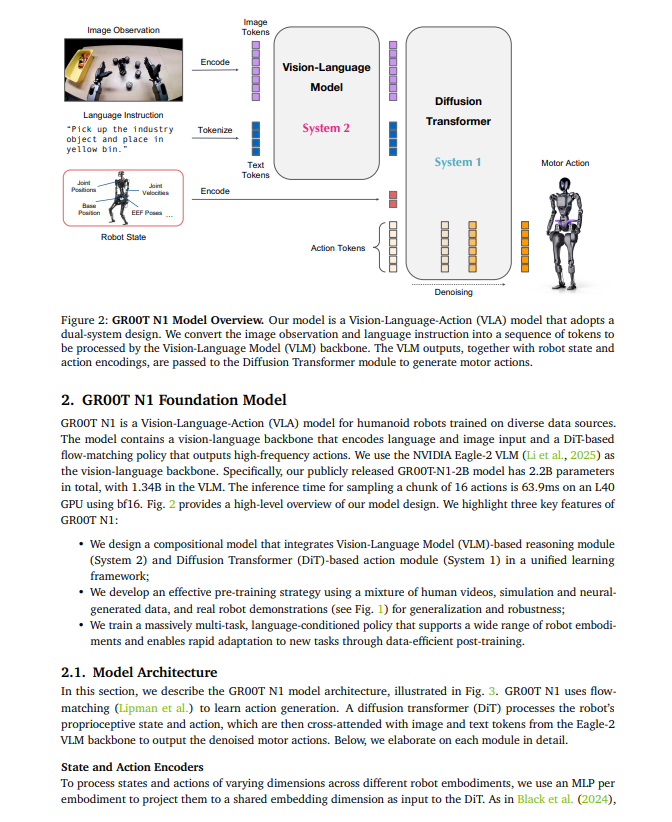
this is an 8-step blueprint on how NVIDIA built GR00T N1, a single open model that controls robot arms and full humanoids with one set of weights:
step 1 → split the brain in two: System 2, a vision-language model, reads the scene and the instruction. System 1, a diffusion transformer, turns that into fluid motor actions in real time
step 2 → run each system at its own speed: the reasoning model runs at 10Hz and the action model outputs motor commands at 120Hz
step 3 → build a data pyramid: web data and human videos at the base, synthetic data in the middle, real robot data at the top
step 4 → learn from videos that have no actions: a latent-action model labels human videos so they can be used as training data for the robot
step 5 → generate the data you can't collect: a video model fine-tuned on 88 hours of teleoperation turned it into 827 hours of new robot trajectories, roughly 10×
step 6 → simulate the rest: 780,000 simulated trajectories, equal to 6,500 hours or nine continuous months of human demonstrations, generated in just 11 hours
step 7 → use one model for every body: a small encoder per robot maps any arm or humanoid into the same model
step 8 → post-train on almost nothing: with only 10% of the data, GR00T N1 reaches 42.6% success on real humanoid tasks, against 10.2% for Diffusion Policy. with full data it reaches 76.8%
most robotics courses teach you how to train one robot for one task
this paper teaches you how NVIDIA trains one brain for every robot
the result: a 2.2B-parameter model that samples 16 actions in 63.9 ms, open weights, open data and open benchmarks
Send this paper to Claude Code or Codex and start building on the same model NVIDIA is putting inside humanoids ↓
NVIDIA and Jensen Huang just open-sourced the brain for humanoid robots, and published a 36-page paper on exactly how they built it
It is more useful than most paid robotics courses:
this is an 8-step blueprint on how NVIDIA built GR00T N1, a single open model that controls robot arms and full humanoids with one set of weights:
step 1 → split the brain in two: System 2, a vision-language model, reads the scene and the instruction. System 1, a diffusion transformer, turns that into fluid motor actions in real time
step 2 → run each system at its own speed: the reasoning model runs at 10Hz and the action model outputs motor commands at 120Hz
step 3 → build a data pyramid: web data and human videos at the base, synthetic data in the middle, real robot data at the top
step 4 → learn from videos that have no actions: a latent-action model labels human videos so they can be used as training data for the robot
step 5 → generate the data you can't collect: a video model fine-tuned on 88 hours of teleoperation turned it into 827 hours of new robot trajectories, roughly 10×
step 6 → simulate the rest: 780,000 simulated trajectories, equal to 6,500 hours or nine continuous months of human demonstrations, generated in just 11 hours
step 7 → use one model for every body: a small encoder per robot maps any arm or humanoid into the same model
step 8 → post-train on almost nothing: with only 10% of the data, GR00T N1 reaches 42.6% success on real humanoid tasks, against 10.2% for Diffusion Policy. with full data it reaches 76.8%
most robotics courses teach you how to train one robot for one task
this paper teaches you how NVIDIA trains one brain for every robot
the result: a 2.2B-parameter model that samples 16 actions in 63.9 ms, open weights, open data and open benchmarks
Send this paper to Claude Code or Codex and start building on the same model NVIDIA is putting inside humanoids ↓