

Figuring out how to live well in the 21st century. Philosophy, technology, economics, aesthetics. Founder emeritus, @palladiummag.
World
Joined April 2014
- Tweets7.7K
- Following801
- Followers7.6K
- Likes10.4K






Jonah Bennett retweeted

Lately I’ve been learning math with ChatGPT (Astra) as my tutor, using this document scanning camera and a vibecoded tool that pastes the captured image right into the chat.
This way, I just work problems on paper and ChatGPT gives feedback. It’s really nice.

In a healthy labor market, companies would be begging people not to go to college and offering on the job training.
Now, companies make kids go into hundreds of thousands worth of debt to pay for years of training before they'll even consider them.
It's better to dress more authentic-stylish, because otherwise it ends up looking more like barbershop quartet.

The statue of Prometheus is finally finished.
It was cast in Paris, crossed the Atlantic, and was assembled at Starbase. It took us 100 days to go from nothing to this.
People of the West, we have lived through an era devoid of dreams, devoid of destiny.
But the time has come to reclaim our dream of antiquity.
In a few months, we will start building a new city. It will be the most magnificent city in all of history.
After all, the great dream of the West has always been to rebuild Rome.
Come walk beside us in this endeavor. The world is waiting.


This model of a 1,000 tiny states was deprecated long ago by industrialized warfare, which pushes in the direction of larger blocs, not smaller states.
A thousand tiny states will be mowed down by larger continental powers with access to huge pools of well-trained manpower, long-range missiles, satellites, drone fleets, large combined-arms formations, strategic transport, logistics, weapons production, ammunition reserves, etc.
No more thousand tiny states.
The end.

The time to decentralize is upon us!
Decentralization is the only political structure that actually disciplines government, and Switzerland's canton system proves it with 700 years of evidence.
Twenty-six cantons compete for residents and businesses. Appenzell Innerrhoden runs differently from Zurich, which runs differently from Geneva. When Basel raises taxes past the tolerance of its engineers and entrepreneurs, those people move to Zug, which has kept its corporate tax rate under 12%. Basel loses the revenue. The lesson writes itself.
Centralization is the villain. Every time a federal authority absorbs a decision that cantons once made, you lose the price signal. You lose the experiment. You lose the exit option. Brussels crushes this mechanism across the EU, which is why French farmers and German industrialists both scream at the same unresponsive bureaucracy with nowhere to go.
Competition between governments constrains Leviathan the way competition between businesses constrains monopoly pricing. Strip away that competition and governments do exactly what monopolists always do: extract maximum value from captive subjects while delivering minimum service.
The canton system works because it keeps power close to the people funding it and gives those people somewhere else to go.
Take power and responsibility out of the hands of bureaucrats thousands of kilometers away. Localize it to within manageable sections, and watch your area flourish.

Circadian biology is the obvious next paradigm.
We have a long ways to go, tho, since people seem to keep wearing blue light blockers during the day outside.


Another day, another person shredded by official institutions.

“I’m 23 years old… and my clitoris is completely numb, like the back of my elbow. I can’t orgasm. I can’t feel love for my own mother. I can’t even enjoy music anymore.”
That was Laureen Friedman’s raw testimony at a recent Safety Advocates on Mental Health Care panel.
She lives with PSSD — Post-SSRI Sexual Dysfunction. After taking Zoloft, she woke up one day with total genital numbness, zero libido, permanent inability to orgasm, and a sudden emotional numbness she describes as “chemical castration” and an “emotional lobotomy.” What used to be a deeply emotional, empathetic, songwriting young woman now feels disconnected from the core human experiences of love and pleasure.
She says she was never warned this could happen even after stopping the drug.
Millions are prescribed SSRIs every year, often without being told about rare but potentially permanent side effects like PSSD. People deserve full informed consent about what they’re risking.
Have you or anyone you know experienced lasting sexual or emotional side effects from antidepressants?
A bunch of centralized exchanges in crypto are disappearing this year. AscendEX is closing, BitMEX is closing, BitMart is winding down, and I think a lot more of the mid-tier is going to get wiped out.
There are still 239 spot exchanges listed on coinmarketcap.
The world does not need 239 exchanges.
A lot of people rushed into building them because they didn't know what to build, and so wanted to collect fees on trading activity in a profitable part of the industry. Some of the L1 boom obviously came from that same reasoning.
The problem is that when you have a flooded industry, it makes the knife fight bloodbath inevitable, which is what we're seeing now.
By my calculation, roughly 85-90% of spot + derivatives volume is now concentrated in five exchanges. Small exchanges can maybe survive via some very specific customer or regional niche.
But the mid-tier is going to get wiped out.
There is zero chance in hell that Athens becomes the new Dubai, and it's tiresome when people make these analogies.
The next harvard, the next dubai, the next switzerland, the switzerland of this, the yale of that, it's like the Paris of south-central africa!


Is de-dollarization actually happening?
I reconstructed a graph to show what the treasury side of the de-dollarization trend actually looks like since 2008.
1. Private foreign holders have surpassed government holders.
2. Foreign holdings of treasuries are actually on an upswing since their 2020 low.
Unfortunately for treasuries, private entity reserves tend to be more volatile than central bank reserves.
But there's also potential upside here for the U.S., which is that if this trend continues, foreign governments will lose some financial leverage over USG.

With tech like zkpassport, you can scan a passport's nfc chip and create a cryptographic proof that a user has X nationality.
It's now possible to build a social media network filtered/restricted by nationality, all without that network ever receiving or storing the underlying passport data. If designed well, that privacy can still hold even assuming a hostile operator.
Privacy-preserving, cryptographic borders are now possible on the internet.
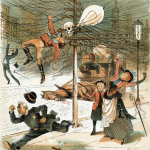
An Unrestrained Demon is the title of this cartoon from 1889.
It was drawn apparently in reference to John Feeks, a Western Union lineman who died after grabbing a high-voltage line 50 feet in the air over Manhattan.
It looks quaint now, because cities know how to build proper electrical infrastructure, so that main street isn't the scene of a massacre every day.
But it's a good excuse to think about what it means to override the conditions life evolved under, and what else electricity is doing to us, and I've been exploring this area for some years.
Electricity is a perfect case of technological development outpacing both our understanding of its consequences and the social technology around our interaction with it.
We now have the power as a civilization to control the night, but light at night is not biologically neutral, and its consequences are not trivial. Unfortunately for us, we've really only started to scratch the surface here. It's not yet possible to definitively attribute chronic disease to artificial light at night. That kind of definitive claim in medicine in general is very hard to come by, and I'm being conservative here.
However, we can say things like: light at night suppresses melatonin and shifts the timing of the circadian clock. We can also say that a single night of even moderate light during sleep has been shown (small controlled experiment) to raise heart rate, reduce HRV, and worsen insulin sensitivity the next morning.
People exposed to more light at night also go on to have higher rates of type 2 diabetes and cardiovascular disease (heart attack, heart failure, stroke, etc.)
Importantly, the problem runs in both directions. Brighter nights are associated with worse outcomes, and brighter days are associated with better ones. Talking about daylight is beyond the scope of this tweet, but just as a practical example, being indoors at noon means you get about 200 lux of light. Outside at noon can be up to 100,000 lux.
(Sidenote: I highly recommend you all download lux meters on your phones and play around with indoor lux vs. outdoor lux measurements so you can see the above for yourself, though obviously dedicated lux meters will get you more accurate results.)
Circadian rhythm, of course, reaches into virtually every physiological system in the body, and circadian rhythm is mainly driven by light (also temperature, exercise, food, etc). Sleep, body temp, hormone release, glucose, and heart function are all circadian-regulated.
So, what to draw from this?
First, virtually no one is aware of these studies. Second, almost no one thinks seriously about circadian rhythm, despite humans having evolved for millions of years under the stable pattern of bright days, dark nights (fire is only single-digit lux exposure). Third, even with this knowledge, we have not even begun to design the social technology and electrical governance needed on an individual and civilizational level.
This leads to the central question: what would a circadian-compatible, 24-hour civilization look like? What happens to cities, offices, hospitals, building codes, and work itself?
The next era of electrical governance is going to be about building biologically robust institutions for a civilization capable of overriding the night.
We're not there yet, and we won't be for a very long time. But now is a good time to start.


I'd support a new kind of email/comms protocol where you can set georestrictions on incoming comms and also specify fees but with more customization than postage stamps had.

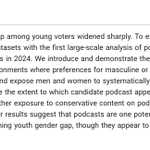
There's finally some new research (working paper) on the role podcasts played in Trump's gains among young men in 2024.
The finding: podcasts seem to explain only a small share of Trump's improved performance among young men.
Lot of money in the podcast space riding on this question.
preprints.apsanet.org/engage…


Caplan is applying Rawlsian-style reasoning to argue that Haitians should be allowed entry into countries they want to move to.
Even if he's not, let's just discuss this below hypothetical a minute, since it comes up frequently.
"Imagine the birth lottery put you in Haiti. What would you want the immigration policy of other countries to be?"
The idea is that if you were born in Haiti, obviously you'd want the right to move to somewhere like the U.S. or any other less hellish state.
But it doesn't show that the preferences of someone outside a country should have enough say to determine that country’s immigration policy. It only shows what that person's interests are. If it tries to show that, then it's just question-begging.
To repeat: either the hypothetical tells us what Haitians want, or it tells us what America/other states ought to do. To get to the second, you have to implicitly assume that outsiders’ interests in moving generate a claim against America to admit them.
But that's exactly the disputed idea in the first place, so this hypothetical really doesn't do much.

Are liberal societies self-undermining?
@JonathanAnomaly and @filipefaria say yes.
In a new response, de Vries and @mboudry cite five reasons why they think that liberalism's prospects aren't nearly as bleak.
Worth a read: onlinelibrary.wiley.com/doi/…
