

Stay curious. Science resources for teens, teachers, and curious homes.
Joined November 2022
- Tweets2K
- Following181
- Followers1.4K
- Likes10.6K




Pinned Tweet
Things to try. Things to notice. Things to explore.
Your curiosity already knows where to start. Follow along, and let's see where it takes you. Stay curious. ✨
1. Freshly made atoms of it hitch a ride on tiny potassium chloride particles in a stream of helium, traveling tens of meters through a thin tube to the chemists.
2. Chemists prefer a 3.1-minute form of it over its longest-lived one, because it can be made in larger batches.
3. Ten minutes of three trillion light ions a second hitting a thin target yields only about 1,200 of its atoms.

7. Its longest-lived isotope lasts only about an hour before half of it is gone.
8. Its first claimed discovery, in 1957, came from bombarding a man-made target with light ions in half-hour bursts, fifty times, and could never be repeated.
9. Its name comes from that failed 1957 claim; it was approved at once and stuck even after credit went elsewhere.

1. Humphry Davy first isolated it in 1808 by electrolyzing a moist mix of lime and mercuric oxide into an amalgam, then boiling off the mercury.
2. Its compounds turn a flame a brick-red orange.
3. The silvery metal dulls in air and steadily frees hydrogen from cold water, leaving a strongly alkaline solution — eager, but far calmer than sodium.

7. Limestone, marble, cave stalactites and the crusty scale inside kettles are all mostly its carbonate.
8. Milk, cheese and yogurt are famous dietary sources of it.
9. It is the element your bones and teeth are built around — the main metal in their hard mineral.
🤖 Made with AI

Three stars, three distances:
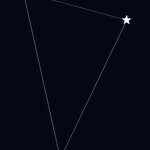
The Summer Triangle is an asterism made of three bright stars. Each belongs to a different constellation: Vega in Lyra, Deneb in Cygnus and Altair in Aquila.
The Milky Way, our own galaxy seen edge-on, flows right through it. In the Tanabata and Qixi festivals of Japan and China, Vega is the Weaver Girl and Altair is the Cowherd, two lovers kept apart by that river of stars.
The three look like neighbors, but they aren't. Altair is about 17 light-years away and Vega about 25. Deneb's light has traveled somewhere between 1,400 and 2,600 years to reach you.
To look that bright from so far away, Deneb must shine tens of thousands to about 200,000 times brighter than our Sun.
Altair spins so fast that it bulges at its equator. It turns once in less than half a day.
Stay curious:
Can you spot the dark rift splitting the Milky Way inside the Triangle?
Which of the three stars would look brightest if they were all the same distance away?
What would the sky look like from a planet circling Deneb?

The hunter among the birds:
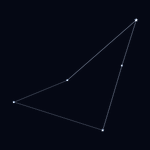
A modest run of stars stretches between the Crane and the Peacock.
Indus is the Indian. Dutch sky-mappers drew it at the end of the 1500s from their East Indies voyages. Sources do not pin one nation — the figure may recall people met in Madagascar, the East Indies, or southern Africa. It is voyage-era sky labeling, not a classical myth.
One southern patch, filled at once with voyage-world imagery: crane, peacock, toucan… and a hunter. The human and the birds share the same sky.
Its brightest star, Alpha Indi, is about magnitude 3.1.
Stay curious:
Locate Indus between Grus and Pavo.
Look up how Plancius drew Indus — arrows or a spear?
How do Indus, Grus, Pavo, and Tucana share one patch of sky?


Test Dissection #2: Star your lucky guesses
A check mark on a guess isn't proof you know it. Tonight: star every right answer you weren't sure about, and write one line on why that answer is right. On your next test, put a tiny "?" beside answers you guess (if your teacher's OK with it) so they're easy to find later.
Why bother? In a lab study, college students answered general-knowledge questions and rated their confidence. Seeing the correct answer afterward doubled how many of their correct-but-unsure answers they still got right on a later test.
Next Thursday: sorting every mistake by its cause.
Sources in the reply.

Source for Test Dissection #2:
Butler, Karpicke & Roediger (2008), J Exp Psych: LMC. doi.org/10.1037/0278-7393.34…
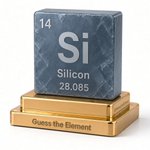
Guess the element — Expert, Keen, Everyday. Try to land it in three.
1/4 Expert:
1. In 1824, Jöns Jacob Berzelius prepared it as a brown powder by heating a fluoride salt with potassium and washing away the leftovers.
2. Its pure crystals copy the diamond's network, with each atom bonded to four others, yet the result is a shiny gray semiconductor rather than a gem.
3. Combined with carbon, it forms carborundum, one of the hardest abrasives, used on grinding wheels and sandpaper.
🤖 Made with AI

3/4 Everyday:
7. Ordinary window glass is mostly its oxide, melted with soda and lime.
8. Clear quartz crystals and most beach sand are its compound with oxygen.
9. The chips inside every phone and computer are built on ultrapure wafers of this element.
🤖 Made with AI

Energy, vitality, all the great civilizations or civilizing epochs have had a weight of energy behind them.
Test Dissection #1: Circle the mistakes you were SURE about
Tonight: find every wrong answer you felt confident about and circle it. Next to each one, write the right answer and a line on what you believed instead.
Why start there? In memory experiments with trivia-style questions, people were more likely to fix their confident mistakes than their unsure ones once they saw the right answer. It's called the hypercorrection effect, and it's shown up in young adults and in kids in grades 3–6.
Those "I was so sure!" moments aren't embarrassing. They're often the easiest mistakes to fix.
Next Thursday: the right answers you guessed.
Sources in the reply.

Sources for Test Dissection #1:
Butterfield & Metcalfe (2001), J Exp Psych: LMC. doi.org/10.1037/0278-7393.27…
Metcalfe & Finn (2012), grades 3–6, Learning and Instruction. doi.org/10.1016/j.learninstr…
Eich, Stern & Metcalfe (2013), on replications. doi.org/10.1080/13825585.201…