Astrophysics PhD | University of Queensland | UC Berkeley '21 | Exoplanets and Stars | @astrosoundbites co-host | Astrophotographer

Joined March 2019
Shashank Dholakia retweeted
The book was not about that bro🤦‍♀️🤦‍♀️🤦‍♀️🤦‍♀️🤦‍♀️🤦‍♀️🤦‍♀️im done with these AI book scrapers
2
2
148
Shashank Dholakia retweeted
Hi!!! Idk if anyone is on Twitter anymore but if you are, this short story chap I've been working on for the last couple years is open for pre-orders thanks to Abode Press!!! Shoutout to desi diaspora oomfs who are looking for a lighthearted but still contemplative read 💜💖💜
1
3
1
7
861
Shashank Dholakia retweeted
This week, Lucia, Cormac, and Shashank dive into the depth of the Mediterranean Sea and journey to the icy desert of Antarctica to discover more about neutrinos. Photo: first detection of a neutrino in a bubble chamber (1970). astrosoundbites.com/2025/07/…
1
2
134
Shashank Dholakia retweeted
In this episode, the (domestic) American sector of Astro[sound]bites covers the recent proposed budget cuts to NASA, the largest in its history. We cover the downsides these cuts would have for science and the economy, and what you can do to speak out. astrosoundbites.com/2025/05/…
4
1
7
364
Shashank Dholakia retweeted
A recent paper led by SXS members Yoonsoo Kim and Elias Most (both at Caltech) is in @AASNova today! This work explores the formation of strongly magnetized "monster" shocks and a transient "black hole pulsar" state from mergers of a magnetized neutron star and a black hole.
6
13
2,109
500,000 images from @NASAWebb were released and we need YOUR help in identifying them. Check out @DoNASAScience’s new project GalaxyZoo. Details below ⬇️
Launching today! 🚀 Join Galaxy Zoo to help identify the shapes of galaxies in over 500,000 @NASAWebb images, many of which have never before been seen by human eyes! Together, we'll study how galaxies have changed over billions of years. Learn more: go.nasa.gov/3SahwSD
4
41
3
173
25,621
Shashank Dholakia retweeted
This ep we cover the big boy on cosmology campus: LCDM. What can't this model explain about the universe? Shashank gives a tour through galaxies' dark matter hearts and Cormac shows how 1500 (ish? Unclear on this one) supernovae may hint at a flaw in LCDM. astrosoundbites.com/2025/04/…
3
5
286
Shashank Dholakia retweeted
5/n Astronomers need to be at the table to coordinate global mitigation, and argue for accessiblilty to space and the sky as the heritage for all humanity, and not let the modern space race devlove into a East India Company-esque colonial project to benefit a few corporations
1
2
6
342
Shashank Dholakia retweeted
1/n I wrote a piece for @thewire_in highlighting the risks to Indian Astronomy and the budding Indian space sector due to increasing number of satellite constellations such as Starlink, as JIO & Airtel scurry to bring starlink satellite internet to India m.thewire.in/article/space/n…
2
12
3
32
3,680
Shashank Dholakia retweeted
a[s]b turns 100! For our ten squared-th ep, we tour astrophysics extremes: the heaviest and lightest, fastest and slowest, brightest and dimmest. To help us, we meet up with old friends to talk dark matter, exoplanets, and how ridiculously long a Ph.D. takes!
1
3
6
263
Shashank Dholakia retweeted
Map of Cricket positions
284
1,735
362
17,297
2,132,201
Deeply sad to hear of Prof. Fajan's passing--a deeply inspiring and dedicated educator at Berkeley. When I took his instrumentation class, COVID switched us to remote mid-semester. He ended up hand soldering Arduino kits and mailing them to us for the final project.
Devastated to learn that Joel Fajans has recently passed away - one of the most inspiring lecturers I ever had as a student. He was so creative and engaging. I think about his lecture on the physics of bikes every week! physics.berkeley.edu/news/re…
1
1
1
441
For students that lived around Berkeley, he even biked over to personally deliver them to our door.
2
65
Shashank Dholakia retweeted
Paper alert 🚨 the Vega dust disk is RIDICULOUSLY smooth! ⭕️ Amazing symmetry in the new JWST (below) + HST images in our work led by the amazing Kate + Schuyler indicates that no giant planets are present in the system ❌ 🪐 but Earths/super-Earths/Neptunes may be present! 🌍
A nearly 100-billion-mile-diameter debris disk encircles the star Vega. Astronomers have long assumed this was a disk of planet-forming material, but new observations with Hubble and @NASAWebb offer a different verdict. "The Vega disk is smooth, ridiculously smooth."
1
5
32
2,539
Shashank Dholakia retweeted
My new paper is out today on a catalog of stellar companions with pulsation timing in TESS photometry! arxiv.org/abs/2410.19729 Paper thread below ⬇️
1
5
25
1,574
Shashank Dholakia retweeted
Really delighted to share our new paper out in Nature today, led by grad student Jerry Xuan at @ETLab_Caltech ! We resolve the first discovered brown dwarf companion GL229 B as a pair of two BDs in a very tight orbit. (thanks in part to Octofitter!) Paper link & thread below:
1
18
1
57
5,420
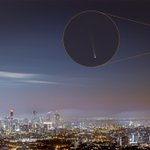
C/2023 A3 (Tsuchinshan–ATLAS) and the Moon rising over Brisbane. Took this timelapse on 30th September while it was still in the early morning sky. Now it should be visible just after dusk in to the west, near Venus. #comet #timelapse #Astrophotography
1
6
16
2,552
Shashank Dholakia retweeted
🚨🚨 Paper Day! 🚨🚨 Check out our new paper on the dynamics of the HIP-41378 system, which hosts the coldest known super-puff. Our idea is that the planet is NOT puffy, but rather that the transit depth can be explained via a set of oblique exorings. arxiv.org/abs/2410.00641
2
5
30
1,897
My first PhD paper is on arxiv today! Rotating planets are slightly wider at their equator compared to the poles. Saturn in our Solar System (below, minus the rings), is about 10% oblate! Can we detect this shape difference in transits from JWST? (1/N) arxiv.org/abs/2410.03449
2
32
2
190
13,752
We constrain WASP-107 b to be rotating more slowly (>13h rotation period) than Saturn or Jupiter in our solar system, assuming it isn't inclined. This is somewhat expected, since it should be tidally locked to its host star, but still a good test of our method! (9/N)
1
1
5
596
In this paper we focus on oblateness, but eclipsoid can be used to model any ellipsoidal planet, whether it's distorted by rotation or tides, and any surface map on planet or star. This, with autodiff in Jax, could let us look at full phase curves of ellipsoidal planets! (10/10)
1
1
8
597