

Physics/Astrophysics | Program Specialist at @NASA | Bi 🏳️🌈 | Sometimes #SpiderMan 🕷 | Views are my own
- Tweets2.9K
- Following3.1K
- Followers3.5K
- Likes10.4K





ALT Margaret Hamilton is reclined inside a NASA spacecraft module, surrounded by control panels and switches.


ALT This test image captures the very first photons of starlight to reach the Wide Field Instrument on NASA’s Nancy Grace Roman Space Telescope. It was taken as an initial performance assessment with the detector array still stowed as it was for launch, far from best focus. Roman’s primary science instrument has opened its eyes to the universe for the first time, revealing a sea of out-of-focus stars, each spread out over many thousands of pixels. The image, which zooms into one detector and zooms again to a single star in the insets, offers a baseline the Roman team will work from to align the telescope’s optics and tune the focus. The team will soon activate the instrument’s fine-guidance system, which will mean Roman can lock onto targets. They’ll also focus the observatory, which will shrink each star’s light to appear as a crisp point, rather than the broad, donut-like features seen here (which appear as expected given the instrument’s present configuration).


ALT Webb’s NIRCam and MIRI combined image of planetary nebula NGC 2392, the Lion Nebula, against the black background of space. The nebula is at center, circular in shape, and looks like a male lion’s head. In the center is a small, pinkish-white circle with eight-point diffraction spikes, a white dwarf star. Surrounding the star are purple-pink cavernous bubbles and shell-like rings. The bubbles and shells form an oval with two small, wide arcs near the top, reminiscent of a lion’s face and its ears. What appears to be extended outward from the lion’s face is a thick ring of purple-blue material. The width of the ring is consistent throughout and resembles a mane. The area closest to the lion’s face looks cloudy, while the edges of the mane look like there are clumps of dust with comet-like tails. In the background are distant galaxies and stars. Some galaxies are yellow and orange points of light and others have spiral structures. Some stars have diffraction spikes.


ALT A large rocket payload fairing with NASA and Roman Space Telescope logos is illuminated at night outside a tall vertical hangar. The fairing sits atop a transport vehicle, surrounded by warm orange and cool white lighting that highlights its curved shape as it is moved out of the facility. NASA/Sydney Rohde (Rocz)




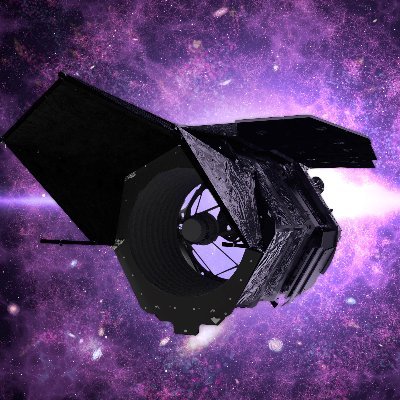
ALT Artist’s impression of the Roman Space Telescope depicting the spacecraft floating against a vivid purple background studded with distant galaxies. CREDIT: NASA Goddard Space Flight Center


ALT This composite image shows the progression of a total solar eclipse over San Millán de los Caballeros, Spain on, Wednesday, Aug. 12, 2026. A total solar eclipse swept across parts of Greenland, Iceland, northern Russia, the Atlantic Ocean, Spain, and a small corner of Portugal. A partial eclipse was visible in parts of the U.S., most of Canada, much of Europe, and northwest Africa. Photo Credit: (NASA/Bill Ingalls)
