

Bioprocess in silico: design, optimize, and scale faster
Cambridge, MA
Joined April 2022
- Tweets66
- Following7
- Followers515
- Likes9






Thanks for highlighting @ArkBiotech's work. We're proud to be pioneering the tech essential for the biorevolution, from cultivated meat to life-saving medications.
@SenFettermanPA the choice is clear: we either seize the opportunity to anchor this future right here in America (Make More Sh*T in America 🇺🇸), or we risk watching more jobs slip through our fingers to overseas competitors. Senator - would love to show you around Ark and discuss how we can strengthen US supply chains, bolster our economy, and improve national security.
Congratulations to @BeneMeat on getting EU approval for cultivated cat and dog food!
vegconomist.com/food-and-bev…
There’s been a lot written about challenges facing the cultivated meat industry recently. But what these articles ignore is: the science is there. The industry is on the precipice of mass adoption. Now it's time to solve scale.
ark-biotech.com/post/scale-t…
Meat used to be a luxury for the select few. The refrigerated railroad car changed this.
Cultivated meat is the next chapter, and better bioreactors will play a key role in bringing cheap, fresh cultivated meat to the masses.
ark-biotech.com/post/railcar…
Ark Biotech retweeted

Ark is one of those rare places that combines
- sharp, passionate, kind colleagues,
- a cutting-edge yet tractable technical challenge, and
- a compelling mission to make the world a better place.
Let's build a better food system together, one line of code at a time!

We're hiring software engineers, modelers, and data scientists to build the the world’s first intelligent bioreactor operating system, so that cultivated meat can reach the masses.
ark-biotech.com/careers
We're hiring software engineers, modelers, and data scientists to build the the world’s first intelligent bioreactor operating system, so that cultivated meat can reach the masses.
ark-biotech.com/careers
Cultivated meat is ushering in a new era of meat production where fortunes will be made and lost and geographic centers of power will shift. The question is who will lead it?
ark-biotech.com/post/geopoli…
But, traditional stirred tank bioreactors will not be able to scale to what is needed for price-parity without sacrificing performance
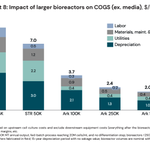
This is why Ark is building fit-for-purpose bioreactors that are 10X+ bigger and 90% cheaper
4. Reduce capital spend
Bigger bioreactors is the biggest lever to reduce capital cost. This is because
Bioreactor variable costs scale at a factor <1
With larger bioreactors, you reduce the number of external equipment needed a

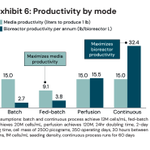
A fed-batch or continuous process is the most cost effective: Fed-batch minimizes media spend but requires more bioreactor capacity (bigger footprint). Conversely, continuous minimizes the need for bioreactor capacity, but requires more spend on media.

Perfusion - media is continuously removed with new media being added at the same time. The cells stay in the bioreactor, enabling them to access fresh media
Continuous - Cells + media are continuously removed with new media being added
3. 4 main bioprocess modes
Batch - the ingredients are put in the bioreactor and left to grow until end of process
Fed Batch - start with bioreactor partially filled and then add in more media at later time to give cells boost of nutrients
2. Improve biomass yields:
Cell density needs to match high-performing cell lines in pharma industry.
Ways to do:
Optimizing cell lines by natural or genetic altering
Removing constraints such as metabolic waste build up
Optimizing for mass increase during differentiation
1. Media is the biggest cost: Reducing cost to $1/L + can support reaching price parity.
Ways to cut costs:
Optimized recipes
1:1 ingredient replacements (finding cheaper ingredients that have same functionality)
Buying in bulk
Recycling media (using leftover stock)

3. Optimizing the bioprocess - the ideal recipe, including environmental parameters like temperature and oxygenation and modes of operation
4. Reducing capital spend (Using equipment that is cheaper or that has economies of scale, like a stock pot vs. a frying pan)
4 ways to reduce cost:
1. Develop cheaper media (cheaper ingredients)
2. Improving biomass yields - using cells and/or media that enables more product for similar input (similar to using dried beans that expand when cooked)
It can be useful to think of the process of making cultivated meat as similar to the process of making soup. It requires:
* Ingredients (growth media and cells)
* Recipe (bioprocess)
* Cooking equipment (bioreactor - the vessel)