

Advocating for systemic reform in long-term care & nursing homes. Creator of The Moss Files 📁. The Power of ONE. Ask Better Questions. Views my own.
USA Long Term Care Advocate
Joined March 2014
- Tweets11.5K
- Following4.7K
- Followers1.2K
- Likes5.1K



Pinned Tweet
This is granular. Going over the basics here. Statues and Regulations are what most people have a working knowledge of. It is the guidance -the "sub regulatory" where the trouble lies. Unfixed and can change overnight.

Deborah Buchanan retweeted

It’s Two Truths and a Lie Tuesday: Nursing Home Edition!🏠👀
This one’s a little more serious than usual.
Which statement is the lie?
1️⃣ About 12% of nursing homes nationwide can qualify for CMS’s new abbreviated Risk-Based Survey.
2️⃣ Staffing, medication administration, and resident assessments are automatically reviewed during every Risk-Based Survey.
3️⃣ One analysis found that only 52% of nursing homes that initially appeared eligible still met the measurable eligibility criteria roughly a year later.
🥁 #2 is the lie.
Infection control is the only area automatically reviewed. Staffing, medication administration, resident assessments, care planning, and other important areas are reviewed only if something triggers a closer look.
And that 52% figure? Consumer Voice reached it by analyzing publicly available CMS data on homes that initially appeared eligible for the new process.
Why does it matter? Problems in nursing homes don’t always announce themselves, and a narrower inspection can mean fewer opportunities to uncover them.
🔎 Learn more:
medicareadvocacy.org/half-of…
📅 Medicare Open Enrollment is coming! Join us for a FREE webinar Thursday, Oct. 8, 2–3:30 ET:
medicareadvocacy.org/free-we…

Deborah Buchanan retweeted

😍Intergenerational connection in action. Hadia Miriam, recipient of the 2026 Above and Beyond Award, shares what’s come next: a TEDxTinley Park speaking slot and a new pen-pal program through Generations Connect ➡️
#Intergenerational #AgeJustice

📁MF #111 — A Whole That Generates More
Shared capacity is the power of unity. But what happens when that capacity begins to generate more?
A group may bring together the abilities its members already possess and accomplish something none could have accomplished alone. That is an important achievement. Yet the possibility does not end with the immediate result. Through the work itself, people can develop new knowledge, confidence, judgment, relationships, and ways of contributing. What they learn becomes available to the next challenge.
The individual grows through participation. The group becomes more capable through the growth of its members. That expanded capacity opens further possibilities, which can in turn develop the people and relationships involved. The process begins to feed itself.
This is the difference between expanded capacity and self-generating capacity. Expanded capacity describes an increase in what people can do. Self-generation describes the ability to keep creating the conditions and capabilities from which further growth becomes possible.
The process is not automatic. People can reinforce mistakes as readily as they can build understanding. Groups can suppress dissent, exhaust their members, or become closed to new information. Self-generation depends on a meaningful purpose, relationships that permit honest contribution, and a willingness to learn and adapt.
But when those conditions are present, unity becomes more than a means of completing a task. It becomes a source of continuing development.
The group becomes more capable, its members become more capable, and the whole becomes better equipped to create what comes next.
Does our collaboration leave us better equipped to create what comes next?
@mtaylorstark
#TheMossFiles
#AskBetterQuestions
New report: 50% of long-term care residents say their quality of life got worse after moving into their facility.
76% aren’t always getting the care they need when they need it.
Only 24% always do.
Nearly 40 years after the Nursing Home Reform Act, person-centered care is still not the norm.
@NYNHCare @MarthaDeaver1
Ask Better Questions.@mtaylorstark
Read the 2025 Resident Report:
theconsumervoice.org/wp-cont…
When Care Becomes a Waiting Game
Only 24% of residents in the Consumer Voice 2025 Resident Report said they always got the care they needed when they needed it. 36% said there was rarely or never enough staff to meet their needs in a reasonable amount of time.
Behind those numbers are basic human needs: a call bell answered, medication given, help getting cleaned up, a meal, or assistance getting out of bed.
A delay that looks like a scheduling problem on a spreadsheet can mean pain, distress, humiliation, or a loss of control for the person waiting. 𝐓𝐢𝐦𝐞 𝐛𝐞𝐜𝐨𝐦𝐞𝐬 𝐚 𝐦𝐞𝐚𝐬𝐮𝐫𝐞 𝐨𝐟 𝐝𝐢𝐠𝐧𝐢𝐭𝐲.
Staffing is not just a number on a report. It is the capacity to turn a promise of care into care actually delivered.
When a facility repeatedly cannot meet residents’ needs in a reasonable amount of time, how do we distinguish an isolated failure from a system operating without sufficient capacity—and what accountability follows?
@consumervoices @ltcconsumer
ASK BETTER QUESTIONS
Read the report:
theconsumervoice.org/wp-cont…

When residents repeatedly wait for basic care, the issue is no longer an isolated failure. It is a system that lacks the capacity to keep its promises. Staffing is the difference between a right on paper and care in real time. @ConsumerVoices

A Voice Is Not the Same as Having a Say
Person-centered care is often described as listening to residents. But listening is only the beginning. A resident can be asked for an opinion, have that opinion recorded, and still have no meaningful influence over what happens next.
In the Consumer Voice 2025 Resident Report, 20% of respondents said their opinions and preferences about daily care and routines were rarely or never considered. Residents described schedules shaped around staff convenience: when they got up, when they showered, and when they were ready for the day.
That is a systems question, not simply a communication problem.
If the institution collects feedback but its routines cannot accommodate reasonable preferences, the opportunity to speak has not become the power to influence. Agency requires a path from expression to consideration, from consideration to a decision, and from that decision to action.
Where, exactly, does a resident’s voice enter the decision-making process—and what happens when the resident’s preference conflicts with the established routine?
@ConsumerVoices @LTCconsumer
Ask Better Questions.
Read the report: theconsumervoice.org/wp-cont…
he 2025 Resident Report shows how often those rights fall short in practice:
32% only sometimes/rarely/never treated with dignity or respect
19% say their opinions about daily care and routines are rarely or never considered
43% find it somewhat or very difficult to live life on their own terms
One resident summed it up: “They make me feel like I don’t have any rights and make me feel that my thoughts don’t matter.”
This report is a call to action for better staffing, stronger enforcement of residents’ rights, and real person-centered care.
@LTCconsumer
Ask Better Questions
Full report:
theconsumervoice.org/wp-cont…
📁MF #112 The Knowledge Is Already Present
The knowledge an organization needs may already be present in the people doing the work. The challenge is recognizing it before it gets lost in the pace, hierarchy, or routines of the day.
A CNA may recognize that a resident is quieter than usual. An LPN may connect that change to a clinical concern. A family member may know that the behavior is unusual for someone who has lived a particular way for decades. Each observation offers a different piece of the picture. None tells the whole story alone.
This isn't an argument for replacing formal assessment with personal impressions. It is an argument for making room to consider relevant observations, evaluate them, and connect them to what is already known. Professional judgment remains essential; so does the information that helps inform it.
The knowledge is there. The work must be able to use it.
Takeaway: An organization cannot benefit from knowledge it has no way to receive.
How much useful knowledge might an organization be overlooking simply because it hasn't built a reliable way to receive it?
#TheMossFiles
Ask Better Questions.
📁WF #17 The Missing Link Between Silence and Unity
Organizations depend on knowledge. They document it, measure it, teach it, and build procedures around it. Yet some of the most useful knowledge often stays with the people closest to the work and never enters the organization’s understanding.
In long-term care, CNAs, LPNs, and family members each bring distinct forms of knowledge about the same person. Charting and clinical assessment supply essential information. Sustained contact adds context, familiarity, practical judgment, and the ability to notice changes that might otherwise go unseen. These sources are not competitors. They are complementary ways to build a fuller picture.
That knowledge, however, cannot strengthen the work if people lack a reliable way to contribute it—or if their contributions are treated as interruptions to the workflow.
Attentive listening is more than hearing someone speak. It means taking seriously what they know, exploring what their observations may reveal, and connecting relevant information to understanding and action. It is not another task to add to the day. It is an #operational engine that can expand capacity within the work already being done.
What capacity becomes possible when everyone has a meaningful way to contribute what they know?
@mtaylorstark
#TheMossFiles
Ask Better Questions.
This is what actually recognizing your people looks like. He’s treating the right ones as the future of the clinics instead of a cost. The 20% isn’t the point—keeping people who can carry the load, who stay for years, and who make the place better is. Average ones create constant drag that never shows up cleanly on a spreadsheet. The ones who belong there compound.
Equity is in the people. Not in some abstract sense, but in the practical decision to staff for capability, pay for it, and keep the ones who raise the standard instead of constantly managing around the ones who don’t. Everything else is just accounting.
@DrHalMDMBA @MarkCCrowley

In my own clinics I've replaced most of my medical assistants with RNs. My top clinic director is an APRN. She's a former college anatomy and physiology professor with an MD, and her NP degree comes from a major university program that wasn't funded by an ACA grant. IYKYK.
I pay my top people about 20% above the going rate. My MBA tells me that's a mistake. Long term it's the cheapest decision I make. I've had the same staff for years.
A great team member can do the work of three average ones. Average performers carry a cost that never shows up on a P&L. I have to watch their work closely, step in and redo things, and teach the same lessons over and over. Many of them can't handle the cognitive workload of a busy clinic. They can also turn toxic and wear down the team dynamic. Your A players end up picking up the slack until they burn out.
A players also recruit A players.
A 20% premium for 3x the output? I'll take that bet all day long.
Deborah Buchanan retweeted

To everyone who reads my words,
You’ve probably noticed I write a lot about beauty and love and silver linings. I want to tell you something, the way I’d tell my own kids over dinner.
I don’t write this way because my life is easy. It isn’t, and it never has been. I’d hate for you to scroll past my posts and think, well, good for her.
Some days the beauty gets so big in me that I have to put it somewhere, so I put it here. What good is a sunset if you keep it to yourself?
But I’ve also been on my knees on the kitchen floor more times than I’d like to admit. Life has broken my heart and then handed me the glue, usually a bit late and usually the wrong kind.
I’ve come to trust that the mess is where the good stuff grows.
So when you read me, I hope you see an ordinary woman with flour on her shirt and a heart that keeps cracking open, who just wants the world a little brighter and is doing her small part.
Love you all,
kr 🤍

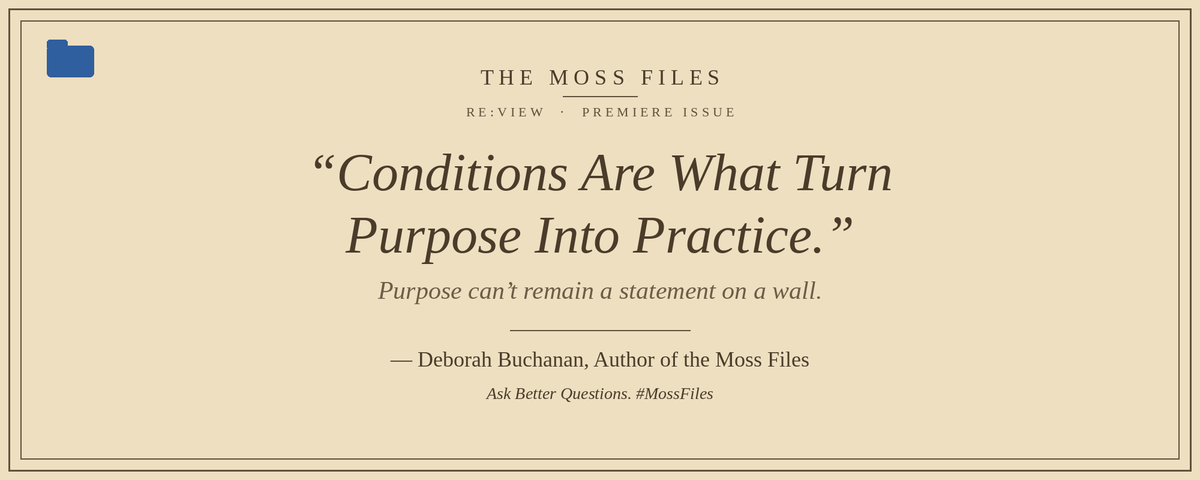
Premiere Issue of RE:VIEW
Building the Future in the Rear View Mirror, quarterly review of The Moss Files. Bookmark it for a later read.
📁MFR*V #114 — The Power of Unity: What Becomes Possible Together?
This week began with a deceptively simple proposition: the power of unity lies in the value of people.
That value exists before people assemble. Each person brings knowledge, experience, judgment, ability, and potential. The challenge is to recognize that value and create conditions in which it can contribute to a shared purpose without requiring individuals to surrender their distinctions.
A shared point of orientation gives those distinctions meaning. Relationships allow knowledge to travel and contributions to build on one another. In this way, a collection of capable people can develop shared capacity that no individual possesses alone.
But shared capacity is not the end of the story. Unity can become load-bearing: the group can carry weight that would otherwise overwhelm individuals. Participation can expand individual capacity, while the group develops the ability to #generate further knowledge, relationships, initiative, and possibility.
This is the #self-generating dimension of unity. The work changes the people doing it, the people change what the group can do, and the group's growing capacity changes what becomes possible next. The field itself can expand as new resources, relationships, and conditions are created.
Yet none of this should be taken for granted. Conditions matter, and people can change some of them. Institutions can also undermine the very capacity they depend on. When operational resources and relationships are eroded, the burden shifts to individuals and residents. Calling for unity cannot excuse that transfer of burden.
The question is not simply whether people can work together. It is whether their organization enables them to develop, support one another, and create a capable whole.
The week's progression
MF #107 — The Value of People: Recognizing the capacity people bring and the potential that remains undeveloped.
MF #108 — A Shared Point of Orientation: Bringing different perspectives into relationship with a common purpose without requiring uniformity.
MF #109 — The Work Between Us: Understanding how relationships transform individual capability into shared capacity.
MF #110 — The Weight We Carry: Recognizing unity as load-bearing capacity, not merely the redistribution of tasks.
MF #111 — A Whole That Generates More: Exploring how collaboration can renew and expand the capacities of both individuals and the group.
MF #112 — Changing the Conditions: Recognizing people's ability to create new relationships, resources, and fields of possibility.
MF #113 — The Institution We Make Possible: Examining whether organizational decisions cultivate human capacity or consume it.
Reflection
Unity is not sameness. It is not the absence of disagreement, and it is not a demand that individuals sacrifice themselves for the whole.
It is the deliberate cultivation of relationships through which people can contribute their distinct capacities to a shared purpose. It allows the group to carry more, while ensuring that individuals are not left carrying everything. At its most generative, it creates the conditions for further growth.
The bigger table is a beginning. Shared purpose provides orientation. Relationships make cooperation possible. #Stewardship determines whether the resulting capacity is cultivated or depleted.
The power of unity lies in the value of people—not only in what they bring, but in what they can develop, sustain, and create together.
Looking forward
The next question is what happens when this capacity encounters the systems in which people must work. How does shared knowledge become collective intelligence? How does collective intelligence inform decisions? And what organizational structures allow human capacity to travel through the system and become reliable institutional capability?
Unity opens the possibility. The next task is to understand how that possibility becomes practice.
#TheMossFiles
Ask Better Questions.
@ConsumerVoices @Dignityforyou @Dignity_MA @mtaylorstark

📁MF #110 — The Weight We Carry
We often describe unity in terms of what people can accomplish together. There is another measure worth considering: what people no longer have to carry alone.
An individual can be highly capable and still be overburdened. Knowledge, responsibility, uncertainty, decision-making, and the work of keeping things moving can accumulate on one person's shoulders. When the surrounding relationships are weak, that individual may have to anticipate every problem, supply every answer, and compensate for every gap.
Genuine unity changes the distribution of that weight. People can depend on one another's knowledge, judgment, follow-through, and support. Responsibility is shared meaningfully, with people able to contribute and act at the appropriate level. The group becomes capable of carrying what would otherwise overwhelm an individual.
But distributing weight is not the same as distributing tasks. An organization can delegate more work while leaving the burden of uncertainty and responsibility exactly where it was. It can call for teamwork while expecting already stretched people to absorb still more.
Load-bearing unity does something different. It increases what people can sustain together. When individuals no longer have to carry everything themselves, capacity is released. There is more room to think, notice, learn, exercise judgment, and develop new possibilities.
In long-term care, this distinction is critical. We need not celebrate the resilience of workers who continually compensate for institutional deficiencies without asking why they are being required to do so. Their ability to endure is not proof that the organization has developed the capacity to support them.
Does our way of working together distribute the weight—or simply redistribute the work?
What would need to change for people to share responsibility without being left to compensate for institutional deficiencies?
@MarkCCrowley @wassdoc
Ask Better Questions.
#TheMossFiles
📁MF #109 — The Work Between Us
What makes a collection of capable people into a capable institution?
It is tempting to look at the people assembled, count their qualifications, review their job descriptions, and assume that the organization possesses the sum of their abilities. But individual capability and institutional capability are not interchangeable. Having capable people in the room does not guarantee that they can accomplish anything together.
Something must happen between them.
Knowledge must travel. Relationships must be cultivated. People must be able to build on what others know, communicate what they observe, and influence decisions that affect their work. The organization must make room for individual judgment while establishing the connections through which that judgment can inform the whole.
Consider the knowledge held by a CNA who notices a change in a resident, the nurse who must assess its significance, and the administrator responsible for ensuring that the organization can respond. Each person may be capable. But if the observation does not travel, the assessment cannot inform the necessary response, or the organization cannot act on what it learns, the capability of the whole remains limited.
The value emerges through the relationships between people. Individual contributions do not simply sit beside one another; they can build on one another to produce understanding and capability that no individual possesses alone.
The bigger table creates an opportunity. Institutional capacity determines what the institution can do with it.
What relationships and conditions allow individual knowledge to become a shared capacity for action?
Ask Better Questions.
#TheMossFiles
You Cannot Build Stability by Treating People as Replaceable
We often discuss CNA turnover as a staffing problem. But what if we also examined the conditions under which people are expected to do their work?
A national study of 2,034 nursing homes found that stronger staff-empowerment practices were associated with higher CNA retention. The researchers examined practices such as involving CNAs in quality-improvement teams, keeping them informed about changes in residents’ care plans, and providing opportunities for training and development.
These are not simply workplace perks. They determine whether the people closest to residents are treated as task performers or recognized as contributors whose knowledge, judgment, and participation matter.
Consider what happens when a CNA knows a resident’s routines, recognizes a subtle change, and understands what brings that person comfort. That knowledge develops through time and relationship. When a worker leaves, the loss is not limited to a position that must be filled. Some of that accumulated understanding leaves with them, and the next worker must begin building it anew.
The study does not prove that empowerment causes workers to stay. It does, however, give us reason to examine the relationship between organizational practices and workforce stability.
Retention is not just about keeping a position filled. It is about preserving the human knowledge and relationships that make care more responsive.
If we want greater stability in long-term care, are we examining only what workers are expected to provide—or also whether the organization gives them a meaningful place in the work?
@MarkCCrowley
Ask Better Questions.
Source: Berridge, Tyler & Miller — Staff Empowerment Practices and CNA Retention, Journal of Applied Gerontology.
📁MF #108 — A Shared Point of Orientation
Unity does not require everyone to think the same way. It requires a clear enough shared purpose that people can see how their different perspectives, roles, and proposed actions relate to it.
A common purpose orients the work. It does not demand uniformity. A nurse, a CNA, an administrator, a family member, and a resident may view the same situation from very different positions. Those differences are not automatically problems. Each can reveal something the others cannot see from where they stand.
The useful question is not “How do we get everyone to see it the same way?” It is “How does each perspective help us understand and advance the purpose we have agreed to pursue?”
This distinction matters because #unity is often confused with consensus, and consensus is sometimes enforced as conformity. A group can look harmonious simply because people have stopped asking questions, held back disagreement, or learned which concerns are unwelcome. That is not the same as unity. A group can wear the appearance of unity while the underlying fractures remain.
A shared point of orientation gives differences a constructive relationship. It lets people question assumptions, challenge proposed actions, and contribute what only they can see—without losing sight of the purpose that brings them together.
The aim is not to eliminate distinctions. It is to put those distinctions to work in service of a shared purpose.
What would enable people to remain united in purpose while bringing different perspectives to bear on the same problem?
@NYNHCARE @INOmbudsman @MarkCCrowley
#TheMossFiles
Ask Better Questions.
Deborah Buchanan retweeted

Who has made more money since the 1990s - Doctors or Hospital CEOs?
What if I told you that doctors weren't the problem?
#medtwitter #medX