

DeFi Explorer 🌌 | Alpha Threads🧵 | Unlocking opportunities every day ✨
Amsterdam
Joined January 2025
- Tweets8.7K
- Following234
- Followers1.5K
- Likes8.4K


SpaceXAI just launched Grok Bot:
"every user gets one managed Linux virtual machine that persists across tasks, browser sessions, and logins"
in this 54-second breakdown they show how the bot moves past ephemeral chat into persistent coworkers that execute scripts locally, operate external apps, and generate reports automatically while your laptop is closed.
i took the rollout architecture and turned it into a step-by-step setup guide with the exact approval rules you need.
worth more than most $500 agent masterclasses.
watch the 54-second clip first, then the full implementation guide is below.
the article below is the deeper read


1
141

69.8M impressions and 319K bookmarks across 3 accounts from a single autonomous setup.
in this 24-second clip, Jonathan Bossenger breaks down the core architecture: a single MCP tool wrapping all operations behind one entry point, letting an AI agent create, update, and manage every post, media item, and draft without starting from scratch.
one 8-word hook alone generated 7.1M views and 49K likes.
i took the exact prompt rules and MCP wiring and turned them into a step-by-step guide.
beats any paid growth course you will buy this year.
watch the clip first, then the full system is laid out below.
the article below has the full breakdown


91
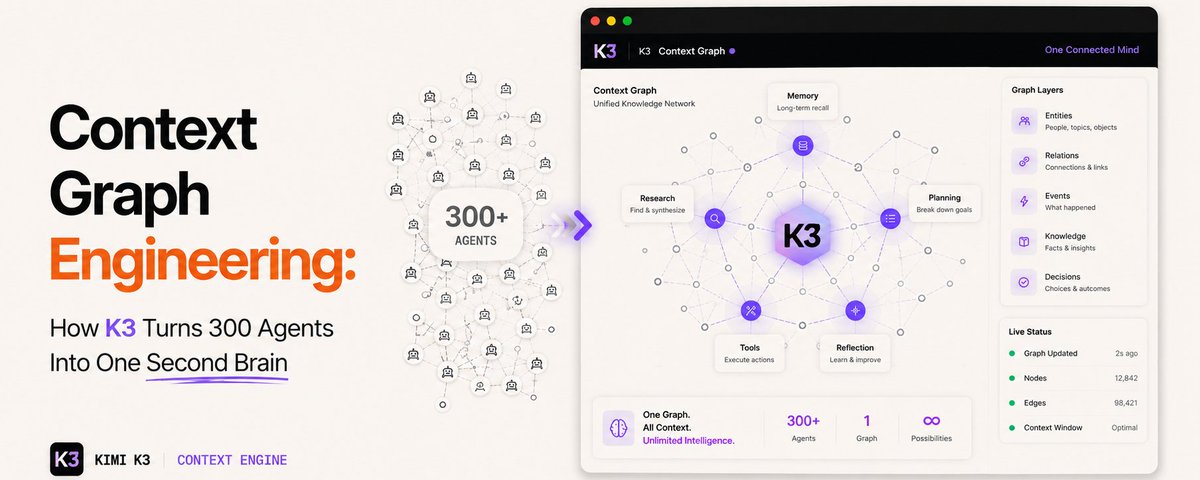
Running 300 agents in parallel is the easy half. The hard half is what happens when you have 300 separate answers and zero idea how any of them connect.
In this 60-second clip, Moonshot AI shows off Kimi's Agent Swarm: an orchestrator that designs its own org chart dynamically, fanning out sub-agents with no predefined roles and stitching everything back into one structured deliverable.
The system decides whether to split at all, not just how
Dynamic decomposition trained via RL, not a rigid prompt template
Synthesizes parallel research into a connected context graph
I pulled the underlying orchestration mechanics and prompting patterns into a practical breakdown.
Watch the clip first, then you can find the full teardown in the article below.

1
103
an institutional hedge fund burns approximately $3.8M per year on overhead, compliance, and headcount before placing a single profitable trade.
in this 7-minute guide, see how the exact same operating architecture runs on a persistent cloud virtual machine for roughly $3,000 a year:
the bottleneck was never math, it was the infrastructure required to run independent layers without hiring twenty people
multi-bot collaboration lets specialized Grok Bot instances share a single workspace filesystem instead of brittle API glue code
execution pipelines talk directly to risk models through local files while background routines run scheduled backtests
i mapped the entire 4-layer quantitative trading framework into an operational blueprint.
give the 7-minute video a watch first, then the full architecture breakdown is below.
the article below has the full breakdown


93
Running more agents sounds like the obvious way to make AI research better. One agent searches ten pages, three hundred agents search everything at once.
Kimi's K3 Swarm can coordinate up to 300 sub-agents and execute over 4,000 tool calls during a single task.
In this 36-second clip you see the hardware reality: running open-weights K3 needs 64 accelerators and half a million dollars in compute just to avoid the $99 monthly fee.
Parallelism creates 300 separate contexts, duplicate entities, and contradictory numbers
Research stops being a search problem and becomes a connection problem
I turned the full 9-step knowledge graph roadmap and Context Sharding architecture into a practical breakdown.
Watch the clip, then read the article below.


1
99

Andrej Karpathy:
“RAG re-derives knowledge on every query. A compiled wiki derives it once and keeps it current.”
in this 60-second breakdown he flips how we use AI - showing why traditional second brains quietly rot after 3 months, and how turning Claude into an LLM compiler gives you a self-organizing knowledge base that compounds with every note.
i took the exact 3-folder architecture and turned it into a step-by-step setup guide with all four core prompts ready to copy.
worth more than any paid course on personal knowledge management.
give the 60-second clip a watch first, then the full setup guide is below.
you'll find the full breakdown in the article below


148
most people are going to use maybe 10% of what Grok Bot can actually do.
in this 19-second clip they show what happens when an AI agent isn't just a chatbot, but gets its own dedicated cloud Linux VM:
just perform a workflow in your browser once, and the bot watches and learns to repeat it on command - handling inbox follow-ups, updating CRMs, and running 24/7 with your laptop closed.
i tested it head to head against Buzz, OpenClaw, and Hermes, then mapped out the exact architecture for running an autonomous research and drafting team.
worth more than any $500 course on agentic workflows.
give the 19-second clip a quick watch first, then the full breakdown is in the article below.


171
Warren Buffett's Playbook:
"turns out the average person is quietly losing $1,474 a year and has no idea"
in this 1-minute clip he breaks down the mindset that defines his long-term success.
i took the core principles of his financial discipline and built an open-source tool with four local sub-agents that catches dead subscriptions and price hikes like Adobe going from $52.99 to $59.99 without moving a single dollar automatically.
i turned that architecture into a step-by-step implementation guide.
beats any paid personal finance course.
watch the clip first, then the article below is the full guide.


Philip Gage published a compression algorithm in 1994. it is still running in front of every frontier model on earth.
Andrej Karpathy argues in this 43-second clip from the Lex Fridman Podcast that we will soon be interacting with these digital entities as daily tools.
but the models fumble basic questions because they don't see text - they see those 1994 data fragments.
i turned the technical breakdown of this blindness into a prompt audit guide.
worth more than a paid prompt engineering course.
watch the clip first, then you'll find the full breakdown in the article below.


111
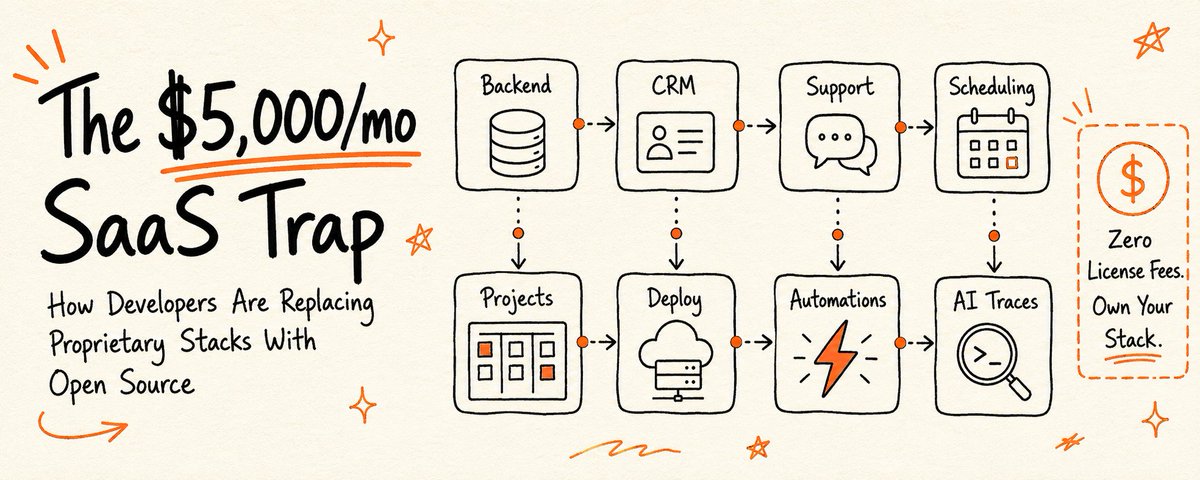
most developer teams are bleeding money every single month on fragmented SaaS tools while identical open source alternatives sit on GitHub waiting to be deployed.
in 60 seconds this clip breaks down how open-source automation replaces bloated subscriptions across your stack:
Supabase for backend, auth, and vectors
Plane for cycles, roadmaps, and task tracking
Cal.com for meeting scheduling
Coolify to deploy on your own iron without Heroku or Vercel
Langfuse and Qdrant for the self-hosted AI layer
watch the clip first, then the full deployment breakdown is in the article below.
79
most dev teams are burning thousands every month on fragmented SaaS tools when open-source alternatives on GitHub can run the entire stack for $0 in license fees.
in this 60-second breakdown on ditching the SaaS tax, every layer gets replaced on your own iron:
Supabase for backend and vectors
Plane, Twenty, and Cal.com for tasks, CRM, and scheduling
Coolify and Langfuse for deployment and AI observability
i turned the whole stack into a step-by-step self-hosting guide with the deployment configurations ready to go.
beats spending hundreds every month on per-seat subscriptions.
give the video a watch first, then the full breakdown is in the article below.
97
NVIDIA Isaac Lab engineer:
"models train at 10,000x real-time speed"
in this 60-second clip, we see how to map end-effector poses to joint configurations without the brittleness of traditional solvers
i pulled the key ideas from the physical AI software market into a practical guide on building automated telemetry scrapers and the $2,000/month robot-as-a-service model
beats any paid course on physical automation
watch it first, then the full guide is in the article below

1
100
Josh Kerrigan:
"make the thing, let the platforms pay for the tools, let the audience turn into the business"
this 2-minute episode of Neural Viz shows exactly why his alien mockumentary universe has hooked 238,000 subscribers since 2025
he treats generative failures as stylistic choices-VHS noise, deliberate glitches, and static framing-to build a character brand that platforms fund and sponsors actually want to rent
i pulled his entire production system and brand-deal playbook into a step-by-step guide
worth more than most paid masterclasses on this
give it a read below.
the article below is the deeper read


83
instead of watching another 2 hours of netflix tonight, check out this 4-minute NVIDIA walkthrough on how physical AI models actually train in simulation
it breaks down the continuous loop of robot AI simulation, showing how platforms like NVIDIA Isaac Lab let developers generate massive amounts of synthetic data to train robot policies without breaking expensive hardware.
i pulled the key software layers and enterprise deployment blueprints into a tactical guide.
the article below has it, with the exact blueprints and workflows ready to use.
83
a $100,000 robot charged a recycling bin because shadows tricked its vision model, and a robotic barista dumped $3,000 of milk on the floor in Tokyo.
in 2 minutes, NVIDIA shows how platforms like Isaac Sim narrow this sim-to-real gap - letting models train at 10,000x real-time speed to log 50 years of edge-case navigation in an afternoon.
the trillion-dollar market in physical AI is not manufacturing the hardware. it is the software layer: fine-tuning open-weight VLA models and selling deterministic control stacks at $500 to $2,000/month per machine.
i took the whole architectural stack and broke it down into a deployable software playbook.
beats any paid hardware course on robotics right now.
watch the 2-minute demo first, then the full breakdown is right below.
the article below covers the full picture
146